

Concerns over lack of new cross-border listings from the JSE


There were no cross-border Initial Public Offerings (IPOs) from African companies in the first six months of 2017, the first time in five years this has happened, according to Baker McKenzie’s latest Cross Border IPO Index.
This means that no commercial company across the African continent chose to list its shares in a stock exchange of a country other than that in which the company is based.
While this is cause for concern, the index also highlighted that five companies in Africa raised a total of $512 million so far in 2017 from domestic listings, up from the eight companies that raised $492 million in H1 2016.
Three of five the companies that went public in H1 2017 are South African, while the remaining two were Egyptian and Tanzanian.
South Africa
The largest IPO from a South African company was from Sea Harvest Holdings Ltd., a deep-sea fishing, fresh and frozen fish and processing and marketing of fish products, raising $149 million. The company had delisted from the Johannesburg Stock Exchange (JSE) 17 years ago.
It was the second fishing company listing on the JSE in recent weeks. A few weeks before its listing, Premier Fishing made its debut on the same exchange to raise $41 million.
The other South African IPO was private equity fund Long4Life Ltd’s listing on the JSE in April. These three domestic listings raised a total of $250 million, the highest amount of capital raising by South African companies recorded during the first half of any year since 2012.
“Historically, South African companies are not actively listing outside their jurisdiction,” explained Wildu du Plessis, Head of Africa at Baker McKenzie.
The last time a South African company listed in a stock exchange outside of the country (cross-border listings) was in H2 2013, when MiX Telematics Ltd. went public on the New York Stock Exchange and raised $116 million, he said.
However Du Plessis explained that the two IPOs in South Africa’s fishing sector point to a readjustment and consolidation in the sector after recent woes.
“Further, the Long4Life IPO shows that there is private equity money available for investment in Africa. If a fund can identify sufficient assets to invest in, then an IPO is a good way for them to raise capital.”
“We haven’t seen a lot of these kinds of IPOs in Africa recently, possibly because the funds have been struggling to find assets to invest in.”
Global
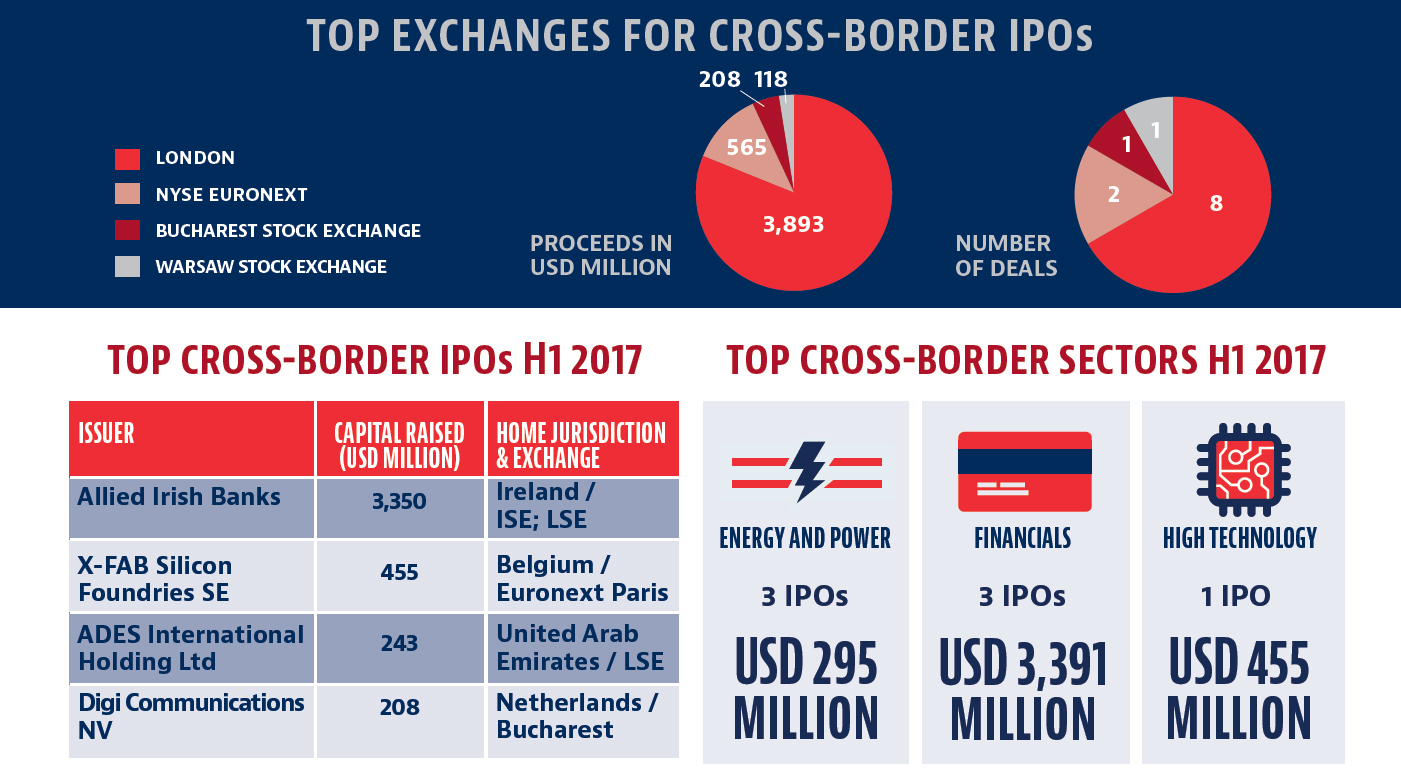
Baker McKenzie’s Cross-Border IPO Index dropped to 12.6, reflecting that capital raising from cross-border IPOs accounted for barely 14% of the value of global equity capital raised, the lowest level since the first half of 2012.
The London and New York Stock Exchange however, both saw more capital from cross-border IPOs than in H1 2016, with values of $3.9 billion and $1.3 billion respectively. These two exchanges, along with Hong Kong and NASDAQ, accounted for over 90% of all cross-border IPOs by value.
“There is a correlation between global IPO predictions and African IPOs, and so the current global recovery is expected to influence a recovery in Africa as well,” said du Plessis.
“However, Africa tends to lag behind the rest of the world so it might be some time before we an improvement the volume and value of IPOs on the continent.”
Read: BRICS Bank looking to offer bonds in Rand and Yuan
















 Loading ...