

The four provinces in South Africa that escaped recession


Four provinces in South Africa have escaped a technical recession after experiencing contractions in the first quarter of 2025.
The North West, Mpumalanga, Limpopo and Gauteng all saw quarter-on-quarter contractions in the first quarter of the year.
However, they managed to reverse this in the second quarter, showing quarter-on-quarter growth of 0.8% or above.
In Q2 2025, South Africa’s GDP expanded by a surprising 0.8% following muted growth of 0.1% in Q1 2025.
A technical recession is defined as two consecutive quarters of economic contractions. It is a short-hand economic metric used to indicate the general health of an economy.
A full recession is a broader, deeper, and more sustained decline in economic activity, factoring in various factors, including employment levels, revenue trends and more focused productivity.
Notably, a technical recession is measured in short-term data (like quarterly GDP), while a full recession is measured over a much longer term.
For example, while South Africa’s short-term GDP data shows some positive growth, over the long term—like the last decade—it paints a picture of stagnation, not growing above 0.7% on average.
Factoring in population growth, which averages between 1.2% and 1.5%, it is clear that even with positive economic growth, the population is getting poorer on a per-capita basis—a form of full recession.
Nevertheless, escaping a technical recession is still a positive thing and gives some breathing room to the four provinces that were at high risk.
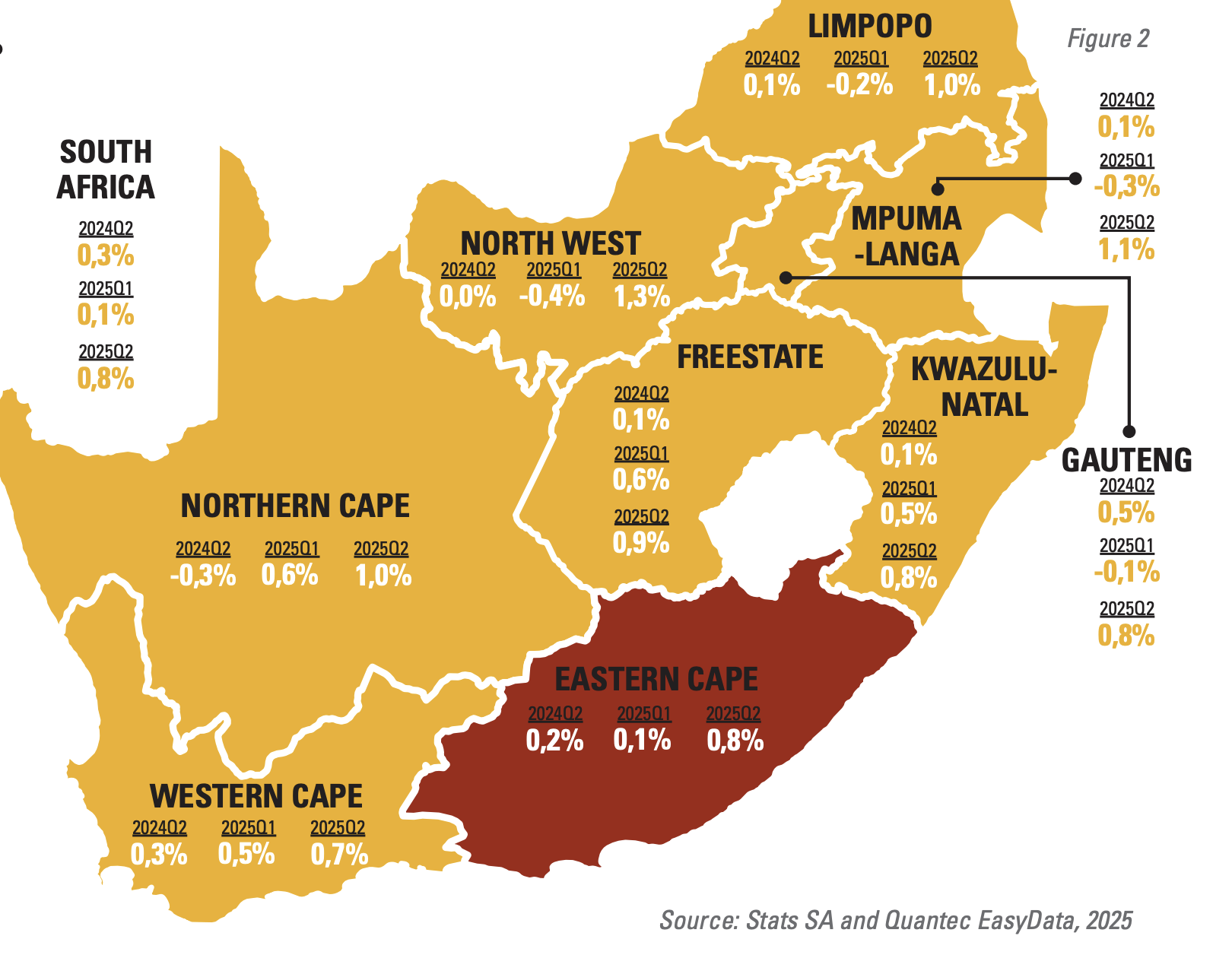
According to the Eastern Cape Socio-Economic Consultative Council, improvements from Q1 to Q2 for the four provinces were as follows.
| Province | Q1 2025 | Q2 2025 |
|---|---|---|
| North West | -0.4% | 1.4% |
| Mpumalanga | -0.3% | 1.1% |
| Limpopo | -0.2% | 1.0% |
| Gauteng | -0.1% | 0.8% |
Every single province in the country saw quarter-on-quarter growth in Q2 2025, with the Northern Cape (1.0%) and Free State (0.9%) seeing substantial growth over the quarter.
After seeing the highest growth (0.5%) in Q1 2025, the Western Cape registered the lowest GDP growth of 0.7% in Q2.
Looking at the yearly statistics, the National GDP increased by 0.6 percentage points, rising from 0.3% in 2024Q2 to 0.9% in 2025Q2.
Growth was robust in North West (up by 1.3 percentage points), Mpumalanga (up by 1.0 percentage points), and Limpopo (up by 0.9 of a percentage point).
Both the Western Cape and Gauteng provinces recorded more moderate increases of 0.3 of a percentage point over the same period.
In the right direction, but not enough
The provincial improvements observed across Q2 2025 are positive news for many following a turbulent 2024, as per Stats SA’s latest data.
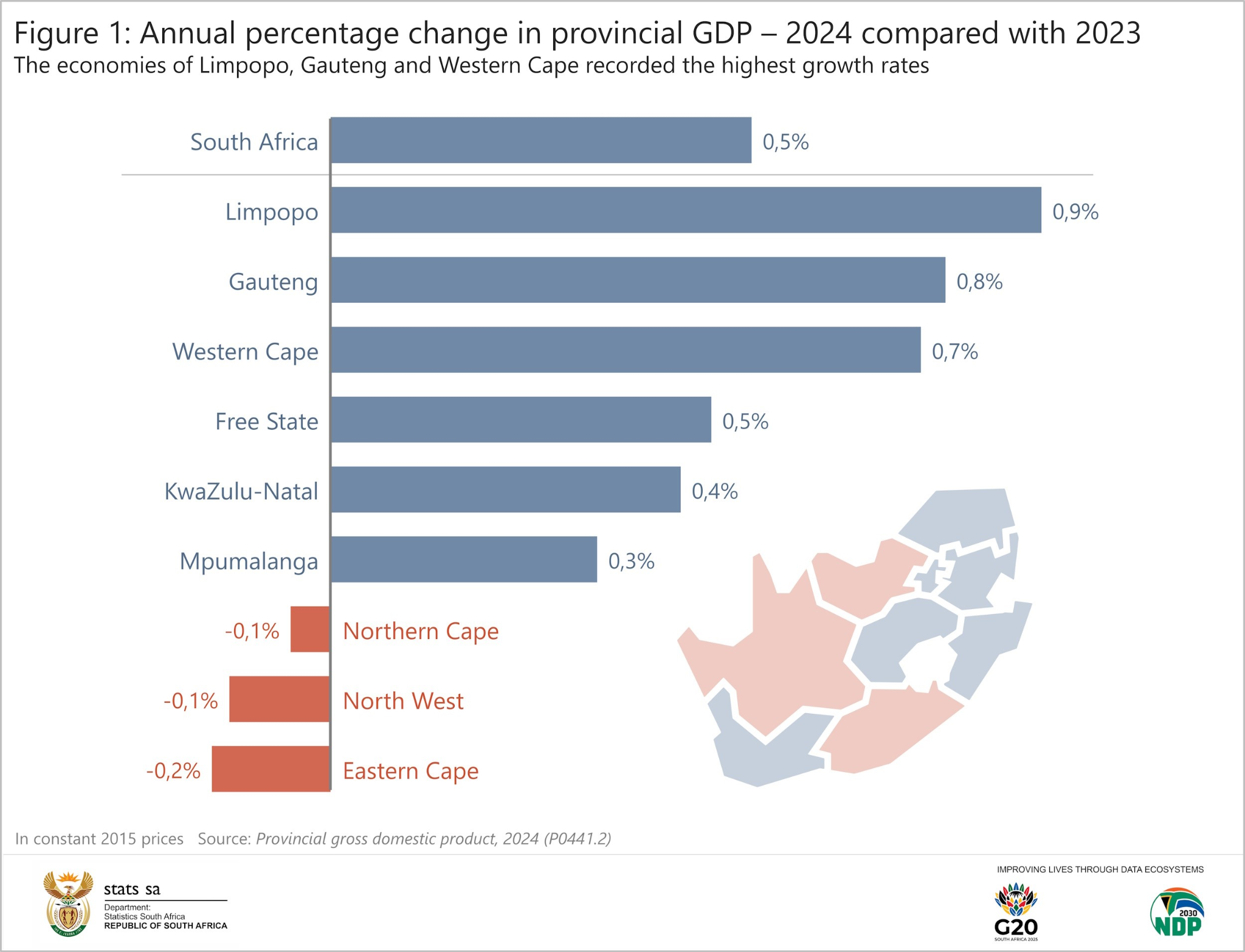
The 1.0% growth seen in Limpopo in Q2 2025 adds to the 0.9% GDP growth seen in the province in 2024 – the last full year of data.
Limpopo registered the highest growth rate of 0.9% in 2024, far higher than the national average of 0.5%.
Limpopo’s growth was driven by two industries: finance, which includes real estate and business services, and personal services.
Other industries in Limpopo that recorded gains include utilities, such as transport & communication, general government, manufacturing and trade.
Gauteng had the subsequent highest growth at 0.8% in 2024, with finance being a major contributor to the province.
The 1.3% growth for the North West in Q2 2025 is incredibly positive news, as the province recorded a 0.1% contraction in 2024.
The province was hindered by disappointing trade, agriculture, transportation, construction, manufacturing, and mining figures during the period.
The Eastern Cape and Northern Cape’s growth in Q2 2025 is also good news, as both economies reported declines in 2024.
Although all provinces in South Africa recorded quarter-on-quarter growth in Q2 2025, the situation remains dire, with GDP expected to grow by only around 1.0% in 2025.
While the economy grows at this rate, the population is estimated to grow at 1.5%, resulting in a decline in GDP per capita.
Essentially, while the pie is getting bigger, there are more people that it needs to feed, meaning that South Africans are getting poorer.












 Loading ...