

Over 50,000 taxpayers cut ties with SARS


The South African Revenue Service (SARS) says over 50,000 taxpayers have ceased to be tax resident in South Africa over the past seven years.
In the revenue service’s tax statistics for 2025, it recorded more than 51,500 taxpayers ending their tax resident status on their tax returns between 2017 and 2024.
This signals a worrying flood of taxpayers cutting ties with SARS and South Africa over time.
While tax residency is not the same as nationality, permanent residence or citizenship, it is one of the few indicators officially tracked by the government to indicate migration flows.
South Africa does not officially track emigration patterns or conduct exit surveys of those leaving the country.
Most migration statistics are sourced from third-party sources, such as the United Nations’ migrant stock report, with local migration patterns inferred from Stats SA’s population estimates.
The latest migrant data from the United Nations shows that approximately 108,000 South Africans emigrated from the country between 2020 and 2024, and just over 1 million South Africans live abroad.
With the SARS data, however, there is a more official recording of taxpayers who have cut or are cutting ties with the country, and a sense of scale of what this costs the state.
A taxpayer can still be a South African citizen while being a tax resident in another or multiple countries.
In fact, many tax and emigration experts will quickly point out that South Africans who emigrate and leave assets behind may still have tax obligations back home.
Changing your status from resident to non-resident must be done formally through a declaration process with SARS and reflected on your tax return.
From the 2017 tax year, individuals were required to indicate their tax resident status on the ITR12 tax return, but not the date on which it changed.
From the 2021 tax year, individuals must indicate the date they ceased to be a tax resident of South Africa on their ITR12 tax return.
Emigration and citizenship change are done through Home Affairs.
However, whether emigrating or changing tax residency, the end result is the same for South Africa – the country loses tax revenue.
South Africa losing out
While SARS has recorded over 50,000 people ending tax residency over the past seven years, it assesses the financial impact through tracking a cohort.
Specifically, the group tracked the tax liability of individual taxpayers with a tax residence change over a ten-year tax period.
This group was assessed since the 2015 tax year.
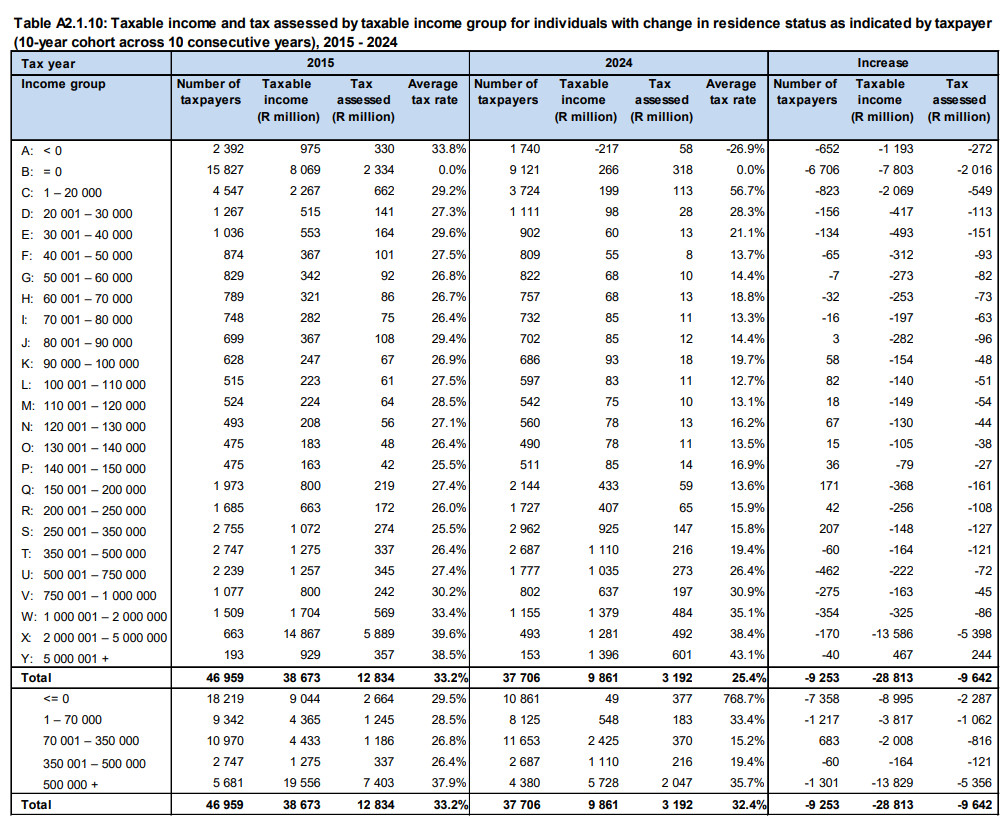
For the 2015 tax year, 46,959 taxpayers declared taxable income of R38.7 billion on which the tax payable totalled R12.8 billion.
For the 2024 tax year, the number of assessed taxpayers decreased to 37,706 people.
The cohort’s taxable income decreased by 74.5% to R9.9 billion, and their tax payable also decreased by 75.1% to R3.2 billion—a reduction of R9.6 billion.
“These decreases…were realised mainly by the bracket above R500,000 taxable income, mainly individuals between 65 to 74 years old and males,” SARS said.
SARS noted that ceasing to be a South African tax resident, and similar changes in an individual’s status, can imply permanent erosion or changes in the tax base.
However, even a person who ceases to be a South African tax resident is still taxed on their South African-sourced income, SARS said.
The changes also point to broader changes in demographics.
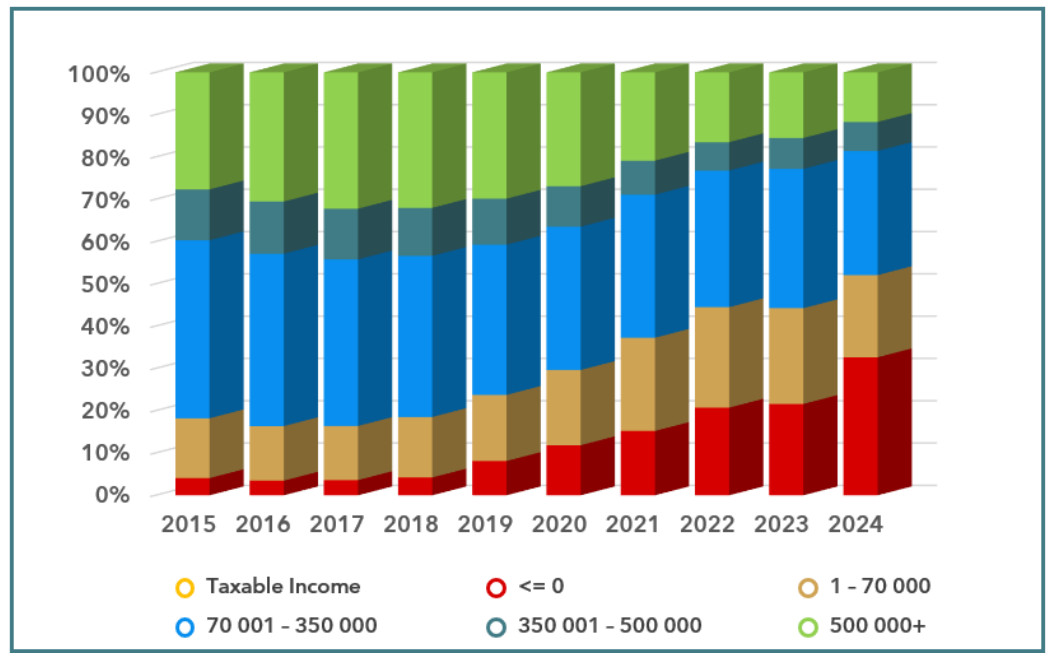
For example, between 2015 and 2020, it’s clear that taxpayers in the income bracket above R500,000 were driving the change in status. This share diminished between 2020 and 2024.
At face value, it would appear that there are fewer high-income earners changing status. However, tax experts previously noted that this could also reflect fewer high-income earners remaining.
The rising trend of taxpayers in the zero to R70,000 bracket changing status, meanwhile, could point to younger people making the change.
SARS noted that the number of taxpayers who changed residence with a taxable income of zero to R70,000 decreased by 31.1% from 27,561 to 18,986 taxpayers in the latest stats.
This was followed by decreases from the taxable income above R500 000 (19.7%).
















 Loading ...