

International finance giant has great news for South Africa


The International Monetary Fund (IMF) has significantly raised South Africa’s 2025 growth forecast, following a surprising year of resilience for the country.
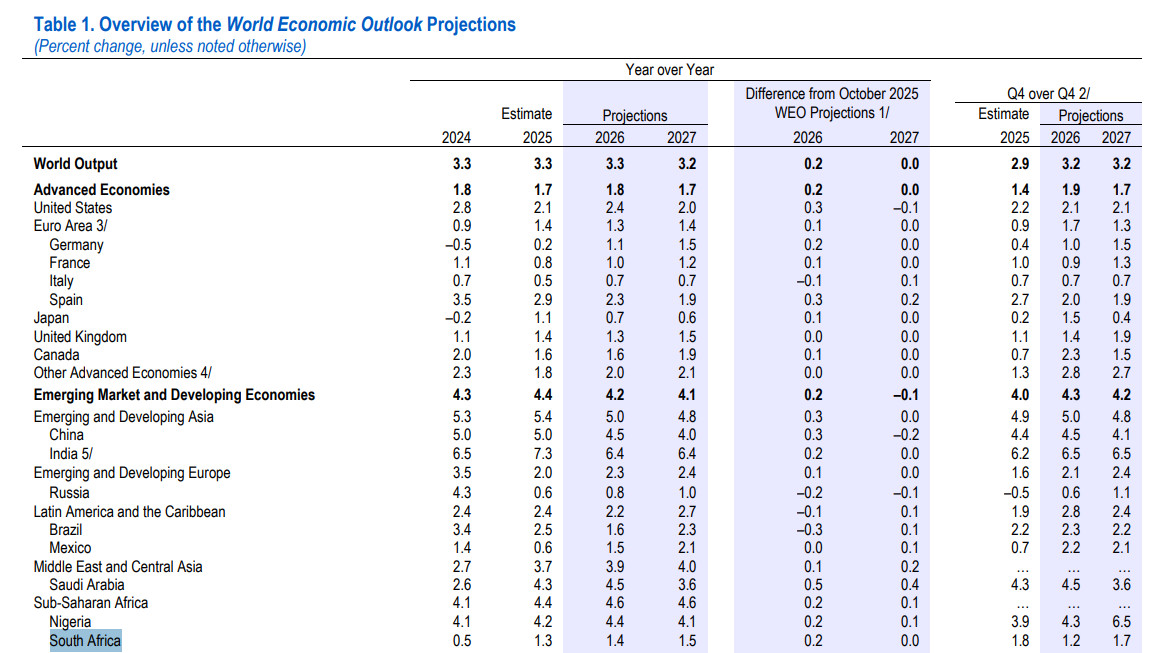
The group’s January Economic Outlook projects that South Africa’s economy grew by 1.3% in 2025, with its early forecast for 2026 pointing to 1.4%.
While this level of growth is still low relative to emerging-market peers and the Sub-Saharan region as a whole, it represents an upward trend—and a significant leap from last year’s projections.
In the January 2025 outlook, the IMF expected South Africa’s economy to grow by 1.5% at the start. However, this tanked to just 1.0% by July as the United States’ global tariff war loomed.
By October 2025, after the impact of the tariffs wasn’t as severe as expected, the projection was bumped up slightly to 1.1%.
Now, at the start of 2026, the IMF has a much rosier outlook for South Africa, moving it back up to 1.3%.
Notably, the projection aligns with the World Bank’s forecast, which also projects South Africa’s economic growth at 1.3% in 2025.
This is supported by a more reliable electricity supply, a strong agricultural harvest, and improved business confidence toward the end of the year.
The end of load shedding, in particular, has been a major boost to growth. In 2024, the IMF slashed its projections for South Africa from 1.8% to just 0.5% by the end of the year due to Eskom’s outages.
South Africa ultimately reported 0.6% growth in 2024, and 1.3% growth in 2025 would double this.
The World Bank’s outlook further projects that growth will increase to 1.4% in 2026 and 1.5% in 2027. The IMF’s projections are the same.
However, as always, these loftier projections depend on South Africa’s continued reforms in electricity, infrastructure and logistics, as well as its ability to make the economy more welcoming to business.
In the meantime, private consumption and private-sector investment are expected to remain the main drivers of growth in 2026.
Still not enough
While the prospect of doubling economic growth and continuing on a positive trajectory is great news for South Africa, it comes with a harsh reality check.
Even at 1.5% growth, this rate is not enough to make a dent in the country’s cripplingly high unemployment rate and drive real per-capita growth.
For one, growth at these levels closely aligns with South Africa’s population growth rate of around 1.3%, meaning South Africans are getting poorer on a per-capita basis.
The 1.5% growth rate is also half of what the government of national unity and President Cyril Ramaphosa have targeted to turn the economy around.
At the start of 2025, the Ramaphosa-led GNU expressed confidence in implementing the reforms needed to boost South Africa’s productivity and create jobs, targeting 3% growth in the medium term.
According to the latest projections from the IMF and World Bank, South Africa looks set to fall short of this by around 1.5 percentage points.
Investec’s scenario forecasts have South Africa reaching 3% growth over five years in its base case, but in two upside scenarios—in which the country prospers and thrives—growth of 5%-7% is needed.
Another important context for the IMF and World Bank projections is that South Africa’s growth is lower than the Sub-Saharan average of 4.4% for 2025 and 4.5% for 2026.
It is also lower than the emerging-market average of 4.3% for 2025 and 4.1% for 2026, underscoring how severely the country is lagging.
Responding to the growth projections, the government said it would continue to work to strengthen reforms, unlock investment and build a resilient and sustainable economy.












 Loading ...