

Reality check for the rand


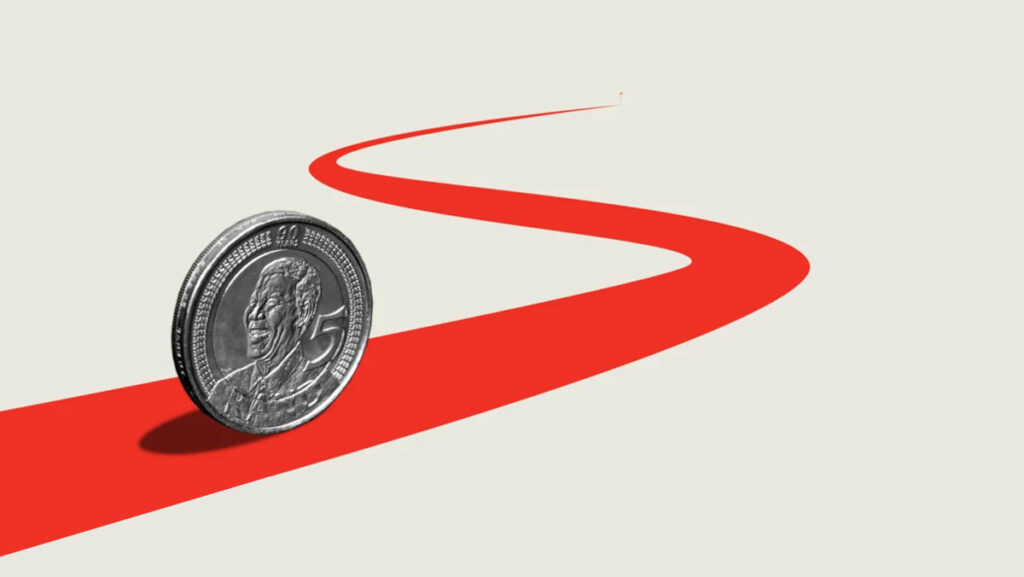
The rand is on a hot streak and is close to crossing the R16.00/$ threshold, but South Africans should not expect this performance to continue.
Bianca Botes, Director at Citadel Global, said that the rand’s recent performance has reached levels as strong as R16.12/$.
Gold has been a fundamental driver, with the gold price reaching a record high of $4,888/ounce. This marked a 67% gain from 2025 and added another 7% year to date.
Safe-haven asset demand has recently intensified over tensions between the US and Europe over Greenland.
Donald Trump recently threatened 10% tariffs on eight European nations, which would rise to 25% in June in the absence of a deal, triggering what traders are calling the “Sell America” trade.
As a result, markets swooped on gold, with financial services giant HSBC predicting it could reach $5,000 in the first half of 2026.
This is good news for the rand, as higher gold prices directly translate into improved terms of trade.
The country’s November trade surplus widened to R37.7 billion, which was the most significant value since March 2022, boosted by precious metal exports.
Other improvements include the S&P’s November upgrade of South Africa’s sovereign debt rating to BB – the first upgrade in two decades.
The EU also recently removed South Africa from its high-risk jurisdiction list, followed by its removal from the Financial Action Task Force (FATF) grey list in October 2025.
“These delistings reduce compliance friction for international transactions and signal the institutional progress that offshore investors have been watching for,” said Botes.
South African Reserve Bank (SARB) Governor Lesetja Kganyago reinforced the positive narrative at Davos, expressing confidence that SA’s 3% inflation target will be achieved in 2026, ahead of the 2027 goal.
With inflation at a 21-year low of 3.2% in 2025, markets are pricing in a 25-basis-point cut when the SARB’s Monetary Policy Committee (MPC) meets on 29 January.
While the rand has also been a strong performer, the dollar has also weakened amid the Greenland fiasco and concerns about the US Federal Reserve’s independence.
Not out of the woods

While the rand has performed well recently, Botes warned that a sustained price below R16.00/$ faces structural headwinds that warrant caution.
This is partly due to South Africa’s growth looking incredibly tepid, with the OECD expecting GDP to reach just 1.3%.
“An economy growing at barely above ‘stall speed’ has limited capacity to absorb currency strength without damaging export competitiveness,” said Botes.
Moreover, there are concerns that South Africa will not be part of the US African Growth and Opportunity Act (AGOA)
The US House passed its extension, which gives African countries duty-free access to the US, but it still requires Senate approval. This comes at a point where South African-American relations are strained.
While gold has also been a strong performer in 2025, there are question marks over the resource’s value.
“A correction in the price of bullion – whether triggered by profit-taking, a de-escalation in geopolitical tensions, or a hawkish Fed pivot – would remove a key pillar of rand support,” said Botes.
“Given how central gold has been to the current rand rally, any meaningful pullback would likely drag the currency weaker.”
Finally, the rand remains a high-beta (more volatile than the overall market) emerging market currency. Global risk appetite can change quickly, which can impact the rand.
Over the last year, the rand-to-dollar exchange rate ranged from R16.12/$ to R19.93/$, highlighting its instability.
Most analyst forecasts cluster around R16.30/$ to R17.10/$ as the likely trading range over the coming months.
The balance of risks tilts toward a stronger rand for longer, but a range from mid-to-high R16.00/$ to low R17.00/$ represents a more sustainable equilibrium than sub-R16.00/$ levels.
“For the week ahead, the FOMC and SARB decisions will set the tone. A dovish Fed combined with an SARB cut could provide the catalyst for a R16.00/$ test,” said Botes.
“Equally, any hawkish surprise or escalation in geopolitical tensions could trigger a sharp reversal given stretched positioning.”
“The EU high-risk list removal takes effect on 29 January, coinciding with the SARB’s MPC decision – a date that could prove pivotal for sentiment.”
















 Loading ...