

Another United States deadline for South Africa


Two bills in the United States seeking to impose sanctions on South Africa are set to expire on 3 January 2027 unless enacted, with the diplomatic divide between the countries wider than ever.
This is on top of the current eligibility review for the African Growth and Opportunities Act (AGOA), the outcome of which is expected to be announced as soon as 1 November 2026.
These deadlines hang over South Africa’s head as the country faces mounting pressure from Washington to bow to its demands over policy.
According to risk analysts at the Institute for Security Studies (ISS), the issues at play may be more about politics and optics for now than about any economic consequences.
But South Africa is still left holding a live grenade that needs to be handled with care, lest it blow up in Pretoria’s face. Of particular concern is timing, the ISS said.
With the United States facing its mid-term elections on 3 November, a relative non-issue like South Africa becomes a nesting ground for lobbyists in Washington.
The ISS said South Africa is an “easy target”, with its policies and international relationships easily folded into US narratives and politics.
Because of this, things like the so-called “five asks” and legislative moves such as two bills calling for sanctions on the country become easy buttons for US politicians to push.
The “five asks” have gained the most direct attention, while the bills have been gathering dust in Congress.
Both bills, introduced in 2025, explicitly call for a review of the United States’ relations with South Africa, including the country’s being booted from AGOA.
The bills state that the programme should include only countries aligned with US interests, with Republican politicians behind the proposed laws arguing that South Africa would not qualify.
The first bill, the US-South Africa Bilateral Relations Review Act (H.R.2633) was tabled in the House of Representatives April 2025 by Ronnie Jackson.
A second bill, called the US-South Africa Bilateral Relations Review Act (S.2752), was tabled in the US Senate in September 2025 by Senator John Kennedy.
Underlining the ISS’s point of politics over substance at play, neither of the bills has made any real progress since being tabled. The last action taken was a year ago.
This shows a lack of bipartisan support for the proposed laws, and, like previous bills of the same nature under the first Trump presidency, they are likely dead in the water.
According to the ISS, if not enacted by 3 January 2027—which is looking highly unlikely—they will expire. However, this does not mean that the intentions behind the bills are dead.
The September 2026 visa restrictions announced by Secretary of State Marco Rubio show that targeted sanctions can be imposed without new laws specifically aimed at South Africa.
And the looming AGOA eligibility review, set for the same week as the US midterms, leaves South Africa’s continued participation in the programme hanging by a thread.
If not handled correctly, the diplomatic tussle between the two countries can very quickly move from optics to economics.
Optics over economics
According to the ISS, as the political relationship between South Africa and the United States has withered, commercial arrangements between the countries have been “surprisingly buoyant”.
“Goods and services trade grew by just over 10% in 2025 to under US$29 billion, while US foreign direct investment has remained surprisingly stable,” it said. South Africa is still part of AGOA. For now.
This stands in stark contrast to the optics around South Africa’s diplomatic relations with the United States and the political theatre around its demands.
Despite the back-and-forth over Washington’s “five asks”, the ISS noted that South Africa has clearly responded to them, just not in the way that makes the politicians happy.
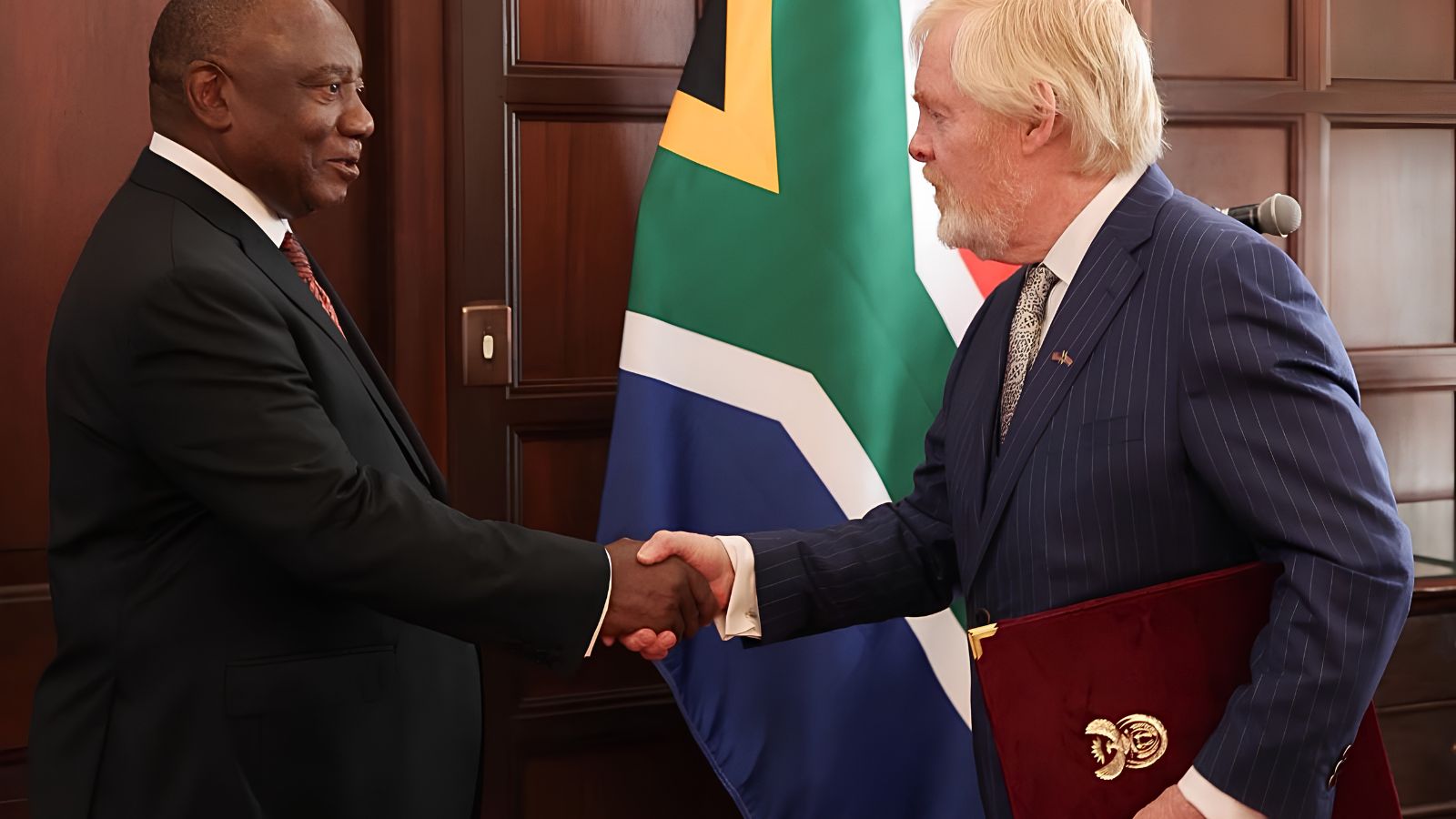
The ISS said that even the US Ambassador Leo Brent Bozell admitted that South Africa is addressing the demands. Two are regarded as dealt with.
Two others are in progress: a rural safety plan has been prioritised, and BEE laws are under review, with equity-equivalent investment programmes expanding.
Regarding the standout—the “kill the boer” chant—South Africa’s courts have already ruled that this isn’t hate speech.
Barring further court action, the government “cannot disregard its own court judgments,” the ISS said, calling it a “red line”.
“Doing so would spell political suicide for senior government members seen as side-stepping legal processes to kowtow to Washington,” it said.
Given the reality of the situation, it appears there is little South Africa can do to appease the United States, as the goalposts on what it considers “addressing the asks” keep shifting.
“Without specifics on how to satisfy the ‘asks’, the disconnect will likely persist due to the US’s shifting goalposts,” the ISS said.
This leaves the country with only a few options, the ISS said, and each carries risks.
- South Africa could refuse further US engagement, drawing red lines over its threats and ending diplomatic ties. This would likely prompt punitive measures that would impact the economy, the ISS said.
- South Africa could lean into commercial diplomacy, adopt a transactional approach, and leverage its critical minerals stock and market access to temporarily set aside political differences. This would be the pragmatic approach, the ISS said.
- South Africa could lie low, wait for a possible change in the 3 November midterms, and hope the goalposts for relations stop shifting. However, the ISS said this may understate the level of bipartisan acrimony towards South Africa.
“The key test will follow immediately after the elections, when both governments confront the dilemma of whether their commercial and strategic interests still outweigh the political incentives driving them apart,” it said.
Until then, the country will look to November for what transpires around AGOA and the US midterms, and see what comes of the push from lawmakers to punish the country in the new year.
Five Asks: United States vs South Africa
| Ask | US Response | SA Response |
|---|---|---|
| That the South African government not interfere with the United States’ processing of Afrikaner refugees | This has been addressed. | This has been addressed. |
| That expropriation without compensation should not be allowed | Partly addressed, but not by the government. The matter is with the Constitutional Court, which will have final say. | The government supports land expropriation without compensation. The matter is with the Constitutional Court, which will have final say. |
| That President Ramaphosa and other senior government officials condemn the singing of “Kill the Farmer! Kill the Boer!” | Ramaphosa and the South African government refuse to condemn it. It has not been addressed. | “South Africa has enacted the Prevention and Combating of Hate Crimes and Hate Speech Act 16 of 2023. This legislation sets a stringent legal framework for the eradication of hate speech and the prosecution of hate crimes. This law is binding on both the State and non-state actors.” The “Kill the Boer” chant has been ruled not hate speech by the courts. |
| That rural crime (ie farm murders) be formally designated a priority crime, with a real, announced plan to address it | The United States has offered financial support, with several plans available, including one designed by the South African government itself. It has not been addressed. | “The South African government remains seized with the challenges of crime in South Africa, which affects everyone and not targeting anyone based on their race, colour, or social origin.” South Africa has already prioritised a Rural Safety Strategy. |
| That South Africa create alternatives, such as equity equivalent investment programmes (EEIP) to Broad-Based Black Economic Empowerment (BBBEE) ownership requirements | The South African government allows some business sectors to participate in EEIP but refuses to offer it to the telecoms or mining industries. | “It is our sovereign right to put in place laws that address the nation’s concern over centuries of racial injustice.” EEIP programmes in telecoms are in the works, and B-BBEE at large is under review. |
ISS analysts: Ronak Gopaldas, ISS Consultant and Signal Risk Director, and Priyal Singh, ISS Senior Research Consultant and Signal Risk Geopolitical Analyst
















 Loading ...