

The Weekend Away Is Becoming a Luxury


A weekend away once started with choosing somewhere to go and finding a place to stay. Today, even a short break often begins with a different question: what will it cost?
Accommodation is only one part of the calculation. Fuel, tolls, meals, activities, e-hailing and other smaller expenses can quickly turn two nights away into a meaningful household expense.
For families already managing higher everyday costs, that makes a weekend away something that needs a little more thought than it once did.
South Africans are not giving up on travel, though. According to South African Tourism, South Africans took 21.2 million overnight trips in the first half of 2026, up from 20.4 million during the same period a year earlier.
Holiday trips increased 36% to 5.2 million, even though overall domestic tourism spending remained below the previous year.
These figures cover domestic overnight travel more broadly than weekend breaks alone, but they point to an important trend. People still want to get away, but they are paying closer attention to what they spend when they do.
That fits with wider household behaviour. TransUnion’s Q2 2026 Consumer Pulse Study found that 53% of South Africans surveyed had reduced discretionary spending, including travel, dining out and entertainment.
The weekend away has not disappeared. It has become a nice to have.
A short trip can still have a long list of costs
One of the attractions of a weekend away is that it does not need to involve a long-distance journey.
For someone starting in Johannesburg, a night or two in Hartbeespoort, Magaliesberg, Muldersdrift or the Cradle of Humankind can offer a change of scenery without spending several hours on the road.
Using Gauteng’s September 2026 price of R26.92 a litre for 95 petrol, an illustrative 80km return trip in a car using 7.5 litres per 100km would use about six litres of fuel. That works out to roughly R162 in petrol before any local driving.
The calculation is similar in the Western Cape. A weekend in Stellenbosch is roughly 50km from central Cape Town each way, depending on the route.
Using the September 2026 coastal price of R26.05 a litre for 95 petrol, an illustrative 100km return journey in a car using 7.5 litres per 100km would use about 7.5 litres of fuel, or around R195 in petrol.
Neither amount necessarily makes or breaks the weekend. But once accommodation, meals, activities, parking or local transport are added, it becomes easier to see why even a short getaway benefits from looking at the total cost.
A destination closer to home may leave more of the budget available for a better room, a meal out or an activity once you arrive. That makes distance part of the value calculation, rather than simply part of the route.
South Africans are becoming more selective about the getaway
Price is not the only thing shaping how people travel.
School calendars, limited annual leave, family commitments and remote-working flexibility can all influence when and where a short break makes sense.
Visiting friends or family may reduce accommodation costs, while staying closer to home can make it easier to fit a trip into a normal weekend.
Feedback from the hospitality sector supports this shift. The Federated Hospitality Association of Southern Africa (FEDHASA) has suggested that higher trip volumes alongside lower domestic tourism spending may reflect shorter breaks, more affordable accommodation, destinations closer to home and more selective spending on activities.
That does not necessarily mean choosing the cheapest possible trip. For one household, value may mean staying somewhere inexpensive and spending more on an experience. For another, it may mean paying slightly more for accommodation close to home because the lower transport cost keeps the total weekend affordable.
The common thread is that South Africans are becoming more deliberate about what they spend and what they get in return.
The room rate is only the beginning
Accommodation is usually the first number people compare when planning a weekend away, but it is only one part of the total cost.
A short break can also include fuel, tolls, meals, parking, e-hailing, activities and other smaller expenses. Individually, these costs may not look significant. Added together, they can change the weekend budget quickly.
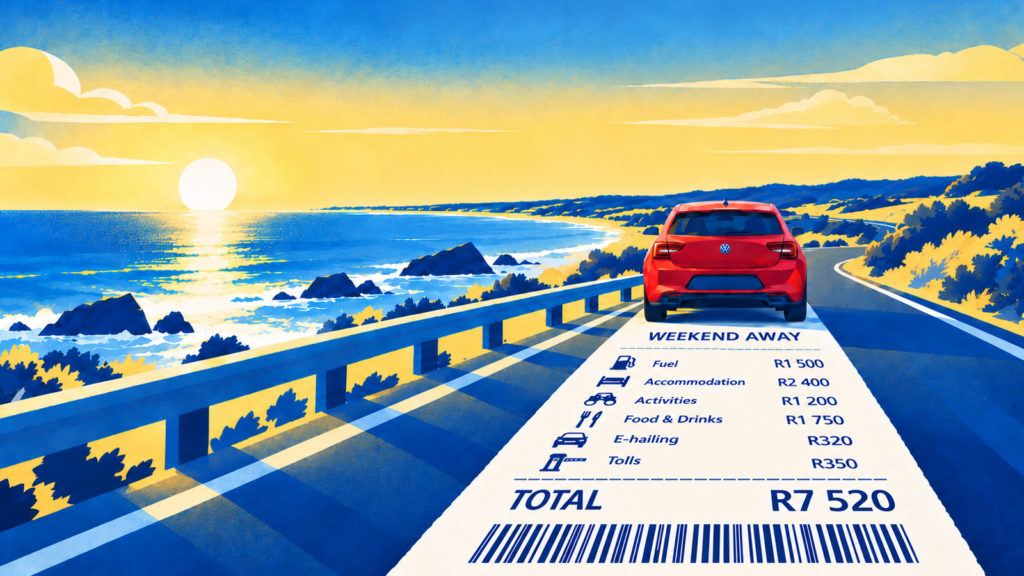
Consider this simple illustrative example for a two-night local getaway:
| Weekend expense | Illustrative cost |
|---|---|
| Fuel | R1 500 |
| Accommodation | R2 400 |
| Activities | R1 200 |
| Food & Drinks | R1 750 |
| Parking, e-hailing | R320 |
| Tolls | R350 |
| Estimated weekend total | R7 520 |
In this example, accommodation makes up only about half of the total spend.
That is why a room that is R300 cheaper does not necessarily make the whole trip R300 cheaper. A destination that requires more fuel, extra transport or more expensive activities can quickly absorb that saving.
The more useful comparison is therefore the full cost of the weekend, not only the room rate.
Adding up the main expenses before booking makes it easier to decide where spending is worthwhile, where costs can be reduced and which discounts could genuinely make a difference.
Several smaller discounts can help the budget stretch further
The same thinking applies to discounts.
No single discount is likely to make a weekend away suddenly affordable. The value comes from reducing costs that were already part of the plan.
Prime South Africa clients can add Prime Advantage for R40 a month, with qualifying discounts available across travel, car hire, e-hailing and selected activities.
Consider an illustrative weekend where a family hires a car, uses e-hailing services and books a qualifying activity:
- Car hire saving: R300
- E-hailing saving: R120
- Activity saving: R180
- Travel saving: R250
- Total illustrative saving: R850
In this example, the family could reduce the cost of a weekend that was already planned by around R850, subject to qualifying partners, availability, applicable allowances and programme rules.
The point is not to build the trip around the discounts. It is to check whether several smaller savings can be applied to costs that were already going to form part of the weekend budget.
That is where the value becomes more meaningful: not from one large discount, but from combining relevant savings across different parts of the trip.
Get a quote from Prime and compare the premium, excess and cover with your current insurance; you may find there’s more value in the numbers than you expected.
See how much Prime SA could save you
Plan the weekend first, then look for value
The domestic travel picture remains encouraging. South Africans are still getting away, exploring locally and finding reasons to travel.
For many households, a weekend away is not really about the distance travelled. It is about having uninterrupted time with family, friends or loved ones, away from the normal routine.
That makes value about more than finding the cheapest option.
Before booking, it helps to add up the full cost of the weekend: accommodation, transport, meals, getting around and the activities you actually want to do. Then look at where discounts may reduce costs that were already part of the plan.
A good-value weekend may simply be one that is closer to home, easier to organise and still leaves enough room in the budget to enjoy the experience once you arrive.
For Prime Advantage members, qualifying discounts can then help stretch that existing weekend budget without changing the trip simply to chase a saving.
The better approach is to plan the experience first, understand the full cost, and then look for value where it naturally fits.
Disclaimer
T&Cs apply.
Prime Advantage membership savings are based on monthly reward allowance and administered by Advantage Rewards. Potential savings depend on the qualifying benefits used and are not guaranteed.
Car insurance benefits are underwritten by Santam Structured Insurance Ltd, a licensed non-life insurer and authorised FSP 1027. Prime South Africa is an authorised FSP 41040.


















 Loading ...