

How the Zuma years killed foreign investment in South Africa


Financial services firm PwC has released a new report on ‘what foreign investors want’ – focusing on factors influencing South Africa’s foreign direct investment (FDI) inflows since 2010.
“FDI is an important enabler of economic growth. For emerging market economies, foreign investment inflows are crucial for transferring money and expertise from multinational companies to local enterprises,” said PwC.
“Emerging markets also need FDI to help finance infrastructure deficits.
“Data from the United Nations Conference on Trade and Development (UNCTAD) indicates that foreign direct investment (FDI) inflows into South Africa declined from an equivalent 2.3% of gross domestic product (GDP) during 2013 to 0.5% of GDP in 2016, with our own analysis providing an estimate of around 0.4% of GDP for 2017.”
According to PwC, the overall number of completed deals in South Africa declined from 163 in 2015 to 117 in 2016 and fell to just 79 in 2017.
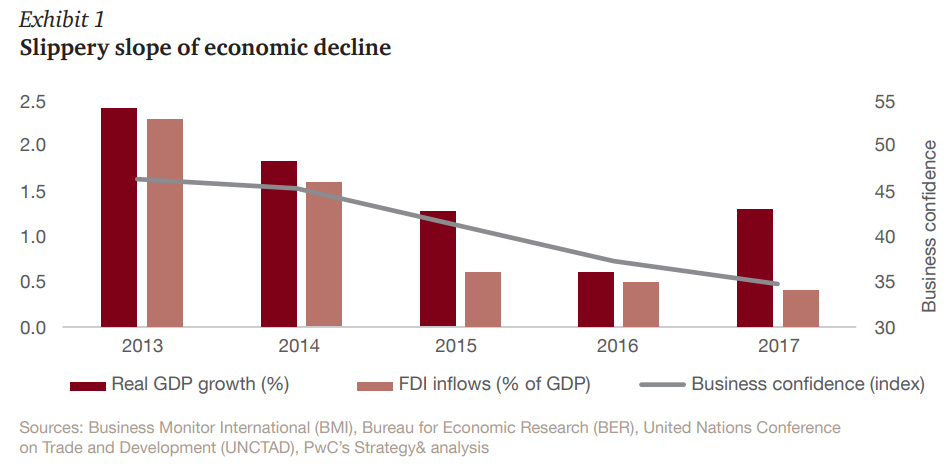
“Economic growth in the country was on a downward trajectory in 2014–2016, with a small recovery seen in 2017,” PwC said.
“As a result, real GDP growth averaged just 1.6% per annum during 2012–2017, in contrast to the National Development Plan’s (NDP) goal of economic growth exceeding 5% per annum towards 2030.”
It added that the NDP originally envisioned the unemployment rate falling from 25% in 2012 to 14% by 2020 and 6% in 2030. This would require the creation of an additional 11 million jobs.
Instead, economic growth has been disappointing and often below the population growth rate of 1.5%, The unemployment rate has actually increased since 2012, PwC said.
“As a result of the economic under-performance, the National Planning Commission (NPC) admitted in September 2018 that the 6% unemployment rate goal is impossible to achieve.”
“Instead, the NPC sees a reduction to 14% as the best possible outcome.
“Given this wide chasm between actual and desired economic outcomes, business sentiment suffered as well: business confidence was at a seven-and-a-half-year low during the second quarter of 2017, with seven-out-of-10 respondents being unhappy with business conditions at the time,” it said.
“Sentiment was slightly better in the second half of the year, before making a marked recovery in the first half of 2018. Nonetheless, according to the Bureau for Economic Research (BER), business confidence remained net negative in H1 2018.”
Read: Here’s what is helping and hurting South Africa’s economic growth
















 Loading ...