

Ramaphosa on what’s being done to prevent stage 8 load shedding


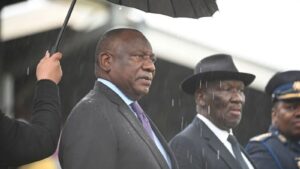
President Cyril Ramaphosa says that the current regulations in place to navigate load shedding in the country only make provision for stage 8 load shedding, but work is underway for the government to do what it can to never reach that point.
Responding in a written parliamentary Q&A this past week, the president said that the Eskom System Operator determines the stage of load shedding required at any particular point in time in consultation with the power utility’s generation segment.
“Stage 6 has been the highest level of load shedding to date, and load shedding equates to approximately 5% of the load in a particular area per stage,” he said. “The industry document that guides how load shedding is carried out…currently goes up to Stage 8 load shedding. Load shedding is executed in a controlled manner to ensure system stability across the country.”
Businesses, analysts, economists and South Africans at large have watched with alarm as Eskom’s ageing power fleet crumbles before their eyes, with 2022 marking the worst year of load shedding on record, with worse expected to come.
The fleet operates on a knife’s edge, as evidenced by the loss of only a few generating units at power stations leading to ever-higher stages of blackouts. Some analysts have predicted that stage 8 load shedding may be on its way soon.
According to Eskom, stage 8 load shedding entails pulling 8,000MW from the grid. If capacity issues go beyond this level, it is up to the System Operator to make specific determinations, per province, for how much additional power needs to be pulled.
On Sunday (23 October), Eskom announced that load shedding would continue at stage 3 and stage 4 until Wednesday at least – with more load shedding at stage 3 and stage 2 anticipated through to the weekend.
Ramaphosa said that plans and developments are in motion to mitigate the power crisis.
“Since the announcement on 25 July 2022 of additional measures to tackle load shedding, the National Energy Crisis Committee (NECOM) has been established to oversee measures to improve the performance of Eskom’s existing fleet of power stations,” he said.
Other measures include accelerating the procurement of new generation capacity; increasing private investment in electricity generation; enabling businesses and households to invest in rooftop solar; and fundamentally transforming the electricity sector to position it for future sustainability, he said.
Significant progress has been made in several key areas, including:
- The Department of Mineral Resources and Energy (DMRE) has published an amendment to Schedule 2 of the Electricity Regulation Act for public comment in line with the announcement made by the president to remove the licencing threshold for embedded generation projects. The schedule was previously amended to raise the licensing threshold to 100 MW, a reform which has already unlocked significant private investment. The new amendment will remove the licensing requirement for generation projects of any size and allow investment in larger, utility-scale projects to rapidly add new generation capacity to the grid.
- Various actions have been implemented to streamline regulatory processes for energy projects with more activities under review. The Department of Forestry, Fisheries and the Environment (DFFE) has waived the need to obtain an environmental authorisation for transmission infrastructure in areas of low and medium environmental sensitivity and in strategic transmission corridors. Average timeframes have been reduced for various regulatory processes, including grid connection, NERSA registration, water use licensing, environmental impact assessment and land use authorisation.
- Eskom is taking steps to address challenges at the power station level, including by deploying former power station managers and skilled experts to improve operational performance and reduce partial load losses.
- A new Ministerial determination has been sent to NERSA for concurrence for over 18,000 MW of new generation capacity from wind, solar and battery storage.
- A revised RFP has been published for Bid Window 6 to increase the amount of generation capacity procured from 2,600 MW to 5,200 MW.
- An additional 200 MW has been procured through the Southern African Power Pool as of September 2022, with work underway to increase imports from the region.
- A standard offer approach has been developed for Eskom to procure up to 1,000 MW of additional capacity from existing generators, contingent on market response.
- Work is underway within Eskom to develop a mechanism to procure surplus energy from customers to increase uptake of rooftop solar installations.
- The Electricity Regulation Amendment Bill, which provides for the establishment of an independent transmission company and the emergence of a competitive electricity market, is being finalised for tabling in Parliament.
- The Integrated Resource Plan 2019 is being reviewed, with a completion target of March 2023, to update assumptions regarding energy availability and technological changes.
“These and other measures currently underway will make a significant difference in reducing the risk of load shedding and achieving long-term energy security,” the president said.
Read: A total blackout would leave South Africa in the dark for weeks: Eskom







 Loading ...