

Here is the expected petrol price for October


Mid-month data from the Central Energy Fund (CEF) show that fuel price recoveries are deep in the red for petrol and diesel, suggesting likely pain at the pumps next month.
According to the CEF’s data, petrol prices are showing an under-recovery of R2.29 and R2.41 per litre for Petrol 93 and 95, respectively.
Diesel price recoveries are just as bad, with under-recoveries of R2.04 and R2.41 per litre for 0.05% and 0.005% sulphur, respectively.
At current levels, both petrol and diesel wholesale prices are set to break record-level pump prices in October, with the ongoing conflict in the Middle East fuelling disruptions.
Diesel prices hit their highest-ever level in May 2026, as the impact of the United States’ war against Iran filtered through to global oil markets.
This was followed by petrol prices hitting their worst-ever levels in June 2026.
Before this, both petrol and diesel had hit their worst-ever levels in 2022, after Russia invaded Ukraine—a conflict that is also still ongoing and exacerbating global fuel supplies.
These are the recoveries at mid-month:
- Petrol 93: increase of R2.29 per litre
- Petrol 95: increase of R2.41 per litre
- Diesel 0.05% (wholesale): increase of R2.04 per litre
- Diesel 0.005% (wholesale): increase of R2.41 per litre
- Illuminating paraffin: increase of R2.56 per litre

With half the month still to go, the recovery data can still change. However, at this point in the review period, it is unlikely, especially given the trajectory of the Middle East war.
The path for fuel recoveries relies almost entirely on oil flows, which have only tightened this month.
Oil prices rose close to $110 a barrel this week—now trading around $107—after a Saudi Arabian pipeline used to bypass the Strait of Hormuz was taken offline.
The East-West pipeline was shut last week after attacks, with the Saudis yet to say when it may restart.
The attacks on the infrastructure “mark a meaningful escalation,” according to Goldman Sachs, with the affected volumes and the duration of the outages remaining highly uncertain.
According to Bianca Botes, Managing Director at Citadel Global, the disruptions threaten up to 4% of global oil supply.
However, it’s not the disruptions and the fluctuating oil prices that are the news, she said.
Instead, a major change is that “a series of institutions has now conceded that the energy shock is not a temporary dislocation to be looked through but a durable feature of the coming quarters“.
The rand is losing its shine
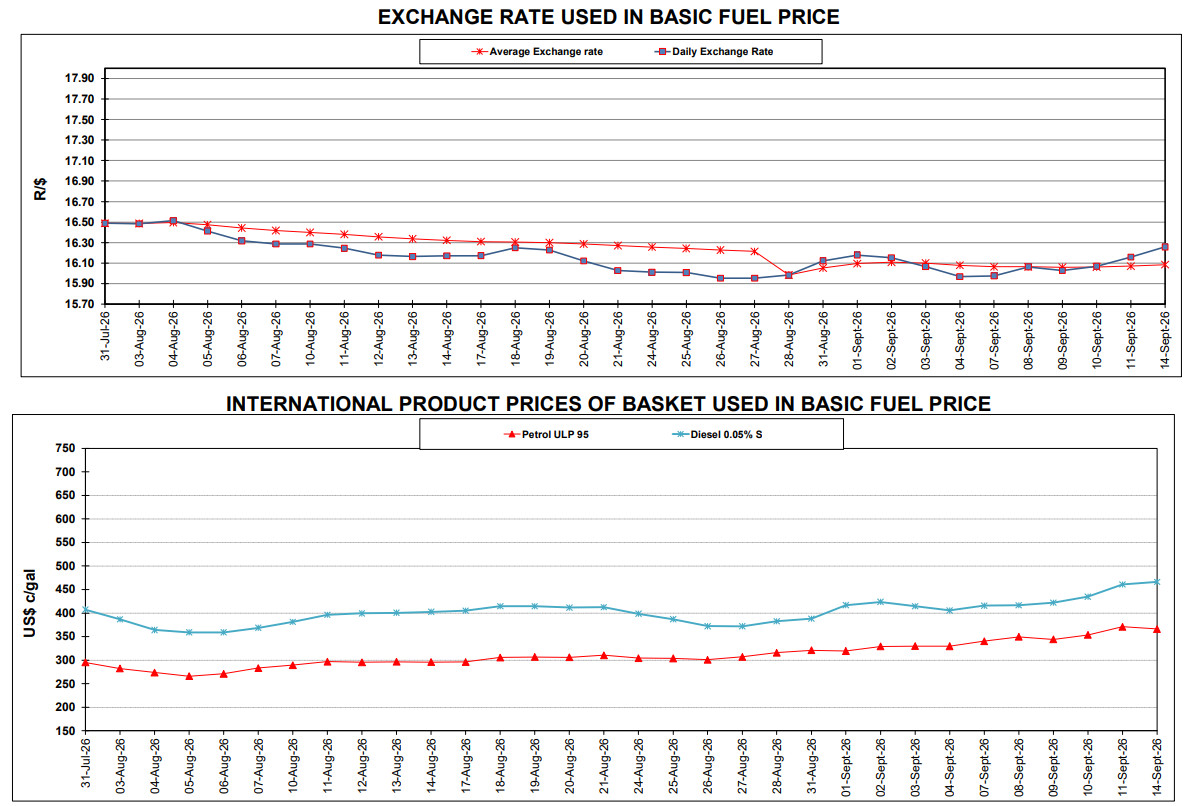
The other side of the equation is the rand/dollar exchange rate. While the rand continues to show resilience amid wider market turmoil, its shine has begun to dim.
The chaos caused by the US-Iran war sent markets into safe-haven commodities like gold, which bolstered the rand.
South Africa has also seen a turn in sentiment, with markets expressing confidence in the economy’s turnaround and progress on reforms.
However, Botes noted that “the commodity cushion is thinning”, as July gold production was down 7.4% year-on-year after a 6.2% gain, and total mining output was down 7.5%.
“So the high prices that have supported the terms of trade are being earned on falling volumes, while gold itself has slipped,” she said.
Economic data from this past month, including a 0.2% contraction in GDP and the unemployment rate hitting 33.6%, have also dulled optimism about the economy.
Business Leadership South Africa (BLSA) CEO, Busi Mavuso, said it was a wake-up call that positive sentiment cannot supplant actual reforms.
Then there’s the fact that the rand, while uncharacteristically stable, is not immune to the wider global market volatility, particularly around the US economy.
The unit is currently trading weaker against the US dollar at R16.32 as markets await the US Federal Reserve’s next interest-rate move.
Investors are closely watching the Fed for clues on the interest rate outlook and whether pressure on the rand could intensify.
Fortunately, for fuel price recoveries at least, the current exchange rate is still helping, rather than hindering, prices.
At current levels, the rand/dollar is still offsetting rising fuel prices by 12 to 17 cents, depending on fuel type.
This is how the price changes are expected to reflect at the pumps (Diesel prices reflect wholesale, pump prices will differ):
| Inland | September Official | October Expected |
| 93 Petrol | R26.76 | R29.05 |
| 95 Petrol | R26.92 | R29.33 |
| Diesel 0.05% (wholesale) | R29.11 | R31.15 |
| Diesel 0.005% (wholesale) | R30.05 | R32.46 |
| Illuminating Paraffin | R20.89 | R23.45 |
| Coastal | September Official | October Expected |
| 93 Petrol | R25.97 | R28.26 |
| 95 Petrol | R26.05 | R28.46 |
| Diesel 0.05% (wholesale) | R28.24 | R30.28 |
| Diesel 0.005% (wholesale) | R28.79 | R31.20 |
| Illuminating Paraffin | R19.83 | R22.39 |
Disclaimer: The daily snapshots from the CEF are not entirely predictive of the final fuel price adjustments, and the numbers may change by the end of the month. The Department of Mineral and Petroleum Resources only announces the final price a few days before the implementation date.
The table below outlines the escalating price changes this year.
| Month | Petrol 95 Price | Diesel 0.005% Price (wholesale) |
|---|---|---|
| March 2026 | R20.30 | R18.60 |
| April 2026 | R23.36 | R26.11 |
| May 2026 | R26.63 | R31.88 (current record) |
| June 2026 | R28.06 (current record) | R29.26 |
| July 2026 | R26.10 | R25.67 |
| August 2026 | R25.58 | R26.90 |
| September 2026 | R26.92 | R30.05 |
| October 2026 (projected) | R29.33 | R32.46 |
With Bloomberg


















 Loading ...