While the rand is currently trading at a surprisingly resilient level of R17.70 against the dollar, its real value is closer to R13.16/$ when considering purchasing power.
This is according to the latest Big Mac Index from The Economist, a rudimentary measure of purchasing power parity (PPP) that gives a good indication of how over-valued or under-valued a currency is against the dollar.
PPP is the notion that, in the long run, exchange rates should move towards the rate that would equalise the prices of an identical basket of goods and services in any two countries.
The Big Mac Index has become a layman’s standard for determining PPP because of the consistency and the wide availability of the McDonald’s Big Mac around the world.
The index provides important insights into the valuation of different currencies, particularly in a year like 2025, when global markets have been shocked by geopolitical events and Trump’s trade war.
It is updated twice a year, reflecting PPP at the start of the year and in the middle of the year, with the latest version reflecting the forex market just before the August tariffs took effect.
US President Donald Trump’s decision to hike tariffs against all trading partners has added uncertainty and risk to markets, reflecting different exchange rate fluctuations.
The tariffs have also had the effect of weakening the dollar, putting even more turbulence into forex trades.
The rand has had a particularly tumultuous year trading against the US dollar so far, swinging between R17.30/$ and over R19.30/$ at the whims of global markets.
The rand started the year on the back foot, hitting R19.00/$ as the Trump administration took aim at the country over “human rights abuses” related to farm murders and new laws like the Expropriation Act.
Things got worse when local politics and ructions in the Government of National Unity (GNU) put the Budget at risk in February and March.
This ultimately pushed the rand to its worst-ever levels in April when Trump announced a 30% tariff on the country at the same time as the contested Budget vote that almost collapsed the GNU.
The rand has since clawed back from its worst-ever levels, with global markets calming and eventually digesting the Trump tariffs.
War breaking out between Israel and Iran in June added more volatility to markets, as did the second round of tariff negotiations, which South Africa failed to achieve.
However, the rand remained surprisingly resilient throughout.
The ‘real’ value of the rand
Currently trading at R17.70 against the dollar, the local unit is still weak, but far better off than many had expected.
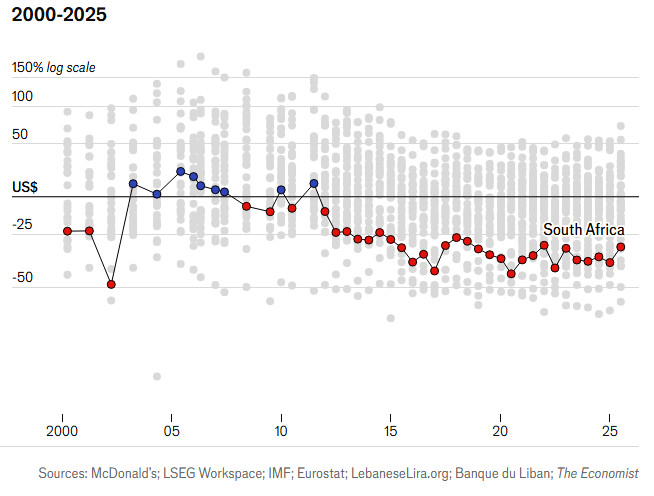
That said, on a PPP basis, it remains incredibly undervalued against the dollar, with the Big Mac Index indicating that it should be trading much lower.
A Big Mac costs R53.90 in South Africa and US$6.01 in the United States. The implied exchange rate is thus R8.97/$.
The difference between this and the actual exchange rate (at the time of the index) of R17.88 suggests the South African rand is 49.8% undervalued.
In a wider context, the rand is the 7th most undervalued currency in the world, behind Egypt, Indonesia, India, Taiwan, Vietnam and the Philippines.
One of the Big Mac index’s biggest flaws is that it doesn’t consider the full picture when evaluating currency differences.
Specifically, financial experts have argued that because of PPP, the cost to produce a Big Mac is typically cheaper in poorer countries, thus skewing the data.
To account for this, The Economist produces a parallel index that factors in a country’s GDP per capita to draw a more accurate conclusion.
In this ‘adjusted’ index, the rand is still heavily undervalued, though, by about 26%.
A Big Mac costs 49.8% less in South Africa (US$3.01) than in the United States (US$6.01) at market exchange rates.
Based on differences in GDP per person, a Big Mac should cost 26.4% less. This suggests the South African rand is 31.9% undervalued.
Adjusted for GDP, the rand should be trading at about R13.16/$.
Why the rand is undervalued
There are many reasons a currency can be undervalued. In addition to economic fundamentals, exchange rates carry a large degree of sentiment as well.
For South Africa, the economic fundamentals are bleak at best: the country’s economy is stagnating with low prospects for growth.
Economists expect, at best, 1% GDP growth for 2025, but more likely significantly lower at around 0.7%.
This come against the backdrop of the country averaging 0.8% growth over the last decade—all while the population continues to grow at around 1.5%, getting poorer each year.
The country is beset with perennial infrastructure issues, power supply problems, a growing water crisis, widespead state corruption and high levels of unemployment.
Sound financial markets are one of the few saving graces on the economic front, with high yield bonds and strong potential being a few of the factors keeping investors keen.
In terms of sentiment, 2025 has been a remarkably negative year for the country’s international image, with the Trump administration putting its race laws and targeted violent crime on the global stage.
In terms of foreign policy, the country has taken stark ‘anti-West’ stances and cosied up to authoritarian regimes. While the state claims neutrality, its actions run counter to this stance.
All of these factors feed into the “risk premium” that is attached to the rand, which could be expressed as a R4.00/$ cost.



















 Loading ...