

SARS forced to give R168 million back to taxpayers


The Office of the Tax Ombudsman’s (OTO’s) annual report for 2024/25 shows that the South African Revenue Service (SARS) was forced to refund ten taxpayers R168 million after complaints.
According to the OTO, it received 4,913 tax complaints over the year, of which 46%, or 2,265 cases, were accepted and subsequently returned to SARS with recommendations.
In the year under review, there was a slight drop in the number of accepted complaints, which may reflect more stringent validation.
The rise in rejected complaints, meanwhile, likely reflects a gap in public knowledge about when and how to use the OTO.
The ombud noted that over 1,650 complaints were rejected by the office, and a further 996 were terminated by the complainants.
The reason for the rejected complaints is largely due to taxpayers not first using SARS’s internal complaints process.
Section 18(4) of the Tax Administration Act requires that taxpayers must exhaust all internal channels
at SARS to resolve their tax issues, unless there are compelling reasons.
In 2024/25, the vast majority (87%) of rejected tax complaints were based on this provision of the TAA.
The balance of rejections was due to matters that were already subject to appeal or objection with SARS, or were outside the ombudsman’s mandate.
On the other hand, accepted complaints reflect successful identification of taxpayer grievances that SARS must address, the ombud said.
The ombud’s recommendations to SARS to assist taxpayers typically related to delays in finalising verification or issuing tax residency certificates.
Other recommendations related to portfolio maintenance, including deregistration and reactivation of
tax numbers, as well as helping taxpayers who were stuck in SARS’ objection or appeal processes.
SARS successfully resolved 2,390 complaints in 2024/25, an improvement on the 2,178 resolved in 2023/24.
SARS accepted and implemented 2,374 recommendations in 2024/25, representing 99.33% of cases resolved. Only 16 recommendations were not implemented, due to various reasons.
Paying back the money
While resolving thousands of tax disputes is a feather in the OTO’s cap, the ombud conceded that a significant part of the office’s impact is seen in rands and cents.
This is the monetary value of the refunds SARS ultimately pays out to taxpayers as a result of the OTO’s recommendations and interventions.
“These refunds are often life-changing for taxpayers, particularly for small and medium businesses,” the ombud said.
The ombud does not publish the full refund value of all the complaints it has processed and recommendations made, but each year it compiles the value of the top 10 complaints.
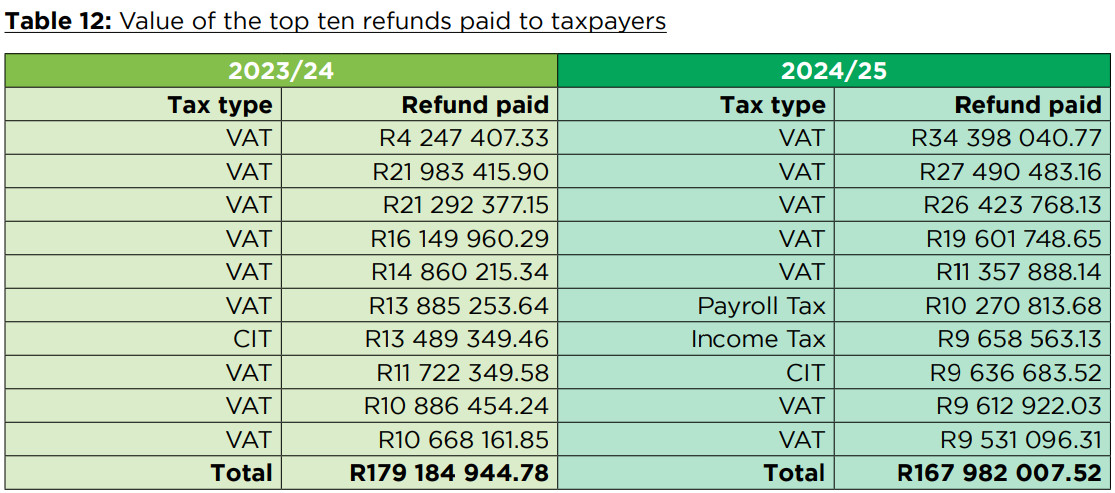
In 2024/25, the OTO facilitated the top 10 refunds amounting to R167.98 million, slightly down from R179.18 million in 2023/24.
“Though there was a decrease of 6.27% from the previous year, the OTO’s interventions continue to provide critical financial relief,” it said.
“The consistent value over three years reflects the systemic nature of refund delays and the OTO’s effectiveness in addressing them.”
Most of the top 10 refunds involved VAT, followed by Corporate Income Tax (CIT) and Payroll Tax.
This is consistent with past trends, where refunds are delayed due to pending verifications, disputes, or systemic backlogs.
The ombud noted that there was also an improvement in how long it took for SARS to resolve disputes, with the most notable improvement being the proportion of recommendations resolved within 15 days.
This increased from 29.98% in 2023/24 to 43.01% in 2024/25.
“However, the increase in matters taking longer than 91 days shows that further work is needed in handling complex or disputed complaints efficiently,” it said.















 Loading ...