

South Africa’s state-owned investment company flunks important test with 8%


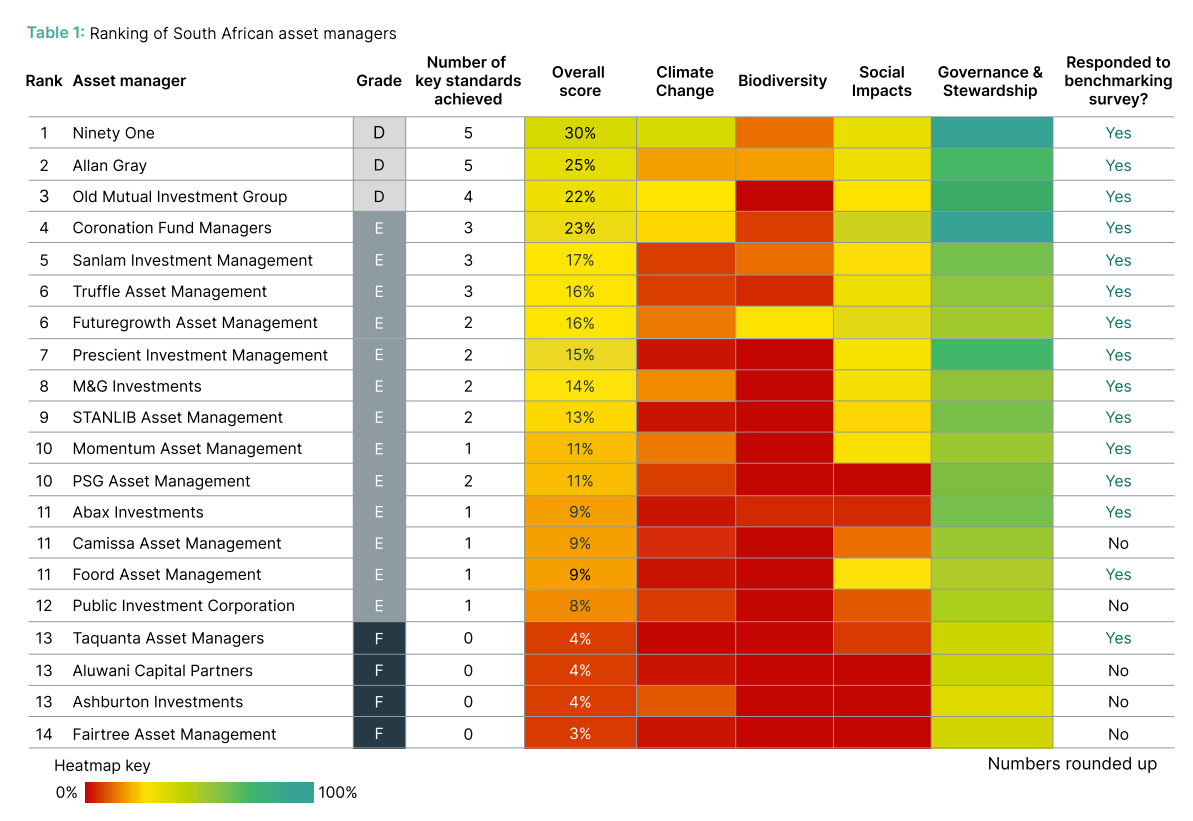
South Africa’s largest asset managers have failed to introduce responsible investment practices, with the Public Investment Corporation scoring just 8% in a study from NPO Just Share.
The Just Share Asset Manager Responsible Investment Benchmark 2025 showed that South Africa’s 20 largest asset managers are underperforming in responsible investment practices.
The responsible investment standards on governance, climate change, biodiversity and social impacts are based on international best practice.
Just Share said that the findings show that the industry is failing to address the systematic risks that climate change, biodiversity loss and inequality pose for investors.
The report uses methodology developed by UK-based non-profit organisation ShareAction, and assesses responsible investment performance against 20 key standards.
Although Just Share said the standards are ambitious, they are still achievable. 15 of the 20 assessed asset managers responded to the initial findings from Just Share.
Just Share noted that 85% of the largest asset managers received only “E” or “F” grades, with scores below 25%.
Four managers failed to meet even one of the benchmark’s 20 key standards for responsible investment.
The top-performing local manager, Ninety One, scored just 30%, alongside a “D” grade. This would place it 24th globally across the asset managers assessed by ShareAction.
South Africa’s largest asset manager, the Public Investment Corporation, has R2.69 trillion in assets under management and received an E-grade, with an overall score of 8%.
It was not the worst performer in South Africa, with Taquanta, Aluwani, Ashburton, and Fairtree all receiving an F.
Problem for retirees
Just Share noted that a significant issue was the lack of information in the public domain, which makes it impossible to measure their responsible investment claims.
None of the 20 asset managers publicly discloses their sustainability metrics across all their portfolios, with limited punishments for companies that do not apply.
Action to address climate risk is notably poor, with only 15% of managers having set net zero targets, compared to 80% of global assets assessed by ShareAction.
65% of South African managers do not restrict fossil fuel investments, despite South Africa’s need for financing to transition to a low-carbon economy.
Most asset managers have not conducted climate scenario analysis or published portfolio transition plans.
Biodiversity is another blind spot, with 90% failing to meet any biodiversity key standards. Futuregrowth is the only manager with sector-specific biodiversity requirements.
Performance on social impacts is also poor, with 80% of assessed South African managers failing to meet any key standards.
“Local asset managers note the importance of human and labour rights frameworks, but none have investment policies that commit to restrictions on companies transgressing these frameworks,” said Just Share.
“Further, no firms provide evidence of excluding investments in a company based on violations of human and labour rights.”
None of the 20 largest South African asset managers have an investment policy that excludes investment in tobacco and controversial weapons.
Although half of the surveyed managers supported a just transition to a low-carbon, inclusive economy, evidence of capital allocation for a just transition remains minimal.
“South Africa is often regarded as a leader in responsible investment in emerging markets, but asset managers are failing to keep pace with their global peers”, said Karishma Bhoolia, senior climate risk analyst at Just Share.
“Asset managers manage the retirement savings and investments of millions of South Africans and could be doing far more to protect those investments from climate risks, biodiversity loss and social instability.”
“These aren’t peripheral issues; they’re fundamental risks to long-term investment returns and the world South Africans will retire into.”















 Loading ...