

Another blow for domestic workers in South Africa


Domestic workers have recorded a reduced increase in pay in the final months of 2025, compounding the significant challenges they have faced over the last few years.
Stats SA recently published its latest inflation statistics for December 2025, which included results from the quarterly survey of housing rents.
While 2025 saw a 21-year low average inflation of 3.2%, December still saw inflation rise to 3.6% from 3.5% in November.
The quarterly survey of housing rents showed that the domestic workers saw their pay increase by an annual 3.8% in December, which was lower than the 4.1% rise recorded at the end of 2024.
Moreover, when looking at the real increases, which also account for inflation, domestic workers only recorded a 0.4% increase in December 2025.
Given that December 2024 inflation was 3.0%, domestic workers recorded a 1.1% real increase at the end of 2024.
While December 2025 will still see real increases for domestic workers, they are still incredibly open to abuse and are largely informal.
SweepSouth’s domestic worker survey showed that these employees are not getting paid in line with the National Minimum Wage.
Moreover, many administrative processes and protections for domestic workers, such as registering with the Unemployment Insurance Fund (UIF), are not being carried out.
The sector has also been hit by employers either emigrating or semi-emigrating, leaving many workers without work.
Tracking data over the last five years, the number of domestic worker positions has not exceeded 880,000 in almost 4 years.
This indicates a permanent loss of roughly 150,000 domestic worker jobs in the country since the start of the COVID-19 pandemic.
Increase on the cards
Regarding future pay increases, the Department of Employment and Labour has recently gazetted the National Minimum Wage Commission’s recommendation to raise the bottom line for workers.
The commission’s recommendation would see the National Minimum Wage increase by CPI+1.5% in 2026.
The increases, which were open for public comment until 12 January 2026, will come into effect in March 2026.
Generally, workers and labour unions often welcome hikes in the NMW, while employers and businesses are less enthused, given the increased operational costs.
With CPI averaging around 3.2% in 2025, the National Minimum Wage could increase by around 4.7% to reach R30.14 per hour from its current level of R28.79 per hour.
That said, the commission noted that the inflation rate to be used will be the rate six weeks before the 1st of March.
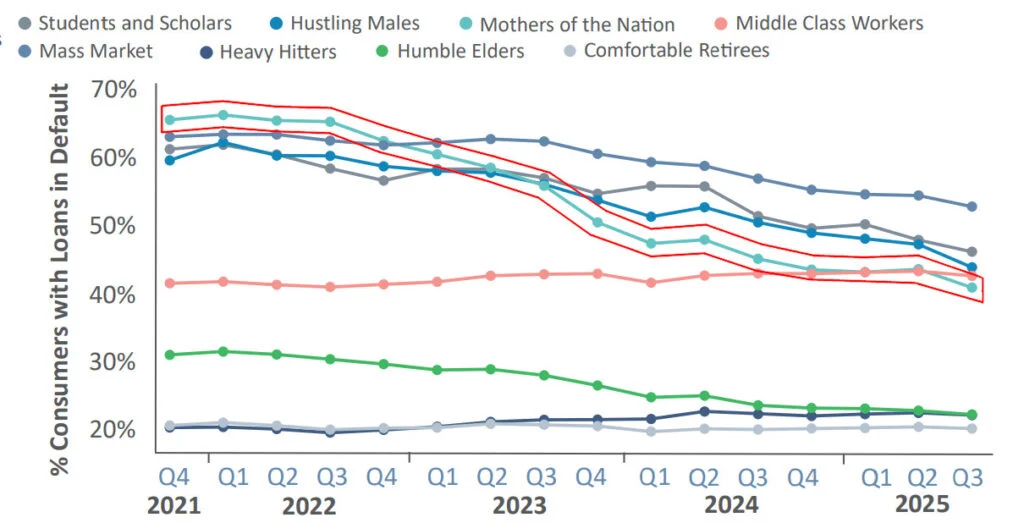
While domestic workers often face financial pressures, data shows they are significantly improving their relationship with debt.
According to Eighty20’s data, by Q4 2021, the Mothers of the Nation segment had the highest default rate among all groups, at around 75%.
The Mothers of the Nation are low-income, female grant recipients, most of whom are unemployed or underemployed. Domestic workers essentially represent it.
Eighty20’s data reflected credit-active individuals with at least one loan in default (or with three or more months of arrears).
That said, the Mothers of the Nation noted their default levels dropped dramatically over four years, reaching just over 40% in Q3 2025. This is lower than the middle class.
However, the group’s latest report shows that default levels among this segment have decreased significantly, reaching just over 40% in Q3 2025 – lower than the default rate among the middle class.


















 Loading ...