

Government left juggling South Africa’s biggest economic problem


The South African government is facing a significant obstacle that is adversely impacting the country’s economy: trying to manage its increasing debt.
“Over the past fifteen years, our debt burden has grown to a point where we are spending more on interest payments than we are on education or health care services,” said President Cyril Ramaphosa in his weekly letter to the nation, citing that South Africa’s economy “has been weighed down by more than a decade of low growth and rising debt.”
South Africa’s gross debt stock is hefty and is expected to increase from R5.21 trillion (73.9% of GDP) in 2023/24 to R6.29 trillion in 2026/27 (74.7% of GDP).
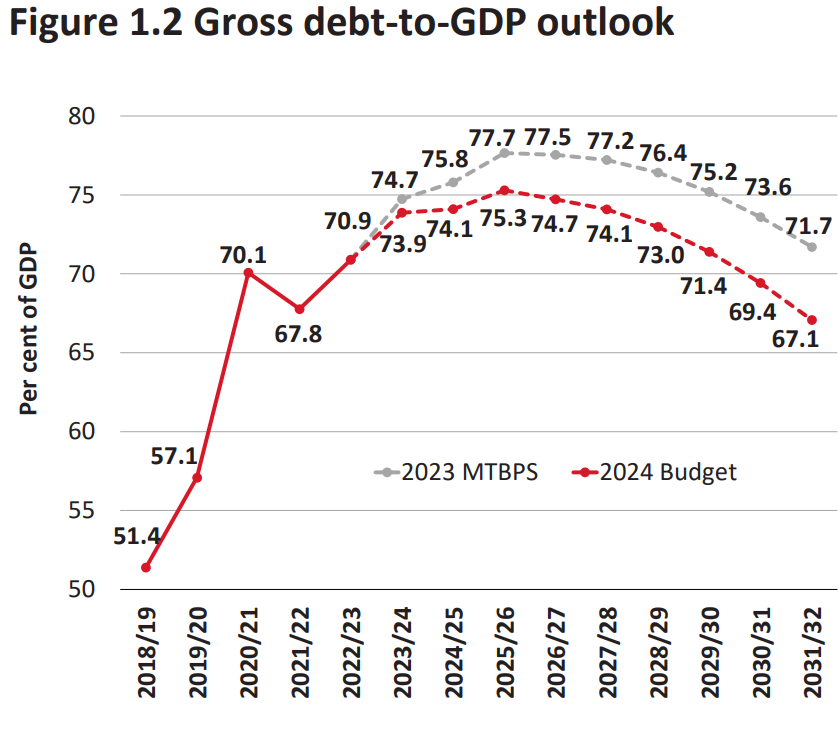
The government’s fiscal plans aim to reduce its debt burden by prioritising the repayment of its debts.
This is argued in the 2024 national budget, saying that it enables the government to attempt to stabilise certain areas to finance critical components of the country that have been neglected due to excessive borrowing.
“By reducing debt, we will create more space to spend on the things that matter – building our infrastructure, improving our schools and hospitals, and making our communities safer,” said Ramaphosa, citing that the less the state borrows, the more there is that can be invested in the economy.
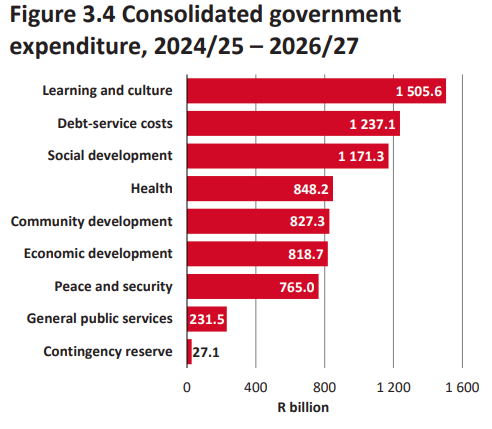
It was announced that the government would spend R382.2 billion in 2024/25 in debt-servicing costs (approximately 20% of government spending and 5.2% of GDP), which amounts to more than R1 billion a day in payments.

“To put this into perspective, spending on debt-service costs is greater than the respective budgets of social protection, health, or peace and security,” said finance minister Enoch Godongwana in his speech.
As such, the government decided to tap into its Gold and Foreign Exchange Contingency Reserve Account (GFECRA) to reduce its debt projections.
As a result, debt-service costs will decline by R30.2 billion over the 2024 Medium Term Expenditure Framework period.
South Africa’s over R5 trillion in debt “would be higher without the planned drawdown of R150 billion of South Africa’s GFECRA, which is in line with international practices,” said Annabel Bishop, chief economist at Investec.
“Using the GFECRA to reduce debt, however, was the most likely avenue – but is also a temporary measure in a weak economy, with debt likely to just creep up again if tax revenues undershoot, and the GFECRA cannot be quickly replenished,” she added.
As such, the government’s gross borrowing requirement is expected to decrease from R553.1 billion in 2023/2024 to R428.5 billion in 2026/27, given the use of the GFECTRA to reduce borrowing in the medium term.
Shane Packman, an investment analyst at financial services group Morningstar, said that “the reduction in government debt is seen as a net positive (in the short term),” however, he stressed that caution is still warranted, “as dipping into contingency reserves may leave the country more vulnerable to future exogenous shocks.”

















 Loading ...