

Social unrest erupting in South Africa


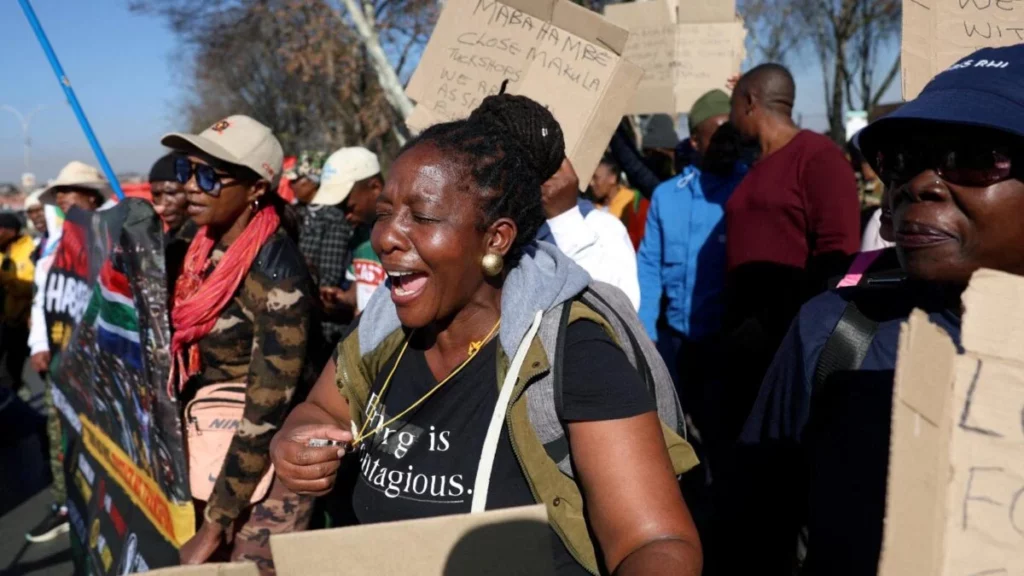
Growing frustration over water shortages has led to protests disrupting traffic in parts of Johannesburg and Soweto, as several major metros introduce tighter water restrictions.
In Johannesburg, motorists have been warned to avoid Heidelberg Road in City Deep following renewed protest action linked to power outages and suspected service delivery grievances.
The Johannesburg Metropolitan Police Department (JMPD) said protesters initially took to the streets on Monday night, with demonstrations continuing into Wednesday morning.
“Following initial demonstrations over power outages last night, crowds dispersed, temporarily leaving heavy debris scattered across the roadway.
“However, protesters have regrouped and resumed activity early this morning,” said JMPD spokesperson Xolani Fihla.
The protest has affected the section of Heidelberg Road between Impex Avenue and Mpumelelo Road, where burning tyres and debris have created hazardous driving conditions.
Fihla added that further updates would be issued once the protest had subsided, the roadway had been cleared, and traffic could safely resume.
Residents of Protea Glen in Soweto have also taken to the streets following a week without running water.
Frustrated community members said they have been left without clear answers on when their water supply will be restored, while also complaining about a lack of water tankers to assist affected households.
Residents barricaded sections of the R559 Main Road using burning tyres, rocks and other debris.
The disruptions affected traffic at the intersection of Sunrise Avenue and Orange Street, which connects Soweto and Randfontein.
Police are monitoring the situation, with motorists advised to exercise caution when travelling through the area.
The protests come as water shortages and pressure on municipal infrastructure become increasingly prominent across Gauteng and other parts of the country.
The City of Tshwane introduced Level 2 water restrictions on 12 November, with enforcement reaffirmed on 16 November.
The restrictions will initially remain in place for 30 days as the metro attempts to reduce consumption.
According to the city, water demand has exceeded its permanent Rand Water allocation by 34% and its temporary allocation by 19%.
Dam levels a concern in the Western Cape

Tshwane has been instructed to reduce consumption by 200 million litres per day to prevent the collapse of the Rand Water storage system.
The restrictions prohibit residents and businesses from watering gardens with municipal drinking water, washing vehicles using hosepipes and filling swimming pools with municipal water.
The Tshwane Metro Police Department is conducting inspections, with fines starting at R5,000 for contraventions.
Johannesburg is already operating under Level 1 restrictions, which prohibit garden watering and filling swimming pools between 06:00 and 18:00. The city has also warned that Level 2 restrictions could follow if consumption does not decline.
Water and Sanitation Minister Pemmy Majodina announced on 16 November that allocations from the Western Cape Water Supply System would be reduced immediately for the 2026/27 water year.
Domestic and industrial allocations are being cut by 7%, while agricultural irrigation allocations will be reduced by 15%, with the measures intended to save approximately 56.8 million cubic metres of water annually.
The City of Cape Town has subsequently announced that Level 1 water restrictions will take effect on 1 December, targeting a 10% reduction in overall consumption.
The restrictions come as combined storage across the Western Cape’s six major supply dams stood at 72.5% on 16 November, down from 84.4% a year earlier.
However, unlike the Western Cape, Gauteng’s water challenges are largely linked to infrastructure and distribution capacity rather than a shortage of raw water.
The Department of Water and Sanitation has said that treated-water demand is exceeding bulk pumping and storage capacity, despite the Vaal Dam remaining above full supply capacity.
Several areas across Johannesburg, Tshwane and Ekurhuleni are experiencing intermittent low pressure or water outages as municipal reservoirs struggle to recover.















 Loading ...