

South African households are getting poorer


South Africa’s households were poorer in the second quarter of the year, the latest Momentum/Unisa SA Household Wealth Index shows, with net worth levels at the lowest seen since 2014.
According to the report, published this week, a growing number of households will not be able to cope with emergency expenses, and also not have a sufficient income in retirement.
“In short, South African households’ quality of living is in a state of deterioration,” the group said.
“This precarious situation can be ascribed to a self-inflicted slow growing domestic economy that failed to create strong job growth and sufficient returns on household assets.”
According to numbers provided by Stats SA, the South African economy grew at an average rate of 1.6% over the past five years, and only 1.1% over the past three years. The country therefore did not benefit strongly from a world economy that expanded at a much stronger rate of 3.3% over the past five years.
South Africans getting poorer
Momentum/Unisa estimates that the real value of households’ net wealth amounted to R7 007.6 billion at the end of Q2 2017. This is about R10 billion less than at the end of Q1 2017 and also 0.7% lower than a year ago.
The real value of household net wealth is the difference between the real value of households’ assets (consisting mostly of the real values of their retirement funds, other financial investments and properties) and their liabilities (mostly the value of their outstanding credit and other debts).
To obtain a sense of the magnitude of households’ net wealth, it can be expressed as a percentage of their annual gross income. This shows that household net wealth declined to an estimated 279.7% of their gross income in Q2 2017 – from 284.6% in Q1 2017.
This is also much lower than the 305.2% reached in Q2 2014.
The reasons behind the pattern of declining household net wealth over the past three years can be ascribed to the real value of household assets declining, while their liabilities remained more or less constant, Momentum/Unisa said.
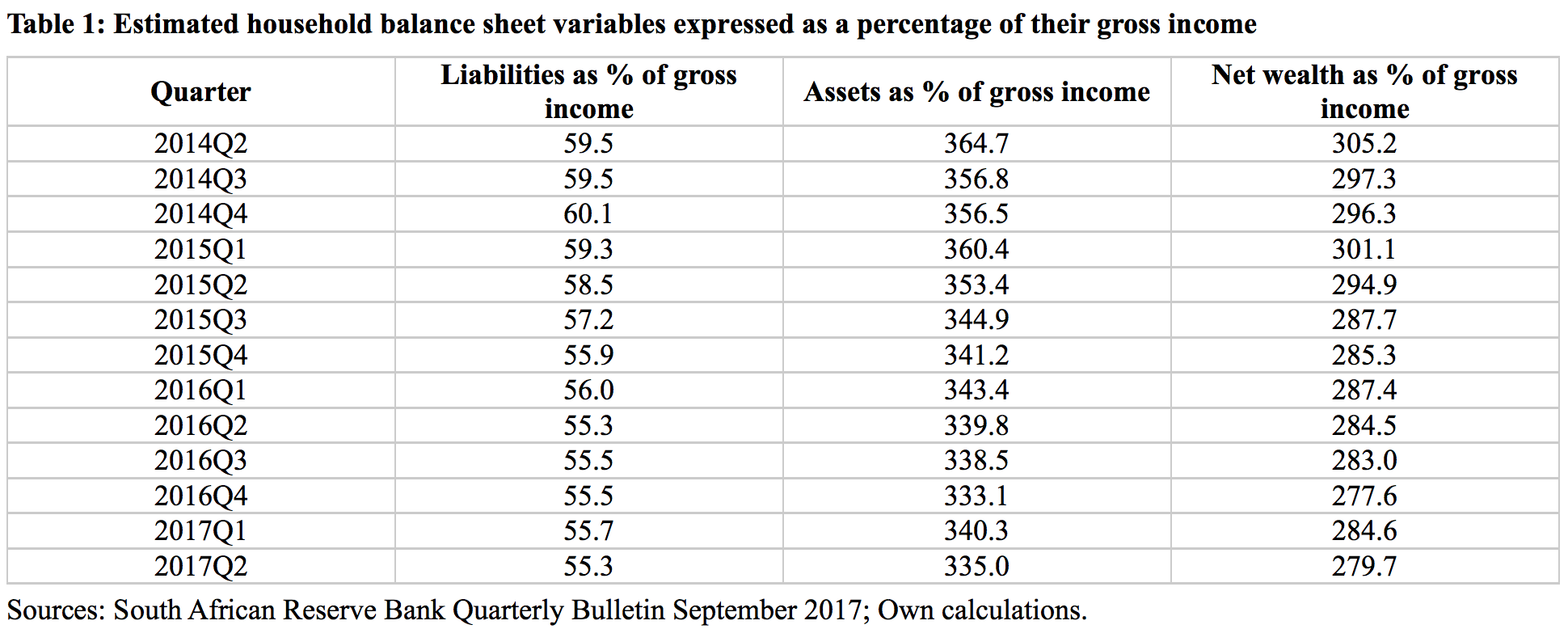
According to the index, over the past three years the real value of household assets declined as a percentage of their gross income – this can be attributed to mostly the decrease in the real value of households’ financial assets; specifically, the real value of their retirement funds, which mainly consist of investments in listed shares and bonds.
However, the decline in the real value of listed shares outpaced the increase in the real value of bonds, which contributed to the decrease in the real value of household financial assets, Momentum/Unisa said.
In contrast, the ratio of household liabilities as a percentage of their gross income remained constant at levels of 55% over the past 18 months.
Momentum/Unisa estimates that the real value of outstanding household liabilities increased to R1 386.9 billion in Q2 2017 from R1 372.7 billion in Q1 2017. This is 1.1% higher than in Q2 2016.
Outlook for the rest of the year
According to Momentum/Unisa, the preliminary estimates point to the real value of household net wealth recovering somewhat during Q3 2017.
“This is mainly as a result of the real value of financial assets increasing, while credit growth remained subdued,” the group said.
However, for households’ financial wellness to improve sustainably, they need to improve their decision making in terms of how much of their income they should use to save, spend, insure and repay debt – as this will to some degree offset the negative effects of political events on the economy, it said.
Read: Average household wealth in South Africa versus the world


















 Loading ...