

SA slides down global cloud ranking


A new study ranks South Africa 20th out of 24 leading IT economies, sliding down from a position of 18 a year earlier.
The BSA evaluated national laws and regulations in seven policy areas critical to the development of a globally integrated cloud marketplace.
The findings released today in the 2013 BSA Global Cloud Computing Scorecard build on a first edition of the study, published in early 2012.
“It is discouraging that South Africa has not made better progress in adopting policies that are conducive to cloud innovation,” said Drummond Simpson, chairman of the BSA South Africa committee.
“Every country’s policies affect the global cloud marketplace. It is imperative for South Africa to focus on improvements in promoting free trade, data privacy, cybercrime and security in order to improve its standing and help grow the global cloud.”
Global scenario
The Scorecard’s biggest mover is fifth-ranked Singapore, which vaults up five places after adopting a new privacy law that builds user trust while also promoting business innovation.
The study found that Japan continues to lead the global rankings with a comprehensive suite of laws supporting digital commerce. Australia remained in second place, and the US edged into third this year, pushing Germany into fourth place in the rankings.
The study found that cloud policy improvements in many of the world’s biggest IT markets have stalled. Notably, all six European Union countries covered in the study have lost ground in the rankings.
Others are effectively unplugging themselves from the global market — with especially counterproductive policies in Korea, Indonesia and Vietnam.
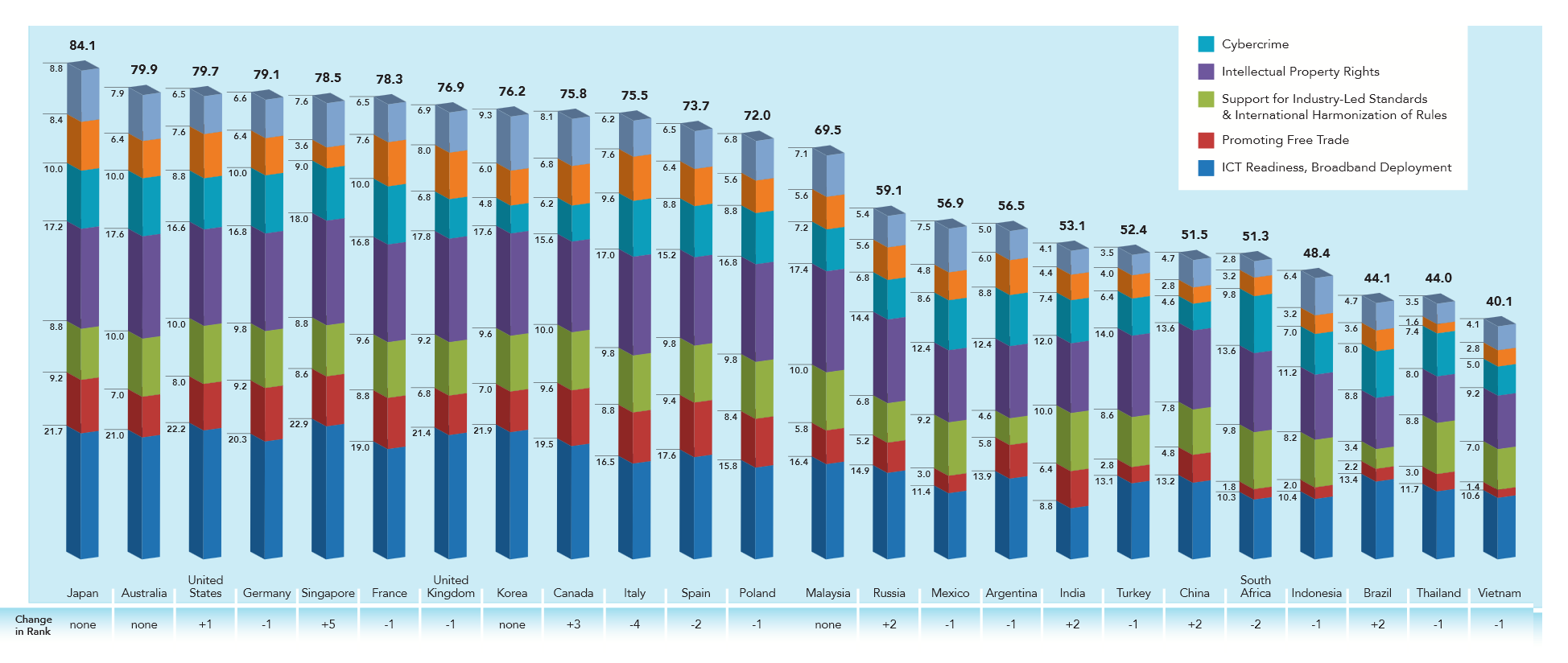
BSA Cloud rankings (click to enlarge)
Data privacy
The research notes that, while there are no there laws or regulations governing the collection, use, or other processing of personal information, a draft Protection of Personal Information Bill is being considered by the South African government. It was debated in Parliament in late 2012.
“Until it is enacted, there is no real privacy protection in place in South Africa. Privacy remains a basic right under the South African Constitution, but its application to the day-to-day use of personal information remains uncertain,” the research said.
SA ICT readiness
Addressing the subject of ICT readiness, the research notes that government aims to have a 5% broadband penetration rate (min. 256 kbps) by 2014.
“South Africa’s broadband penetration, broadband speeds, and affordability are very low. Even growth rates are low,” BSA | The Software Alliance said.
The South African Broadband Policy was released in July 2010 and recognizes national broadband issues and sets the following targets:
- By 2019, universal access to broadband [min. 256 kbps] (Universal access is defined as meaning there will be a public ICT access point within a 2km radius of any person in sparsely populated areas);
- By 2019, household broadband penetration of 15%.
The South African government has created a state-owned operator (Infraco) to participate directly in the construction of broadband networks.
“Details of specific broadband targets and funded initiatives are limited, and there is concern that the broadband expansion projects that are under way are fragmented, and a comprehensive, centrally planned strategy is required,” BSA | The Software Alliance said.
The Department of Communications had aimed to publish a new broadband policy before March 2013, it said.

















 Loading ...