

Bad news for anyone on medical aid in South Africa


The Council for Medical Schemes has published its recommendations for medical aid contribution increases in 2026, urging medical aids to limit price hikes to inflation.
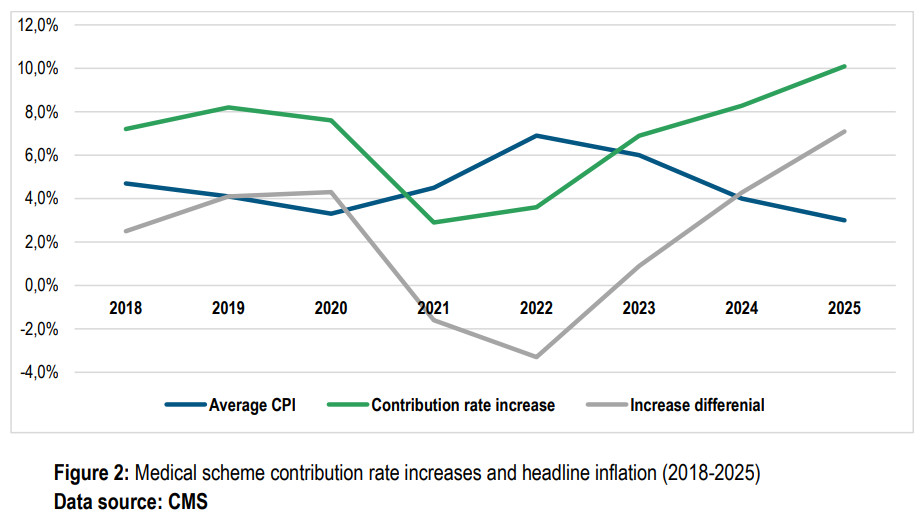
However, historical data shows that this is unlikely to happen, with medical aids overshooting inflation by a massive 7.1 percentage points in 2025 alone.
Broadly, the CMS recommends that medical schemes limit their 2026 price hikes to 3.3% plus “reasonable utilisation estimates”.
In previous years, the council said its historical data points to “reasonable utilisation estimates”, adding around 3.5 percentage points to the hikes.
In its latest circular, the council noted that private medical inflation usually exceeds CPI by 2 to 3 percentage points.
Thus, the “reasonable” increase for 2026 could be anywhere between 5.4% and 6.8%.
The CMS has urged medical aids to keep as close to inflation as possible, noting that contribution increases outpaced inflation by 7.1 percentage points in 2025.
Medical aid contribution increases in 2025 averaged 10.1%, against inflation of 3%. This was up from an already high 10.3% average increase in 2024.
When the CMS made its recommendations in 2024, inflation was expected to be around 4.4% in 2025, giving a recommended range of 6.4% and 7.9%.
The average increase overshot this recommendation by as much as 3.7 percentage points, and none of the major medical aids stuck to the CMS’ guidelines.
Discovery, the country’s largest medical aid scheme, increased by a weighted average of 9.3% for 2025. And this was one of the lower averages among the big medical aids.
MediHelp increased rates by an average of 10.8%, Bonitas hiked rates by 10.2%, and Momentum raised its contributions by 9.4% on average.
September marks medical aid increase month, with all the major schemes expected to announce their 2026 price hikes in the coming weeks.
The CMS said that any medical schemes that may require contribution increases higher than its recommended CPI-linked increments must provide the registrar with a comprehensive business plan with clear financial and actuarial justification.
Medical aid price increases vs inflation
Medical aid ‘age squeeze’ warning
The CMS decried the fact that annual medical scheme contribution rates have consistently increased at a higher rate than consumer inflation, saying this places a significant financial burden on members.
“Coupled with steep increases in the price of electricity and high food inflation, it is evident that most household budgets are significantly constrained,” it said.
The council said that its data points to the unsustainable upward trajectory in medical aid pricing being driven by the schemes’ reliance on high-cost specialist visits and hospital-based care.
It said that medical schemes urgently need to put greater emphasis on primary healthcare to deal with health problems before they escalate, and to improve referral pathways to help contain costs.
Further, although it acknowledged that private medical inflation generally exceeds CPI by 2 to 3 percentage points, it said the annual industry price increase assumptions should be linked to inflation.
“With cash-strapped consumers grappling with the current cost-of-living crisis, raising contributions above CPI is simply unaffordable for most households,” it said.
“The high medical scheme contribution rates also serve as a barrier to entry, particularly for young people, posing a serious threat to the long-term sustainability of the industry.”
The CMS warned that if medical aids continue raising prices above inflation and overshooting its recommendations, they will increase the financial strain on members and risk having them drop their insurance.
Because the cost of care is spent overwhelmingly on older members of medical schemes, losing younger, healthier members due to high costs places the entire system at risk of collapse.
Discovery warned earlier this year that young South Africans are already increasingly putting off medical aid due to cost pressures, creating an ‘age squeeze’.
At the same time, it flagged a doubling of members suffering from chronic disease, requiring higher levels of care.
The group said this was creating a disproportionate burden on members and driving up the cost of care above inflation.


















 Loading ...