

End of the line for 126 more businesses in South Africa


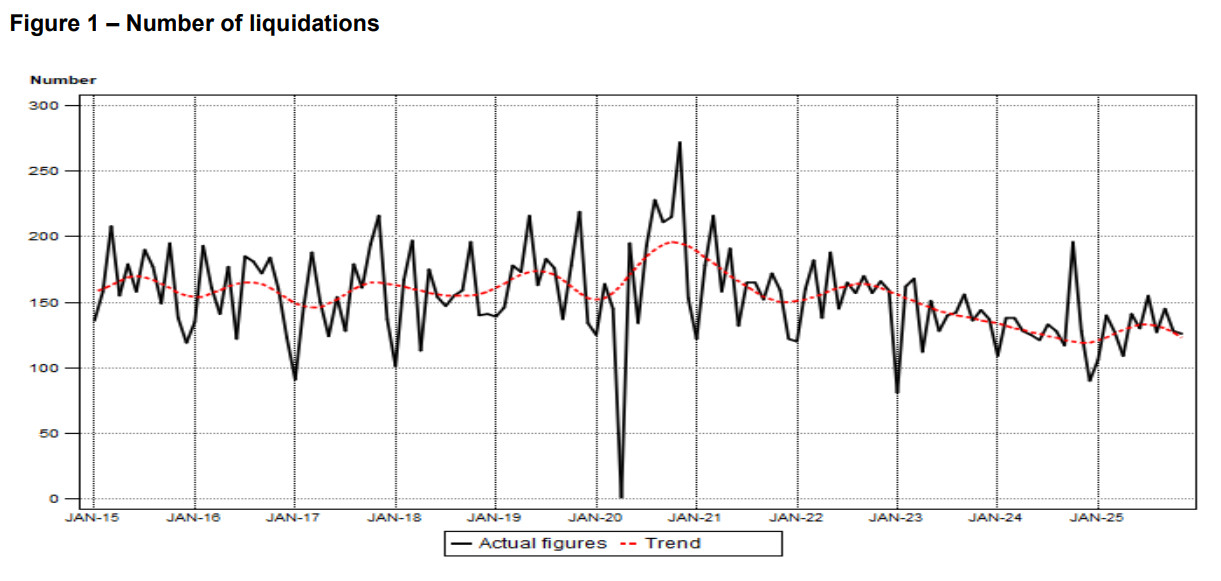
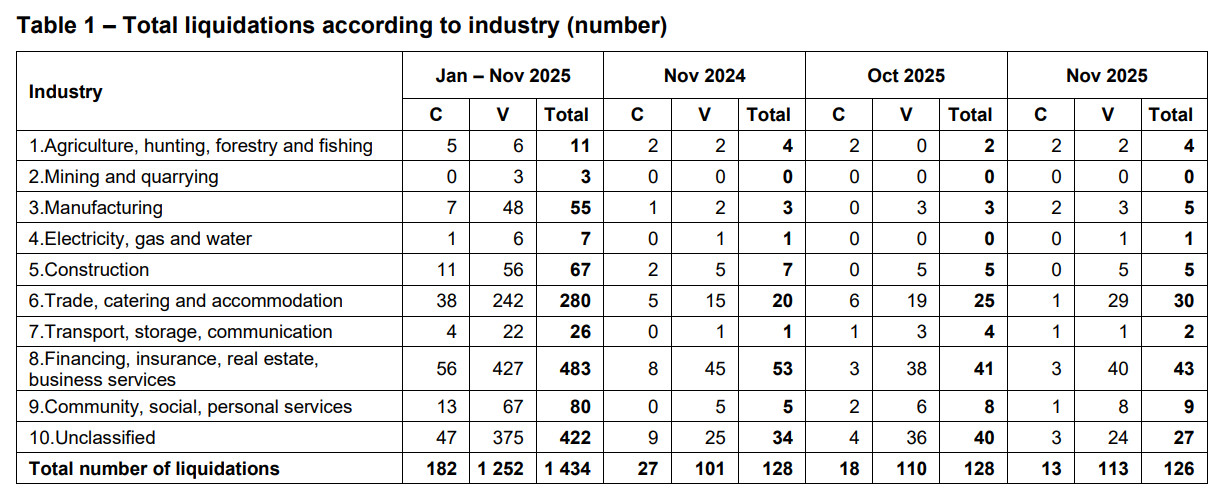
The latest data from Stats SA on liquidations in South Africa shows that another 126 businesses were liquidated in November, taking the total to 1,434 for the year so far.
The number of liquidations in November was down two cases from October, and down 1.6% from November 2024 (also 128 cases).
Between January and November 2025, South Africa recorded 1,434 liquidations, down 1.8% from the same period last year.
The rolling three-month tracking of the data also shows a drop, with liquidations between September and November 2025 running 9.5% lower than the same period in 2024.
Notably, 2025 is now firmly on track to continue the trend of declining liquidation numbers, which began with a peak in closures during the COVID-19 pandemic and subsequent lockdowns.
This will depend on liquidations in December, which, historically, have been lower than in other months.
There were 1,551 liquidations in 2024; therefore, December 2025 would need to register fewer than 117 liquidations to maintain the trend.
However, while fewer liquidations seem like good news, this isn’t necessarily the case.
Business experts have warned that liquidation data is not only limited but also needs to be considered within the broader context of the economy.
Fewer liquidations could indicate an improved business environment, or it could suggest that there are fewer businesses to liquidate.
In the South African context, despite recent months indicating a shift in sentiment, economic growth remains anaemic, with most projections pointing to a modest 1% growth in GDP this year.
This does not allude to a growing and prosperous environment for businesses.
Another factor to consider is unemployment, where the latest data shows a rate of 31.9%—almost a third of South Africa’s workforce doesn’t have a job.
According to the trade credit insurance group, Coface, despite recent developments, businesses in South Africa have been battered by a “toxic mix” of factors affecting trading conditions.
This includes years of high interest rates, weak consumer demand, and rising operational costs.
“Logistical bottlenecks and escalating transport costs further squeeze margins, while global trade tensions and regulatory burdens compound the crisis,” the group said.
Changes incoming
The liquidation data in and of itself doesn’t tell the whole picture.
There are considerations such as voluntary versus compulsory liquidations, liquidations as part of operations, and other processes, like business rescue, at play.
Compulsory liquidations are a key factor, often pointing to insolvency and an economic downturn.
Most liquidations recorded by Stats SA are voluntary (85+%). However, year-to-date, there have been 182 compulsory liquidations, which is 3.4% higher than the same time in 2024.
Notably, there were 183 compulsory liquidations total in 2024—one fewer than the running total for 2025, which is likely to exceed it easily once December’s data is compiled.
According to Stats SA, it is currently working on a revised version of the liquidation stats, following discussions with the Companies and Intellectual Property Commission (CIPC).
South Africa’s liquidation statistics have undergone significant changes in the past. Previously, the data tracked both liquidations and insolvencies; however, the latter was dropped following disruptions during the COVID-19 pandemic.
Now, the data only covers liquidations, which gives a limited picture of the South African business landscape.
Stats SA collects administrative information on liquidations from CIPC and the Department of Trade, Industry and Competition (DTIC).
The data is sourced from the Master’s Office, which has suffered delays and its own processing hiccups in the past.
However, since 2011, companies have been able to enter into business rescue proceedings, complicating the data.
While business rescue can still result in a company being wound up, this information may not necessarily be reflected in the liquidation data.
Notably, data for business rescue is also provided by CIPC, which may factor into the discussions with Stats SA.


















 Loading ...