

Households in South Africa are getting hammered


The latest Cost of Living report by the Competition Commission shows water and electricity costs are running away from headline inflation, with South African households bearing the pain.
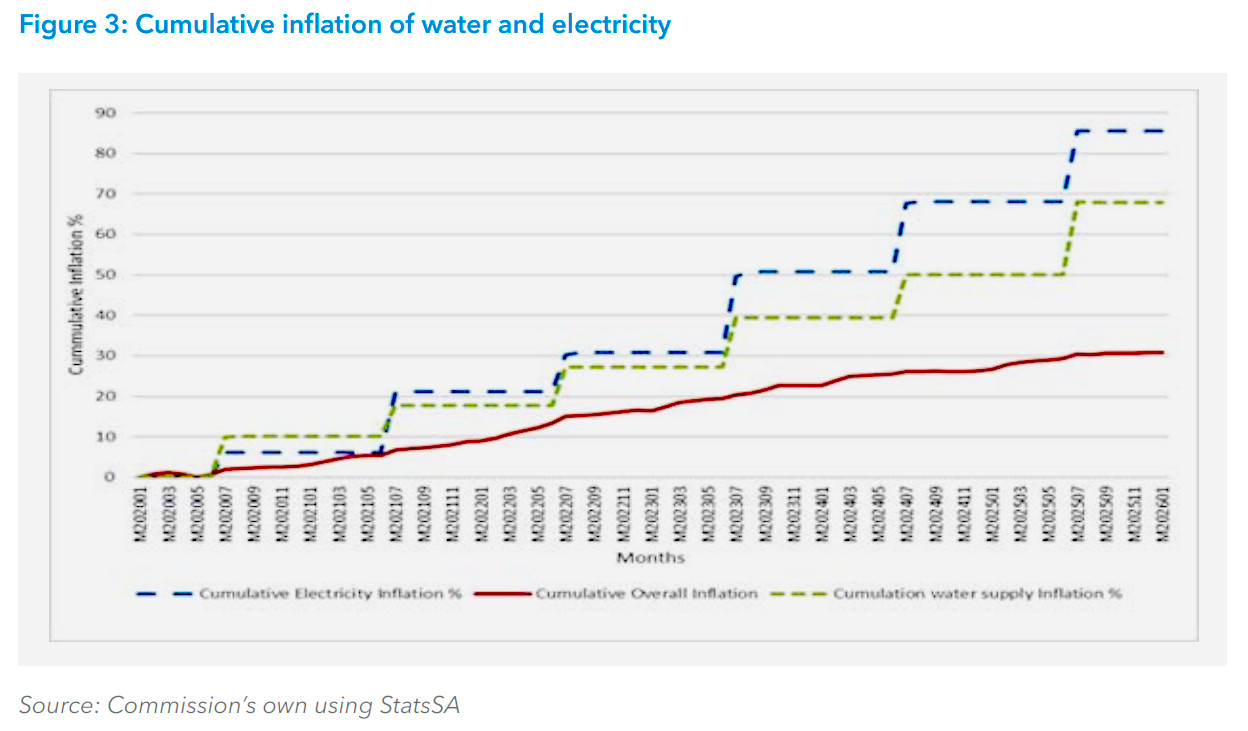
According to the group, electricity inflation in the country has surged by approximately 85% over a five-year period to January 2026.
This is in contrast to the 30% general inflation over the same period.
The 85% rise includes the July 2025 hike in municipal electricity tariffs. Before these adjustments, the cumulative price increase from 2020 to June 2025 was 68%, the commission said.
However, the increase doesn’t include Eskom’s latest increases.
The report was published on the same day that the national power utility hiked its tariffs for direct customers by 8.8%. Municipalities will see increases of around 9% in July.
The Competition Commission added that water supply inflation followed a similar and notable acceleration.
Following municipal tariff revisions in 2025, the price of water supply increased by 68% over the five-year period.
Before the July 2025 adjustment, the cumulative price increase from 2020 to June 2025 was 50%, it said.
According to the commission, these price pressures emanate from the government, with state-owned entities like Eskom and municipalities driving the higher costs.
Water and electricity are regulated and administered price points in South Africa, but the commission said this does not mean they’re affordable.
“Prices are primarily determined by providers’ operating expenses and financial requirements, with each municipality generally setting its own tariff for end users,” the group said.
Unfortunately for South African households, these expenses and financial requirements are severely tilted against them and affordable services.
For Eskom, decades of mismanagement, corruption and neglect have left it with significant cost pressures, while also facing a mountain of debt owed to it by municipalities.
The municipalities, meanwhile, have faced much of the same, with maintenance, infrastructure investment and network expansion falling by the wayside amid wider service delivery collapse.
The problem is not going away anytime soon
The Competition Commission said that a key concern is that the water and electricity price pressures are not expected to go away anytime soon.
With the 8.8% Eskom tariff hike already effected for 2026, and the 9% municipal hikes still to come, South African households will continue to face financial pressure.
The National Energy Regulator, Nersa, has also allowed Eskom to increase tariffs by another 8.8% in 2027, with tariff hikes in the utility’s next MYPD application also expected to come in higher than expected.
This stems from a blunder by Nersa while processing the latest MYPD that resulted in an undercalculation of Eskom’s costs by R54.7 billion.
To correct for this error, Nersa allowed for the R54.7 billion to be paid by customers over time.
The first tranche of R12 billion will be paid through higher tariffs in 2026, bringing the average increase to 8.8%, effective 1 April. This was previously a 5.4% hike.
A further R23 billion will be paid in 2027, with price hikes jumping from the original 6.2% to 8.8%.
The balance of R19.7 billion will be recovered through future price applications by Eskom in the next wave of hikes.
“This means consumers are likely to continue facing significant price hikes for electricity over the next few years,” the commission said.
This also means that electricity prices will continue to veer away from CPI, with the South African Reserve Bank targeting inflation at 3%.
“This growing divergence underscores the extent to which administered prices for essential services…have outpaced general price pressures,” the commission said.
This significantly intensifies the cost burden on South African households and “reinforces the central role of utilities in shaping the cost-of-living trajectory,” it said.
“Recent policy developments further indicate that upward tariff pressures are unlikely to abate in the near term.”








 Loading ...