

Another crushing blow to South Africa


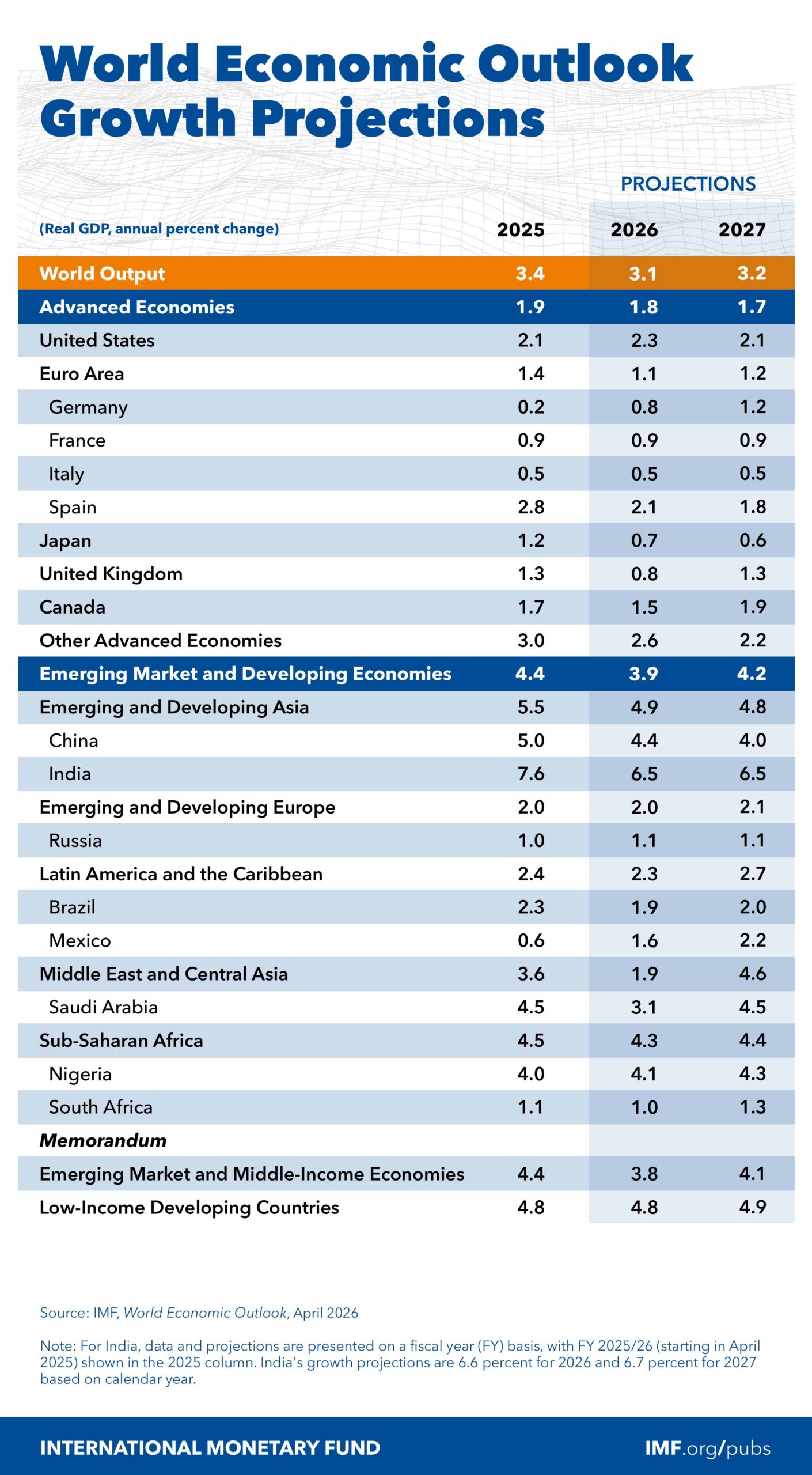
After raising South Africa’s economic forecast in its January outlook, the International Monetary Fund (IMF) is now expecting much worse for the country, thanks to the war in the Middle East.
The IMF has published its April 2026 World Economic Outlook report, which comes after global markets were shocked by the United States’ war against Iran at the end of February.
Prior to the outbreak of the conflict, the IMF had forecast South Africa’s GDP growth at 1.4% for 2026. This has now been cut to just 1.0%.
The downgrade reflects a stark turnaround after fortunes for the country swung in a more positive direction at the end of 2025 and early 2026.
In the January 2025 outlook, the IMF expected South Africa’s economy to grow by 1.5% at the start. However, this tanked to just 1.0% by July as the United States hit global markets with its tariffs.
By October 2025, after the impact of the tariffs wasn’t as severe as expected, the projection was bumped up slightly to 1.1%.
At the start of 2026, South Africa’s outlook for FY2025 was much rosier at 1.3%. Stats SA’s final measure, reported at the start of April, hit slightly below this forecast at 1.1%.
With 2025’s main economic battle over, the outlook for 2026 has now dimmed significantly.
| Outlook | 2025 Forecast | 2026 Forecast |
|---|---|---|
| January 2025 | 1.5% | 1.6% |
| April 2025 | 1.0% | 1.3% |
| July 2025 | 1.0% | 1.3% |
| October 2025 | 1.1% | 1.2% |
| January 2026 | 1.3% | 1.4% |
| April 2026 (latest) | 1.1% (actual) | 1.0% |
Notably, this is not only for South Africa, but for global growth as a whole. The IMF has also slashed expected global growth from 3.3% before the war to 3.1% as of its April review.
But even accounting for the hit to global growth, South Africa appears to come off much worse.
The projected growth for South Africa for 2026 is the lowest among emerging markets and developing economies, including Russia, which is at war.
Adding to the pain, the IMF has warned that downside risks dominate its outlook, meaning worse may yet lie ahead.
“Under an adverse scenario with larger and more persistent increases in energy prices, global growth would slow further to 2.5% in 2026, and inflation would reach 5.4%,” it said.
Under an even more severe scenario, in which there is more damage to energy infrastructure in the Middle East, the impact would be even larger.
“Global growth would be cut to only about 2% in 2026, while headline inflation would be just above 6% by 2027,” the IMF said.
The key warning for South Africa—which is already struggling to break more than a decade of stagnation—is that the impact on emerging market and developing economies would be almost twice that on advanced economies.
United States’ war takes its toll
Coming as no surprise, the main driver behind the slashed economic growth outlook is the war in the Middle East.
Without the war, global growth would have been revised upward, the IMF said.
At the end of February 2026, the United States and Israel launched attacks against Iran, killing the nation’s Supreme Leader and sparking retaliatory strikes across the region.
Under the banner of “Operation Epic Fury”, the US kept pressure on Iran with bombardments, eventually leading to the Middle Eastern nation shutting down the Strait of Hormuz.
About a fifth of the world’s oil supply is shipped through the strait—mostly to Asian countries—and the shutdown led to a sharp spike in global oil prices, putting pressure on markets worldwide.
Oil prices, which were trading under $60 a barrel at the start of the year, quickly surged to over $110 a barrel.
South African motorists felt the impact directly in April, as fuel prices saw record increases of R3 and R7 per litre for petrol and diesel, respectively—even after government intervention.
There was some hope that the war would be resolved after the United States and Iran agreed to a ceasefire last week.
However, subsequent negotiations over the weekend broke down, putting markets on edge once again.
According to the IMF, the war in the Middle East is a massive brick on the back of the global economy, following the Trump administration’s 2025 tariff war.
“Headwinds from higher trade barriers and elevated uncertainty have been offset by tailwinds from technology-related investment, accommodative financial conditions, and fiscal and monetary policy support,” it said.
“The Middle East conflict presents a significant counterforce to these tailwinds through its impact on commodity markets, inflation expectations, and financial conditions.”
However, the global financier said that, in addition to the direct impact of the war, the knock-on risks are to the downside and dominate forecasts.
“Geopolitical tensions could worsen even more than they already have—turning the situation into the largest energy crisis in modern times,” it said.
This could lead to a domino effect, where the economic shock could lead to domestic political strains erupting, bleeding into other international policies and trade disputes.
Government budgets could come under pressure, leading to fiscal buffers being eroded, pressure on long-term interest rates and, in turn, on broader financial conditions.
A key risk flagged by the financier is the erosion of institutions, including central bank independence and monetary policy credibility.















 Loading ...