

Tax-maxxing: 5 ways to make the most of tax-efficient investing



If you don’t have a Tax-Free Investment Account yet, you’re losing out on the benefits of untaxed compounding gains. Few South Africans maximise their tax-free investment opportunity, introduced by the government in 2015 to incentivise household savings.
One of the highlights from this year’s Budget Speech was the announcement that the National Treasury increased the annual limit on tax-free investment contributions from R36 000 to R46 000.
That’s a whole R10 000 extra to invest without paying tax on interest, dividends or capital gains. Here’s how investors can maximise growth on their Tax-Free Investment Accounts.
What are Tax-Free Investment Accounts?
A Tax-Free Investment Account (TFIA) is one of the most tax-efficient ways for South Africans to save and invest for the future.
Tax-Free Investments are approved account types and investment vehicles offered by authorised financial service providers and recognised by SARS. Amounts earned in these accounts are free from income tax, dividends tax, and capital gains tax.
Why Shyft?
Shyft has just introduced Tax-Free Investment Accounts, making it stand out as one of South Africa’s most comprehensive financial platforms.
Shyft has seamlessly integrated TFIAs, onshore and offshore multi-asset investing, foreign currency, and global payments into a single mobile or desktop experience, backed by instant funding from any South African bank card.
If you already have a TFIA elsewhere, you can transfer it to Shyft – the global money app from Standard Bank – and manage all your investments in one place, no matter where you bank.
1. The best time to start contributing is now
Even if the lifetime contribution limit of R500 000 is reached sooner, starting early gives the investment more time to benefit from compounding growth over the long term – no matter how long the investment grows, it will remain untaxed.
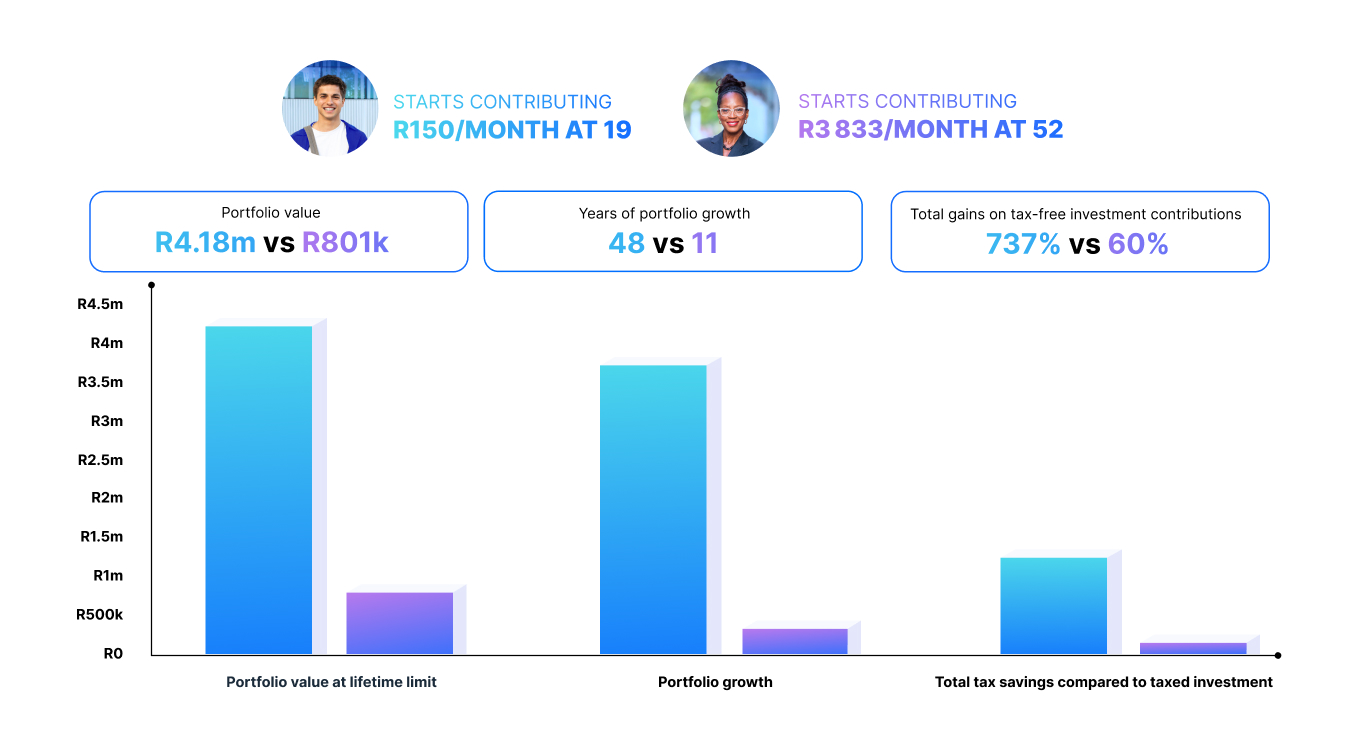
Look at this case study of two hypothetical South Africans contributing different annual amounts to their TFIAs over different time periods.
One investor starts by contributing as little as R150/month – taking 47 years to reach his lifetime tax-free investing limit of R500 000.
Increasing his contributions when his income allows, from R150 to R250 to R1000/month, could result in a potential tax-free portfolio value of R4.18 million – a 737% gain!
The other investor starts later in life and maxes out her annual contributions, reaching her tax-free investing limit in 11 years. Her R500 000 investment could grow to a potential R801 000, with 60% gains.
They both invest the same total amount in the same ETF, but contributed over different timelines.
2. Investing your tax-free contribution in qualifying Exchange Traded Funds (ETFs) means your money can grow in more ways
Tax-Free Investment Accounts can hold cash, earning tax-free interest. But
Exchange-Traded Funds listed on the Johannesburg Stock Exchange grow in more ways, through dividends and profits when share prices rise. In a Tax-Free Investment Account, dividend payouts and profits from share price increases are not taxed.
The risk is that share prices can sometimes lose value while cash deposits earning tax-free interest can’t, but are likely to grow at a lower (but stable) rate. The good thing is that you can hold both in your TFIA. You should maximise tax savings in a balanced, diversified investment portfolio.
3. Reinvest the dividend payouts to maximise your TFIA growth
Any reinvestment of dividends in any portfolio amplifies growth over the long term and even more so where dividends are untaxed within the portfolio.
4. There is a “cost” to withdrawing from a TFIA
There is generally no “cost” in the sense of a tax charge or penalty for withdrawing from a TFIA. But there is an important opportunity cost.
The withdrawn amount cannot simply be replaced later, and the investor permanently loses the opportunity for that amount to continue generating tax-free returns within the TFIA. Any amount withdrawn reduces the value that can continue growing tax-free.
5. For retirement: keep your RA, just add a TFIA
Retirement funds and TFIAs enjoy different tax benefits. Contributions to a Retirement Fund are only tax-deductible within certain limits, and the returns are taxable within certain limits.
While contributions to a TFIA are not tax-deductible, the returns are not taxed. Ideally, you should aim to take advantage of both tax incentives to achieve a balanced retirement portfolio.
Tax-maxxing facts
- The annual limit for Tax-Free Investment contributions is R46 000.
- The lifetime limit for Tax-Free Investment contributions is R500 000.
- Exceeding the limits is penalised in the form of normal tax payable of 40% on the excess amount above the annual and the lifetime limits.
DISCLAIMER: This content is not intended to be and does not constitute advice of any nature. Please consult a registered financial advisor before making investment decisions.

















 Loading ...