

South Africans set to pay the highest petrol price in history


South African motorists are set to pay the highest petrol price in the country’s history from Wednesday, 3 June 2026.
This is despite a recovery in fuel price fundamentals that would ordinarily have resulted in lower prices at the pumps.
The Department of Mineral and Petroleum Resources has published the official fuel price adjustments for June. It confirmed that inland 95 unleaded petrol will increase by R1.43 per litre to a record R28.06 per litre.
The new price surpasses the previous record of R26.74 per litre reached in July 2022, when global oil markets were shaken by Russia’s invasion of Ukraine.
The latest increase comes after two months of extreme volatility in global oil markets. South Africa’s fuel prices have surged this year due to escalating geopolitical tensions in the Middle East, particularly the conflict involving the United States and Iran.
According to the Department of Mineral and Petroleum Resources, the worsening crisis and the effective closure of the Strait of Hormuz disrupted around 20% of global oil supplies.
As a result, Brent crude oil climbed from $93.67 per barrel to a peak of $138 per barrel in April, keeping international fuel product prices elevated throughout May.
Although oil prices stabilised above $100 per barrel for most of May and eventually eased below that level towards the month-end amid hopes of a US-Iran truce, the decline came too late to significantly improve South Africa’s fuel price recoveries.
Additionally, the rand remained relatively resilient, trading between R16.30 and R16.65 to the US dollar, helping to limit some of the pressure from higher oil prices.
Under normal circumstances, the improved recoveries and stable currency would have translated into lower fuel prices.
However, the National Treasury’s decision to partially reverse fuel levy relief introduced earlier this year ultimately pushed petrol prices higher.
To shield motorists from soaring fuel costs in April and May, Finance Minister Enoch Godongwana cut the General Fuel Levy by R3.00 per litre for petrol and R3.93 per litre for diesel.
From June, Treasury is reinstating half of that relief, adding R1.50 per litre back to petrol prices. In addition, the Slate Levy was increased to R1.58 per litre to help recover a R14.2 billion industry deficit.
The combined effect of these tax and levy adjustments outweighed the benefits of lower international fuel prices, resulting in the record petrol price.
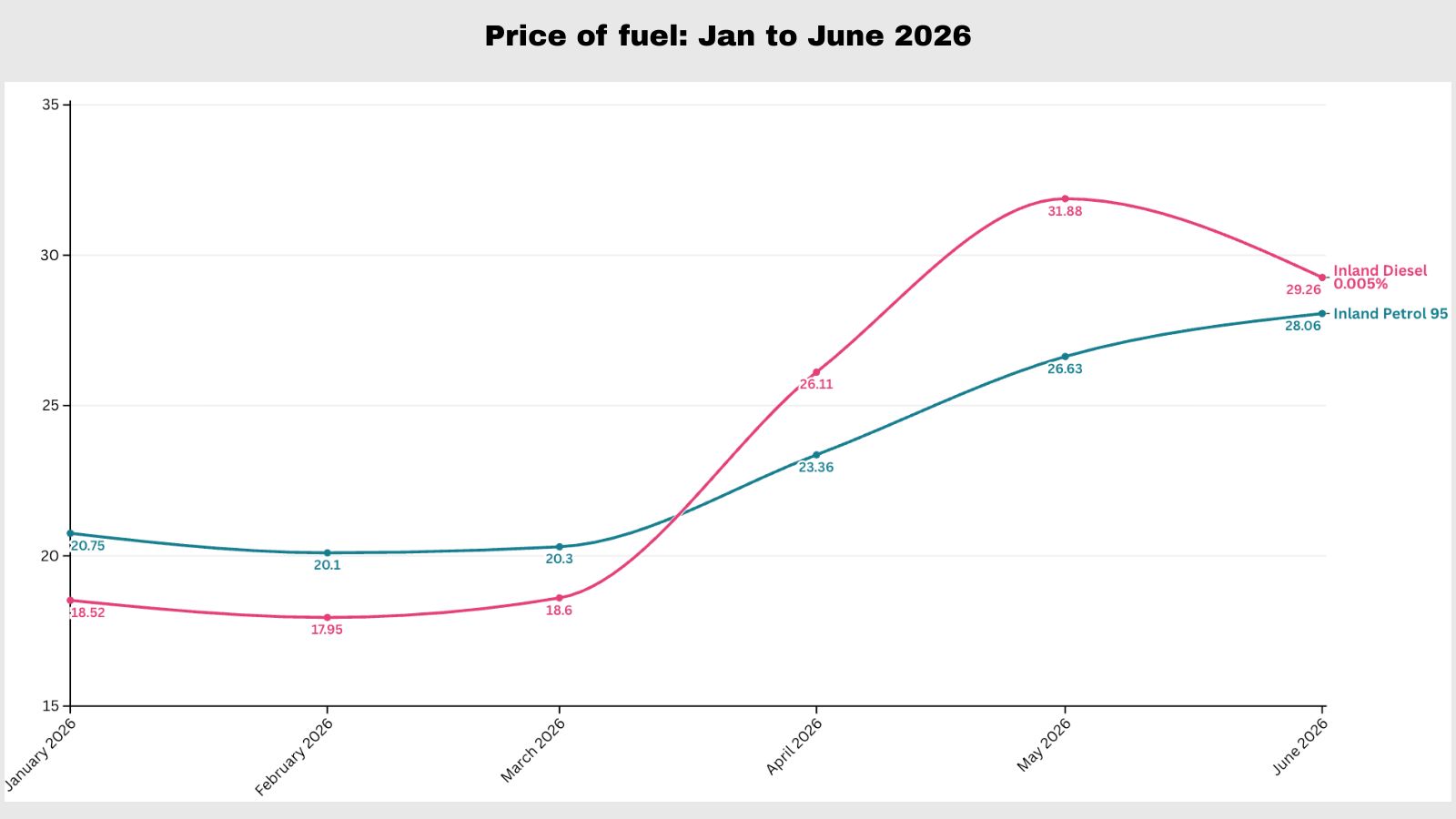
2026 has been a year of pain so far
Diesel users, however, will receive some relief. Despite R1.96 per litre being added back through the fuel levy adjustment, diesel prices will still decline by between R2.62 and R3.25 per litre. Inland diesel 0.005% wholesale will fall to R29.26 per litre.
The reduction follows record diesel prices in May, when inland diesel 0.005% wholesale reached as high as R31.88 per litre.
Even with the June decrease, fuel prices remain substantially higher than at the start of the year.
Petrol has increased by R7.31 per litre between January and June, while diesel, which had risen by as much as R13.36 per litre during the year, will still be R10.74 per litre higher than January levels after the latest adjustment.
While many motorists may assume higher fuel prices benefit filling station operators, this is not the case.
“The South African Petroleum Retailers Association (SAPRA) welcomes the latest fuel price adjustments, particularly the decline in diesel prices, which should bring some relief to parts of the economy,” SAPRA said.
“However, SAPRA notes with concern that the increase in petrol prices will add further pressure on consumers already facing strained household budgets.”
SAPRA added that lower diesel, illuminating paraffin, and LPG prices could ease costs for transport-dependent sectors, farmers, small businesses and households.
However, SAPRA National Chair Henry van der Merwe stressed that retailers do not benefit directly from higher pump prices.
“Petroleum retail margins in South Africa are regulated and fixed, meaning retailers do not benefit directly from price increases, even as operating and financing costs remain elevated,” he said.
“Any easing in fuel-related costs is important for consumers, businesses and the wider economy. The decline in diesel, paraffin and LPG will be welcomed by many South Africans, even as petrol remains under pressure,” van der Merwe said.
“For retailers, however, the underlying operating environment is still challenging, which is why longer-term sustainability in the sector remains important.”















 Loading ...