

South Africa bracing for bad news next week


Economists expect South Africa to record a quarterly decline in gross domestic product next week, with fixed investment set to recede for a second consecutive quarter.
Stats SA will publish South Africa’s GDP numbers for the second quarter of the year next Tuesday (8 September), with the outlook tilted to the downside.
According to economists at Nedbank, South Africa’s real GDP growth likely weakened from 0.5% qoq in Q1 2026 to a contraction of around 0.2% qoq in Q2.
The banking group noted that high-frequency indicators point to weakness in mining, manufacturing, electricity, gas, and water, as well as domestic trade.
While agriculture and parts of the services sector likely remained supportive of growth, these gains would probably be insufficient to offset broader weakness elsewhere in the economy, it said.
These weaknesses would be particularly pronounced in sectors like construction, which are dependent on fixed investment to spur growth.
The construction industry’s contribution to South Africa’s economy almost halved to 2.3% of value added in 2025 from 4.2% in 2008, according to Statistics South Africa.
Investment has remained a key weakness in the government’s efforts to boost South Africa’s economic growth, with the country failing to achieve an annual average GDP growth of 1% over the past decade.
With investment forecast to decline by 0.7% next quarter, these pressures will likely persist.
The group expects investment to have receded by 0.7% in Q2. If the forecast is correct, fixed investment would be recording its second consecutive quarter of decline.
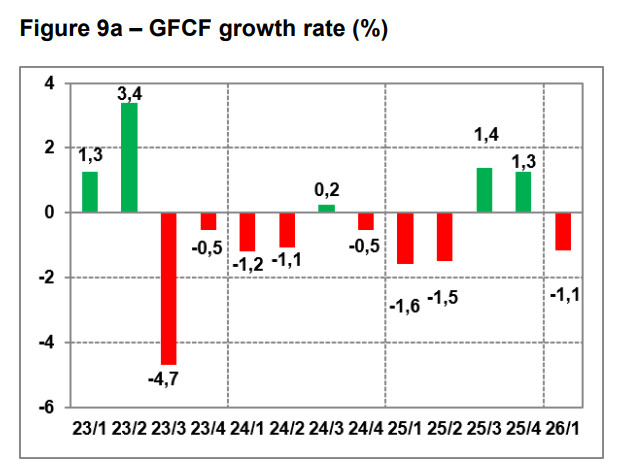
Fixed investment, or gross fixed capital formation (GFCF), declined by 1.1% in the first quarter of the year.
GFCF is a measure of the net addition of fixed assets, such as buildings, machinery, and infrastructure, in an economy and indicates investment trends.
Nedbank said that private-sector investment disappointed in Q1 and will likely disappoint again in Q2.
However, easing structural constraints, reduced risk premiums and continued investment in renewable energy should help lift outlays modestly above 2025’s even lower levels.
“Public sector investment has also started to recover from a low base and is likely to provide additional support,” it said.
“While these developments are unlikely to trigger a sharp turnaround in the sector, they should help support construction activity and moderate the pace of contraction.”
The banking group said that risks to the fixed investment outlook are still tilted to the downside.
Heightened geopolitical tensions, higher oil prices and weaker global growth could prompt businesses to delay or scale back investment plans, it said.
“Domestic constraints, including criminality and disruptions within the construction sector, present additional headwinds,” it added.
Ramaphosa’s promises
President Cyril Ramaphosa has promised to unleash investment opportunities in South Africa, setting an ambitious economic growth target of 3%.
But to accomplish this, gross fixed capital formation needs to reach about 30% of GDP by 2030—a far stretch from the approximately 14% it currently covers.
The government is looking to improve the credibility of the infrastructure pipeline by focusing on project preparation and financing rather than simply identifying potential projects.
The state’s latest construction book, which lists the project pipeline, includes more than 170 projects.
Of those, 55 with an estimated value of more than R407 billion are under construction, while 32 worth about R48 billion have been completed.
Ramaphosa has long promised to turn South Africa into a construction site, having allocated R1.07 trillion toward the buildout over the next three fiscal years in the 2026 budget.
However, Nedbank’s capital expenditure project listing for the first half of 2026 showed that the country has seen the value of announced investment projects plummet by 81%—or R580 billion—from 2025.
This is the lowest amount since 2017.
With the GDP figures coming next week, the bank expects South Africa to only marginally improve its 2025 GDP growth in 2026.
The economists expect a full-year GDP reading of 1.2%, up 0.1 pp from 1.1% in 2025, with GDP averaging only 1.7% over the next three years.
“We expect a moderate recovery over the next three years…however, US trade policy and the war in Iran pose significant downside risks,” the bank said.
“South Africa’s ability to cope with these headwinds depends on faster progress with reforms in the energy, logistics and water sectors.”











 Loading ...