

South Africa’s winning streak is over


South Africa’s economy is expected to break its longest quarterly growth run in almost a decade as the war in Iran crimps domestic demand and key sectors accounting for almost a fifth of gross domestic product contract.
GDP likely shrank 0.1% in the second quarter, compared with an expansion of 0.5% in the prior three-month period, according to the median estimate of 14 economists in a Bloomberg survey.
Unlike the first quarter, which reflected only the initial impact of the Iran war that began Feb. 28, the second fully captures the fallout from the conflict.
Fighting raged throughout the period, pushing up Brent crude and agricultural-input prices as traffic through the Strait of Hormuz—a key waterway for about a fifth of the world’s seaborne oil and liquefied natural gas supplies—was restricted.
A 25-basis-point interest-rate increase in May also began to filter through the economy, weighing on domestic demand.
Higher input costs from the war contributed to manufacturing and mining output contracting 1.5% and 2.7%, respectively.
“For the most part, we’ve had very weak high-frequency data throughout the quarter; sentiment has been quite subdued,” said Keabetswe Mojapelo, head of economic research at Old Mutual Ltd.
While consumer-facing sectors have been resilient, “it’s really touch and go,” he said. “We’re going to get the true impact of rising inflation and the little tightening we had in monetary policy.”
Inflation has been above the central bank’s 3% target since March.
The GDP outcome will probably influence the central bank’s monetary policy committee’s interest-rate decision on 23 September.
It remains to be seen how the MPC will weigh “the trade-off between weak growth and a strong rand versus above-target near-term inflation and a high oil price,” Morgan Stanley economist Andrea Masia said in a note.
“Fading inflation-shock momentum suggests oil prices are no longer propagating widely, so at this point we remain of the view that the MPC will remain on hold later this month.”
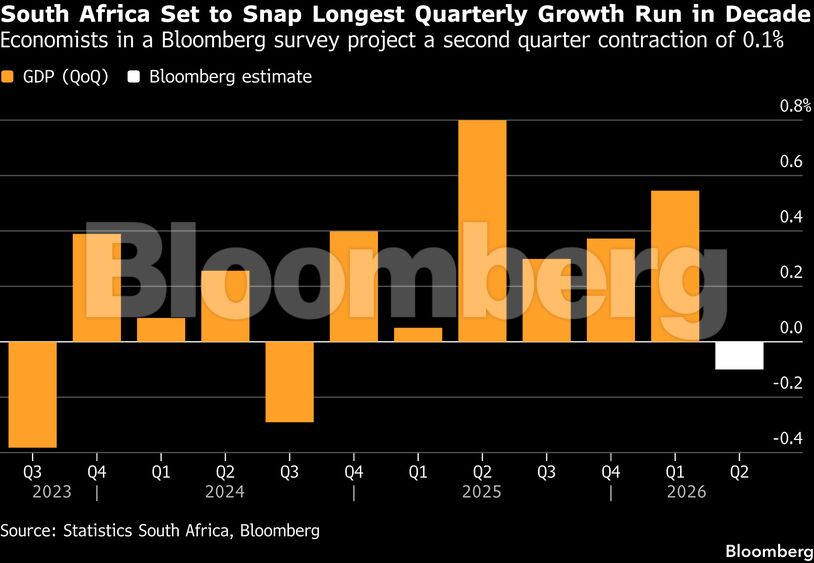
A minority of economists in the Bloomberg survey expect growth, albeit at a slower pace.
John Loos, an independent economist, predicts the pressure on the economy from the Iran war will be more pronounced in the second half of the year as higher inflation and interest rates slow spending.
“The slowdown in real consumer spending from last year will be a key contributing factor,” he said.
“I don’t think a contraction yet, but still positive,” Loos said.
“This year, you’ve got higher inflation, and it looks like we’re going to have higher inflation for the year as a whole. We’ve got interest rates rising slightly again.”
Loos added that export-driven sectors will also probably see slower growth as a result of the war, as it impacts productivity and feeds through into household incomes.
Retail and wholesale trade sales in the second quarter also came under pressure. Retail sales rose a meager 0.4%, and wholesale trade slumped 4.2%.
The uncertainty triggered by the war is also likely to keep gross-capital-formation levels suppressed, Mojapelo cautioned.
“Sentiment indicators have not been on an upbeat trajectory; a lot of the sentiment surveys all point to uncertainty with the war,” he said.
“It might be investment is still sluggish, but not structural per se, but because of the uncertainty that we have, and also the interest rate trajectory as well from a funding perspective; that is likely to persist.”














 Loading ...