

End of an era for Audi in South Africa, and petrol price joy for November


The rand remained relatively stable after the government announced two months of fuel price relief on Wednesday, and after it said it would reduce the frequency of weekly fixed-rate bond auctions and introduce a bond buyback programme.
The benchmark 2035 government bond saw a significant increase, with its yield dropping by 14.5 basis points to 8.59%. The rand held steady at 16.3775 per dollar.
The National Treasury stated that it would decrease the amount of fixed-rate bonds sold each week and implement a bond buyback program as part of its efforts to demonstrate fiscal discipline and reduce debt levels.
“The reduced supply, along with the new buyback programme, likely explains the positive reaction in the bond market,” noted Lisette IJssel de Schepper, chief economist at the Bureau for Economic Research.
According to the Stats SA, South Africa’s inflation and retail sales rose year-on-year by 4.5% and 3.3%, respectively.
Johann Els of PSG Financial Services stated that the central bank’s rate hikes in May and September should suffice for now, although the sharp rise in fuel prices in October poses a risk of broader inflationary spillovers. [Reuters]
On Thursday, 22 October 2026, the rand was trading at R16.40 to the dollar, R21.97 to the pound, and R18.44 to the euro. Gold is trading at $4,091.05, while oil prices were at $110.90 a barrel.
5 important things happening in South Africa today

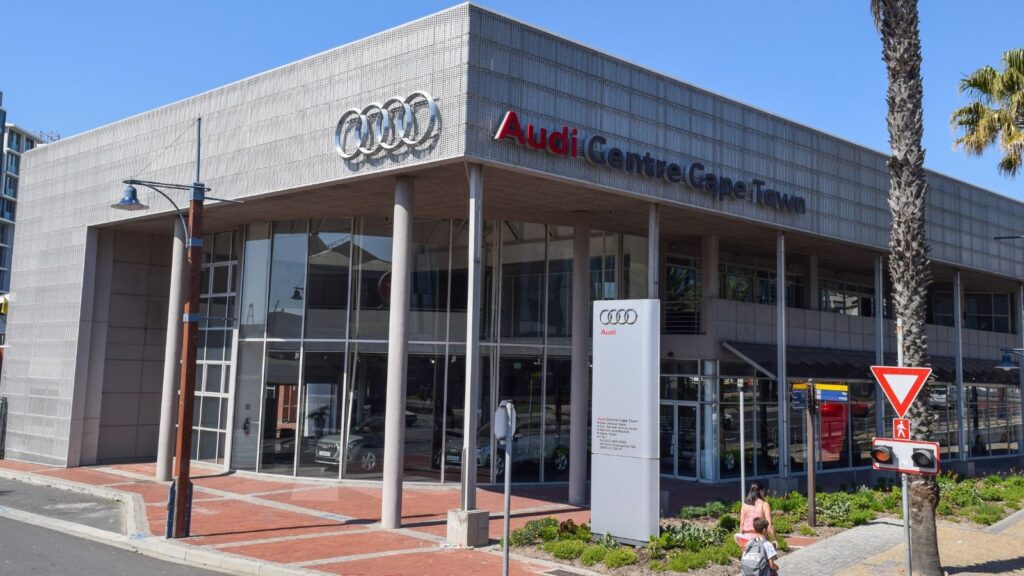
End of an era for Audi in South Africa: Audi will discontinue the A1 and Q2 in South Africa after over a decade. This is part of a trend where 28 models have been withdrawn from local showrooms in recent years, reflecting Audi’s 76% sales decline amid rising competition. [Daily Investor]
Petrol price joy for November: Finance Minister Enoch Godongwana has announced another round of fuel price relief, through cutting fuel levies from 4 November. The minister announced that the fuel levy will be temporarily reduced by R3 per litre for diesel and R1.50 per litre for petrol from 4 November 2026 until 1 December 2026. [BusinessTech]
French warning for South Africa: French protests over the past weeks, which involved widespread looting and destruction, highlight potential scenarios for South Africa if frustrations escalate. Hundreds of shops were targeted, and government buildings were burned. The Arab Spring demonstrated how protests can rapidly spread under the right conditions. Similarly, the riots in KwaZulu-Natal in July 2021 showed how political and economic tensions can lead to significant social unrest. [Business Day]
New era for 39-year-old iconic South African tech company: Mustek, a JSE-listed technology group with a market cap of R830 million, has transitioned to a technology investment holding company, ending its 39-year run as a traditional IT distributor. [MyBroadband]
Eskom’s employee costs to produce a kWh of electricity increased by 1,422%: Eskom’s employee cost per kilowatt-hour (kWh) of electricity produced rose from 1.79 cents in 1994 to 27.25 cents in 2026, a 1,422% increase. Employee cost per kilowatt-hour, typically expressed as cents per kWh, is a key operational efficiency and cost-effectiveness metric for power utilities. [Newsday]


















 Loading ...