

South Africa’s economy is much bigger than you thought


Stats SA has published its revised benchmarks for the country’s gross domestic product, and rebased the data to 2022, showing that the economy is over 5% larger than previously stated.
Rebasing and revising benchmarks for the economy is an international practice that aligns the metrics used to measure an economy’s scale with new developments across markets.
South Africa’s previous base year was 2015. While it is recommended that benchmark revisions and rebasing happen every 5 years, Stats SA delayed the process due to Covid-19.
With the economy normalising following the Covid-19 pandemic, the process has now been implemented.
The 2026 benchmarking and rebasing exercise changed the base year from 2015 to 2022, updated the source data, and transitioned to the 2018 classification of individual consumption by purpose.
The process also improved the methodology for the non-observed economy and owner-occupied rent.
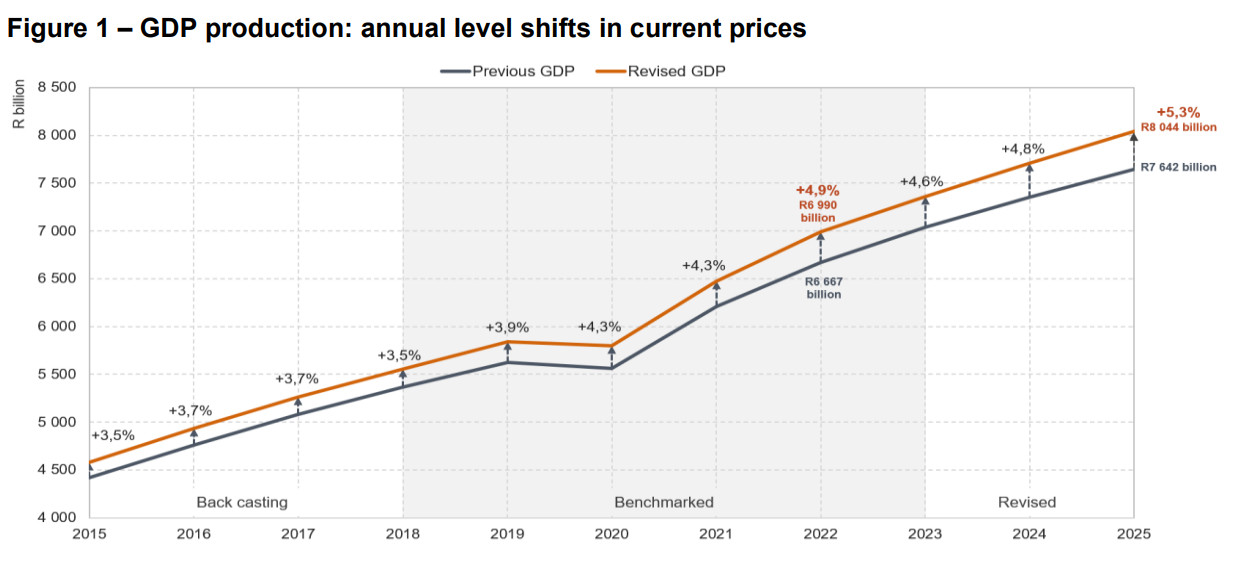
As a result of the changes, the size of South Africa’s economy in 2022 was raised to R6,990 billion, up by
around 4.9% from the previously published R6,667 billion.
The largest change occurred in the mining industry (up by 12.5%). This was due to the inclusion and better coverage of illegal mining.
The second-largest change occurred in finance, real estate, and business services (up by 9.1%). This was primarily due to improved methodology for compiling owner-occupied housing estimates in real estate activities.
In the context of 2025 (the latest full year), South Africa’s economy is 5.3% larger than previously reported, now captured at R8,044 billion, versus R7,642 billion before.
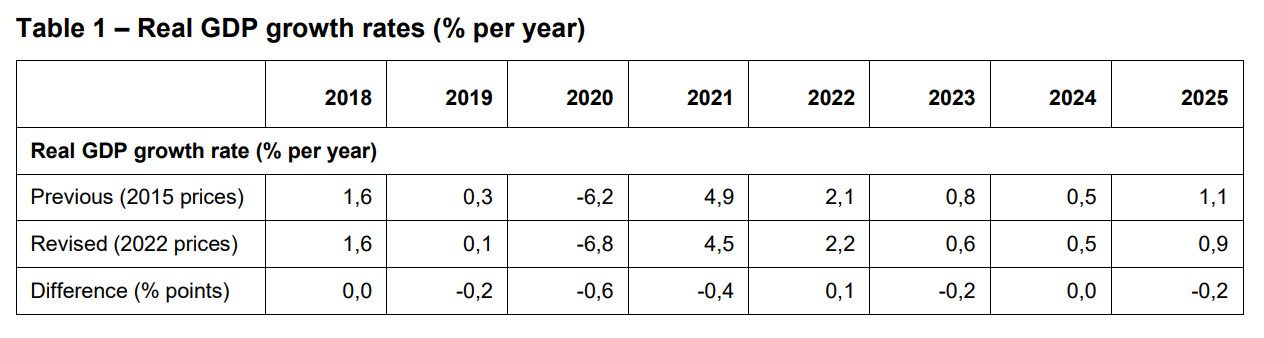
Notably, the revisions and rebasing also impact South Africa’s GDP growth over the years.
With the new basis, the 2.1% growth recorded in 2022 was actually marginally higher at 2.2%. The 0.8% growth in 2023 was 0.2 percentage points lower, at 0.6%.
2024’s economic growth was unchanged at 0.5%, and 2025’s growth, which was celebrated for pushing past 1% at 1.1%, was actually only 0.9%.
Different but still the same
Importantly, Stats SA noted that the rebasing and benchmarking revisions don’t fundamentally change the makeup of the economy—they just give a clearer and more accurate picture of it.
“Benchmarking and rebasing refined the measurement of the economy without materially changing its
sectoral composition,” it said.
The finance, real estate and business services industry remains the largest contributor to the economy (21.8%).
Four industries strengthened their contribution to the economy, namely:
- Finance, real estate and business services (0.9 of a percentage point),
- Mining and quarrying (0.5 of a percentage point),
- Trade, catering and accommodation (0.3 of a percentage point) and
- Transport, storage and communication (0.1 of a percentage point).
Manufacturing, personal services, electricity, gas and water, and general government services came in weaker. The rest were relatively flat.
On the demand side, household final consumption expenditure saw the largest revision, and the non-observed (informal) economy has become a key contributor at 8.7%.
This economy now excludes non-profit institutions, which are now counted as a new formal industry.
North-West University Business School professor Raymond Parsons said the changes to South Africa’s GDP data show that the country’s economy is resilient, but also flags lagging reforms.
“The services sector seems to have done most of the heavy lifting to anchor economic activity, and household consumption is still revealed as a vital engine of growth,” he said.
“Fixed investment, on the other hand, remains a lagging factor.”
Parsons said the changes do not drastically rewrite the fiscal space in South Africa but will provide technical ‘breathing room’ for measures such as stabilising South Africa’s public debt.
Johann Els, Chief Economist at PSG Financial Services, said that, based on the revised GDP estimates, the gross debt ratio for the current fiscal year could fall from 78.2% to an estimated 74.5% of GDP.
The consolidated budget deficit could fall from 3.9% to an estimated 3.7% of GDP, while the primary surplus could ease from 1.7% to an estimated 1.6%.
“These are improvements in the ratios, not in the actual rand amounts of government borrowing or spending,” Els noted.
Importantly, despite the broader positive outlook, the data “still reveals vulnerabilities at various levels,” Parsons said.
“The headwinds and tailwinds that need to be navigated by SA remain the same,” he said.
“The revised GDP picture emphasises why accelerating the pace and implementation of key structural reforms are nonetheless still needed to unlock SA’s true economic potential, if South Africa is to break out of its current narrow 1%-2% growth corridor.”

















 Loading ...