

Harsh reality check for South Africa



The Parliamentary Budget Office (PBO) says that the picture of “resilience” painted by Finance Minister Enoch Godongwana in his Medium-Term Budget Policy Statement (MTBPS) isn’t real.
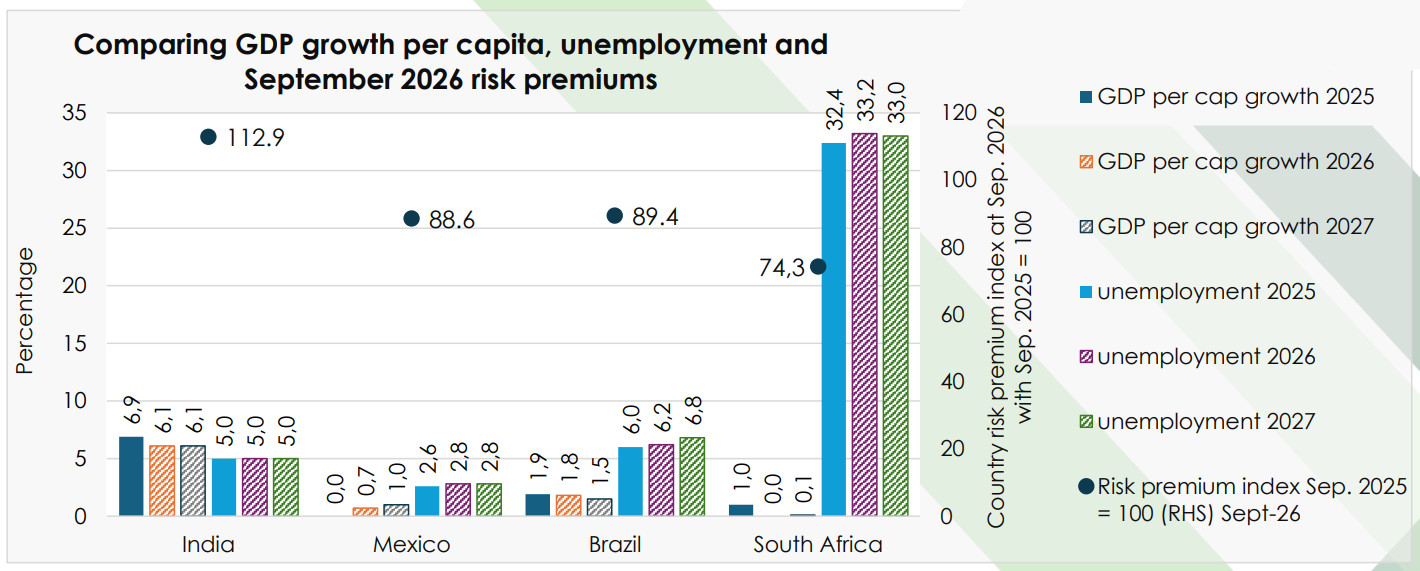
While the buzz around the mini-budget has been positive and well-received by markets, the PBO flagged negative per capita growth and crisis-level unemployment as the reality South Africa faces.
It noted that the talk of improved sentiment and budget surpluses obscures the fact that the government is underspending in critical areas, such as basic services and social security.
As a result, the focus on short-term positives and talk of “resilience” underplays the very real problems caused by the government’s fiscal policies, it said.
The PBO is a unit within Parliament established to provide independent and expert analysis of the nation’s budget and fiscal policies.
It supports Parliament’s fiscal oversight role by offering unbiased, evidence-based research and analysis on socio-economic conditions, the impact of fiscal choices, and the broader economic landscape.
In its post-MTBPS presentation to parliament, the group acknowledged the improvements and positive turns in the country’s finances.
However, it tempered the ‘good news’ angle of the statement with a strong dose of reality.
One of the harshest reality checks was that the National Treasury was missing the targets set in the government’s 2024-2029 Medium Term Development Plan (MTDP).
It also accused the Treasury of conflating positive financial measures with improved fundamentals.
For example, “the 2026 MTBPS mistakes the government’s budget surplus and a recently improved risk
premium for economic resilience,” it said.
The PBO said that the boost instead comes from the sale of government bonds.
“Sovereign risk premiums in many emerging markets have recently improved because global fund managers have sold off developed country government bonds,” it said.
For South Africa, specifically, the office said that local bonds are not a safe long-term investment for global fund managers.
Instead, “they are short-term, speculative, carry trade choices that are highly profitable because of the South African Reserve Bank’s commitment to high real interest rates.”
The PBO went further, saying that the story being spun about “resilience” is becoming more questionable in light of the fiscal consolidation policy that it says has been in effect since 2012.
Under this policy, the government’s commitment to fiscal consolidation was said to boost business sentiment and spur investment and economic growth.
However, the PBO said it has instead restricted expenditure, created backlogs in infrastructure development, contributed to the under-resourcing of government at all levels, and entrenched poor governance.
“Continued efforts at fiscal consolidation have been met with very slow progress in structural reforms while the country’s economic growth model remains structurally fragile,” it said.
“The 2026 MTBPS claims that an improvement in risk premiums on government debt signals resilience, but negative per capita growth and crisis-level unemployment is not resilience,” it said.
Economy in trouble
Under the MTDP, South Africa set targets to achieve 3% economic growth and reduce unemployment to below 28% by 2029/30.
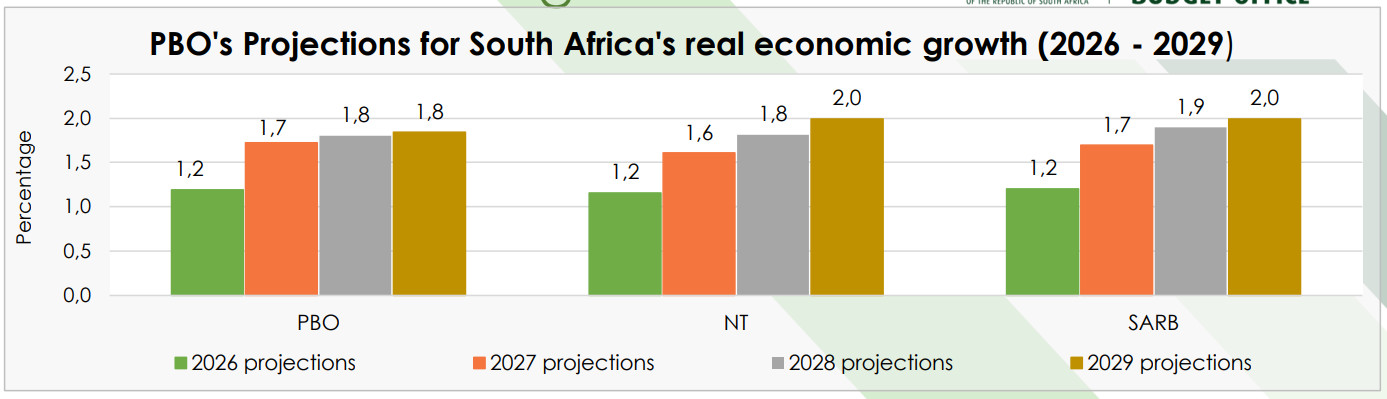
The PBO noted that, under the MTBPS’ projections, the economic outlook is for at most 2.3% growth by 2029, if everything goes well with Operation Vulindlela.
Most official projections (NT, SARB) forecast growth of 2% in 2029, while the PBO’s projections are lower at 1.8%.
Meanwhile, unemployment is escalating, hitting 33.6% in the latest reporting period, and is in dire need of intervention.
Contrary to the ‘good news’ budget being presented, the Parliamentary office said that aggregate demand remains weak and, again, not resilient.
Public investment is also insufficient to drive structural transformation.
“The South African economy remains extremely concentrated in terms of market share and wealth, with high levels of financialisation, deindustrialisation, and unemployment,” it said.
As it stands, the MTBPS does not explain how budget adjustments support the MTDP 2024–2029 and the wider goals of the National Development Plan, it said.
The office said that Parliament should pay close attention to how the budget aligns with the MTDP and monitor actual savings and expenditure outcomes rather than short-term wins.
“Building a sustainable growth path requires investing in resilience to multiple serious risks and crises,” it said.
“The cost of not increasing government expenditure on basic services and social security seems likely to be very large in the medium term.”














 Loading ...