

Iconic South African industry goes from best to one of the worst in the world


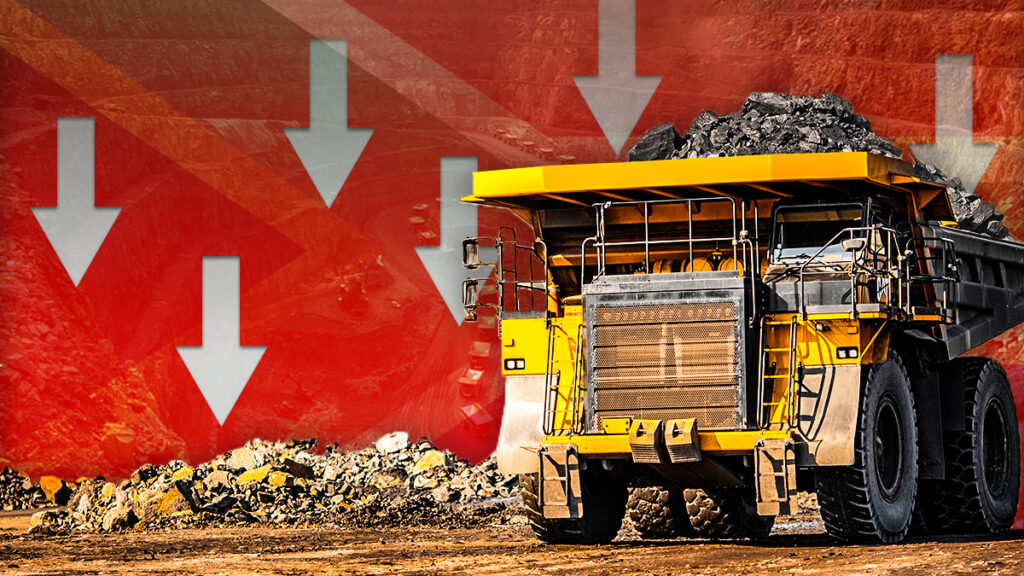
South Africa’s mining sector, once one of the strongest in the world, has steadily declined to become a global underperformer.
This is according to KPMG South Africa lead economist Frank Blackmore, who noted that the industry’s weakening position is clear when compared both to its own past and to the broader economy.
Mining is considered an iconic industry in South Africa, serving as the backbone of the national economy for over a century.
The sector is responsible for driving industrialisation, infrastructure development, and international trade.
This is because the country possesses some of the world’s most valuable mineral reserves, including the largest deposits of platinum group metals (PGMs) and manganese, as well as significant gold, diamond, and coal resources.
However, Blackmore noted in an interview that the mining sector is nowhere near as big as it used to be, generating fewer jobs, GDP, and downstream industries.
He added that South Africa has “let a vital cog in our economy kind of slip away.” Blackmore said the most useful benchmark is the industry’s own peak years.
“The best comparison we can make is to the heydays of mining in South Africa and ask ourselves what has gone wrong over this period.”
Measured against 1994, the decline is stark. “The GDP or output that was produced is still 11.5% lower in real terms than it was in 1994,” Blackmore said.
This is despite strong growth elsewhere in the economy. “Total GDP over this period in real terms has increased 95%, so nearly doubled, at an average rate of 2.3% a year.”
Had mining simply grown in line with the rest of the economy, its contribution would be valued at R450 billion in real terms, whereas we are currently only producing around R205 billion.
While mining is a cyclical industry that depends on global commodity prices, Blackmore stressed that many of the sector’s problems are self-inflicted.
He noted that these price booms come and go, but what matters most is making a sector more investor-friendly.
Falling down the world rankings

International rankings reflect the damage. The Fraser Institute ranked Africa as the worst-performing mining region in 2025, with five jurisdictions in the bottom tier, followed by Latin America with three, and one each from Canada and the US.
South Africa continued its downward slide. It now ranks 15th from the bottom overall. On the policy front alone, South Africa dropped to 70th out of 82, down from 66th last year.
Survey respondents cited rising concerns over political stability, socioeconomic agreements and the country’s geological database. The country’s policy perception score declined by nearly 20 points.
“We were a leading country in the 80s and 90s—often top three in many minerals,” Blackmore said.
He added that regulation is a major factor. “Our score for regulation has more than halved, from 40 to 20,” which highlights South Africa’s poor reputation as an investment destination.
Infrastructure failures have added further pressure. High electricity prices have hurt gold and platinum group metals, while bulk commodities such as iron ore and manganese are constrained by rail and port issues.
“Even if we could mine a lot more, we just couldn’t get the stuff out of here,” he said.
There are signs of improvement, particularly in administrative processes. Blackmore pointed to the rollout of a national cadastral system to clarify mineral rights.
“If you want to open a mine, you don’t know who owns what rights,” he said, adding that the new system is “a big tick” toward restoring certainty.
Despite the damage, Blackmore said demand remains strong. “The demand is there,” driven by global development and the energy transition.
If South Africa addresses regulatory and infrastructure issues, mining could again drive growth.
“That demand could be the catalyst to get South Africa’s mining sector back to where it was and help tackle the country’s biggest problem, which is jobs,” he said.
















 Loading ...