

The areas in South Africa where more people are unemployed than working


South Africa’s unemployment rate declined for the first time in almost two years in Q4 2021 as the manufacturing and mining industries added jobs to meet the demand for commodities stoked by Russia’s war with Ukraine.
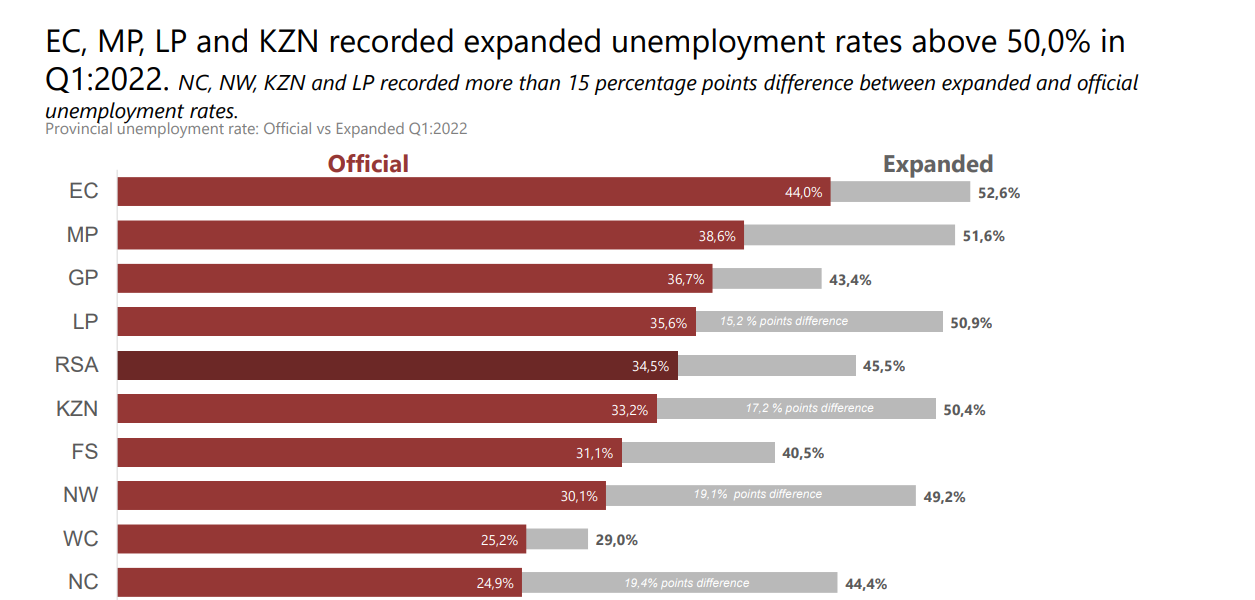
The jobless rate fell to 34.5%, from 35.3% in the final three months of 2021, while unemployment according to the expanded definition, which includes people who were available for work but not looking for a job, fell to 45.5% from 46.2% in the fourth quarter.
Despite this improvement, the data shows that the Eastern Cape, Mpumalanga, Limpopo and KwaZulu-Natal recorded expanded unemployment rates above 50%. In addition, the Northern Cape, North West, KwaZulu-Natal and Limpopo recorded a more than 15 percentage points difference between expanded and official unemployment rates.
The largest employment increases were recorded in Limpopo (81,000), Gauteng (62,000), North West (58,000), Northern Cape (up by 57,000) and Free State (54,000). The only province to report a drop in jobs was KwaZulu-Natal (53,000).
The drop in unemployment also partly due to improved response rates among those with jobs in metropolitan areas after the statistics office resumed face-to-face interviews and increased publicity for the quarterly unemployment survey. Response rates climbed to 64.7%, from 44.6% in the previous quarter, according to the agency.
“The response rates haven’t yet reached pre-virus levels and “therefore data users are still advised to use some estimates with caution,” statistician-general Risenga Maluleke said.
Thanda Sithole, FNB senior economist, said: “The data revealed that the employment recovery has significantly lagged the GDP recovery, reflecting persistent economic uncertainty from the pandemic and war in Ukraine. While the 1Q22 employment increase is encouraging, we are concerned about the current level of employment relative to pre-pandemic levels.”
The lack of job gains alongside the rising cost of living could put additional pressure on the employed and government fiscus.
The economist said that the current level of private sector fixed investment (at 10.2% of GDP) alongside higher production costs and elevated global uncertainty implies that the employment recovery could be prolonged, with the unemployment rate remaining ‘sticky’ above pre-pandemic levels.
Peter Attard Montalto, head of capital markets research at Intellidex, said Stats SA’s data-collection problems rendered the numbers “meaningless,” citing discrepancies in formal employment between the quarterly labour force and employment statistics surveys.
“They used to move roughly in lockstep albeit with a spread,” he said. “Now the quarterly labour force survey has become much more volatile.”
The recovery in the unemployment rate may be short-lived as a record number of electricity outages forecast for this year, the worst flooding in almost three decades in the eastern KwaZulu-Natal province in April, a slowdown in global output, rising interest rates, and surging fuel and food prices caused by extreme weather and the war in Ukraine are likely to weigh on economic growth and job creation.
With further reporting by Bloomberg.

















 Loading ...