

R17 per litre price shock on the cards for South Africa in May


Just as South Africans sucked up a record petrol and diesel price hike on Wednesday (1 April), fuel recovery data for the start of the new month shows an even bigger blow is to come.
The latest data from the Central Energy Fund (CEF) shows early under-recoveries of R7.88 per litre for petrol 95 and R17.57 for diesel (0.005% sulphur).
While these are very early figures, there would have to be a massive turn in market conditions or significant intervention from the national government to avoid another extreme price hike.
The record price increases of R3.06 per litre for Petrol and over R7 per litre for diesel this week were based on fluctuations in fuel price recoveries between 27 February and 26 March 2026.
The next price adjustment on Wednesday, 6 May 2026, will be based on the average unit over/under recovery for the period from 27 March to 30 April 2026.
According to the CEF’s data for 27 to 31 March, another staggering hike is building for May. The table below outlines the recovery changes in the first three days of the period:
Fuel price over/(under) recoveries 27-31 March
| Fuel type | 27 March | 30 March | 31 March |
|---|---|---|---|
| Petrol 95 | (R7.35) | (R7.77) | (R7.88) |
| Diesel 0.05% (wholesale) | (R17.01) | (R17.56) | (R17.46) |
| Diesel 0.005% (wholesale) | (R17.12) | (R17.65) | (R17.57) |
| Illuminating Paraffin (wholesale) | (R16.84) | (R17.59) | (R17.30) |
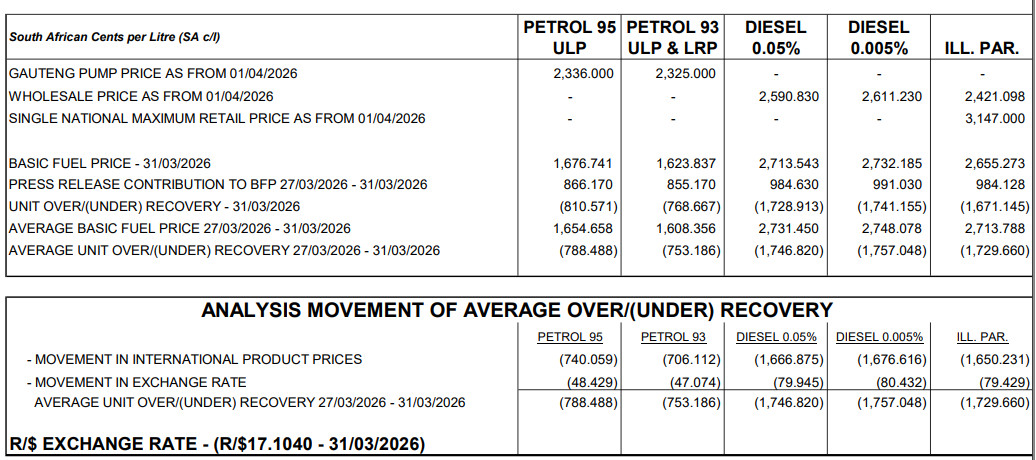
It must be stressed that the CEF data is a snapshot of recoveries in the basic fuel price. It is an indicator of the trajectory of the final adjustment, not the adjustment itself.
An under-recovery reflects increased fuel costs driven by exchange rate fluctuations and petroleum product prices (largely determined by global oil prices).
When an under-recovery deepens, it signals that consumers are “underpaying” for fuel, leading to higher pump prices.
An over-recovery reflects the opposite: consumers are overpaying for fuel, so prices fall.
Recoveries in March were impacted by the United States’ attacks on Iran and the severe disruptions to global energy markets.
This sent recoveries deep into the red, with costs skyrocketing worldwide.
The CEF’s latest data shows that these tensions are carrying forward, with much higher costs feeding through.
These figures are subject to change as market conditions shift—for better or for worse. A clearer picture develops around the middle of the month, with month-end data being the last signal for final changes.
R3 per litre relief will be recouped by the government

The record-high petrol and diesel price increases in April included a R3-per-litre cut to the general fuel levy by the National Treasury, which softened the blow for motorists.
However, this relief is currently set to expire on 6 May 2026, which means an additional R3 per litre could be added back to the fuel price in May.
If the current recoveries hold through to the end of the month and the fuel levy is added back, this could lead to R10+ and R20+ price increases in May.
In announcing the relief, Finance Minister Enoch Godongwana said that it would cost the fiscus R6 billion in April to cut the levy.
Because the intervention is budget-neutral, he made it clear that this cost would be recovered at a future date.
When the government intervened in petrol prices in 2022, it cut the levy by R1.50 and re-added the taxes over a three-month period. The Treasury has not yet indicated how the cuts will be recovered.
According to the Organisation Undoing Tax Abuse (Outa), while the government’s intervention was both necessary and appropriate, it came far too late, and its temporary nature won’t solve the crisis.
It said the government should have intervened much sooner, given that the price pressure was well known and had been building for weeks before the adjustments.
It urged the government to be more timely with its communications in the month ahead.
“Decisions should be communicated at least a week in advance of the next fuel price adjustment on 6 May, to avoid unnecessary uncertainty and volatility,” it said.
Investec Chief Economist Annabel Bishop also flagged the looming price pressures and risks for May.
In a note on Tuesday, she said the latest fuel price increases are not necessarily the end of the hikes, especially if the US-Iran war intensifies over April, further impacting fuel prices.
“Risks have risen, and the fuel price increase, if not quickly reversed in May, will weaken GDP,” she said.


















 Loading ...