

South Africa’s dirty R721 billion secret



The economic cost of air pollution in South Africa is estimated at R721 billion. This includes lost working days and significant pressure on the public healthcare system.
The South African Department of Mineral Resources and Energy (DMRE) has formalised plans to extend the operating lifetimes of ten Eskom-operated coal-fired power plants by at least an additional decade.
While this initiative is framed as a practical solution to secure an electricity supply, a closer financial and economic analysis suggests it could become a costly policy trap.
For businesses, air pollution is not just an environmental concern; it directly impacts operational efficiency.
Fine particulate matter (PM2.5) produced by coal combustion travels across regions, leading to chronic cardiovascular and respiratory illnesses that result in millions of lost working days.
The Centre for Research on Energy and Clean Air (CREA) has reported that the national economic burden of air pollution is already substantial, estimating an annual cost of health impacts at R721 billion, which accounts for around 14% of the country’s GDP.
This economic drain takes into account lost workdays, medical expenses, and unmet investments in areas such as education for children. Extending the lifetimes of these ten power plants will significantly increase these costs.
“The cost to the South African economy comes to an estimated R721 billion (USD 38 billion). This includes lost working days and overwhelming pressure on the public healthcare system,” said CREA.
One of the most notable financial aspects of this pollution is its transboundary nature. The physical and financial damages are highly concentrated in Gauteng.
Gauteng is South Africa’s highest-yielding economic hub, despite the province not burning coal itself.
“The province of Gauteng has no large Eskom coal-fired power stations. The transboundary pollution originates in Mpumalanga and migrates to Gauteng, notably Pretoria and Johannesburg, as seen in air quality modelling,” said CREA.
Gauteng is the most affected region
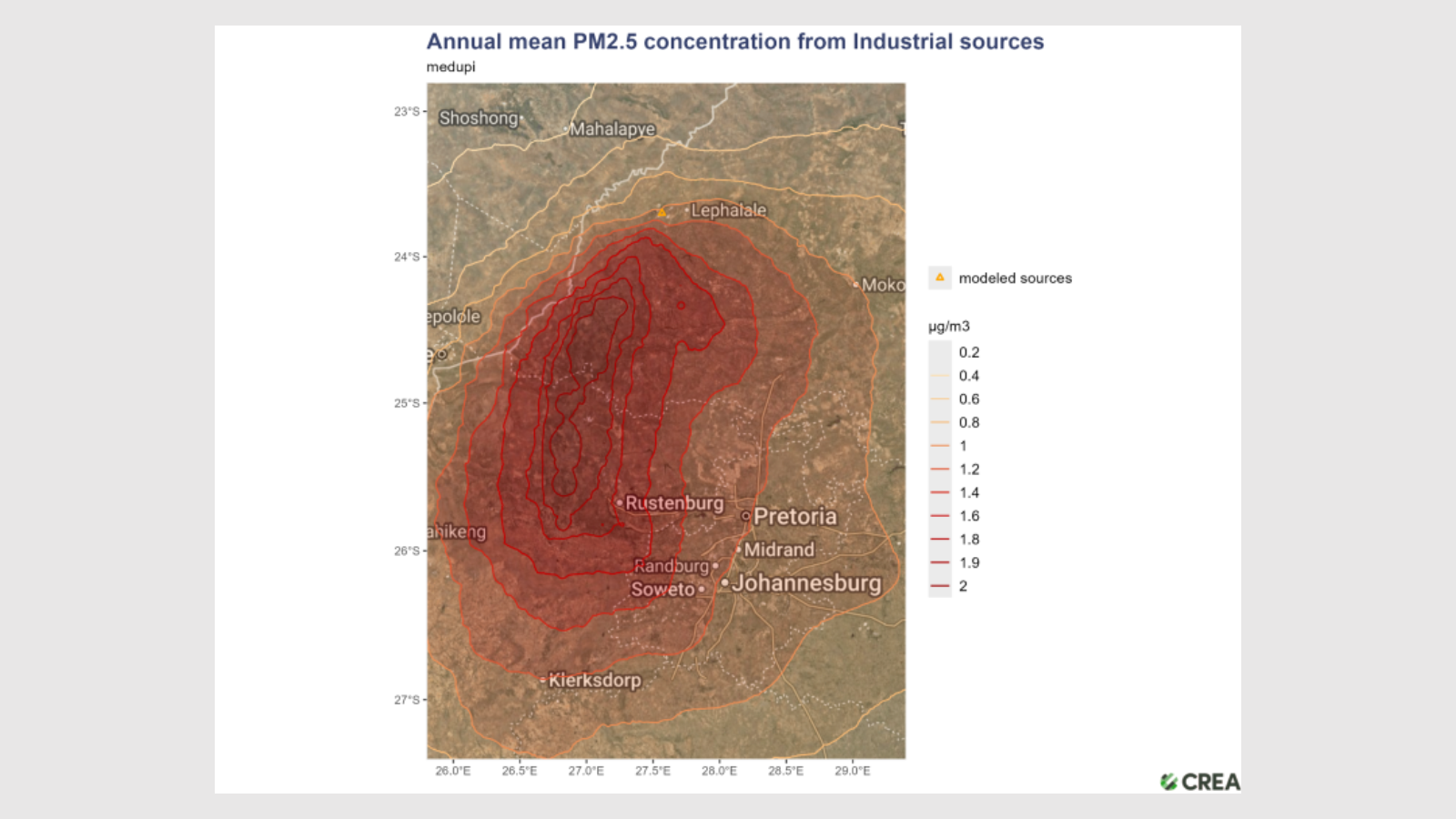
Transboundary migration of coal-related PM 2.5 occurs because these fine particulate matters can remain in the atmosphere for one to two weeks and travel long distances due to regional wind patterns.
This enables them to cross provincial borders and impact large populations far from the original source of pollution, highlighting the transboundary nature of pollution.
As a direct result, the workforce in South Africa’s financial centre faces the most significant health impacts from the coal emissions originating in Mpumalanga.
“Gauteng is the most affected region, with an estimated 15,200 additional deaths, almost half of the total, despite having no Eskom coal-fired power plants,” said CREA.
For Gauteng’s services and industrial sectors, there is an ongoing, localised tax on corporate productivity caused by a depleted, unhealthy, and absent workforce.
In addition to the immediate healthcare and productivity costs, maintaining a dirty electricity grid imposes penalties on other sectors of the economy by shifting the burden of carbon compliance onto them.
South Africa’s Climate Change Act and updated Nationally Determined Contributions (NDCs) legally commit the country to limit greenhouse gas emissions to between 350 and 420 million tons of CO₂ equivalent (MtCO₂e) by 2030.
By failing to do so, the government forces other, more sensitive industries to bear the consequences.
“Extending coal makes these targets harder to achieve and locks in higher emissions from one of the country’s largest sources,” said the organisation.
CREA said that the power sector is typically one of the most straightforward to decarbonise, and that this failure places additional pressure on harder-to-decarbonise sectors to compensate.
Non-utility sectors, such as manufacturing, mining, agriculture, and transport, will need to invest their own capital to achieve significant emissions reductions.
If they fail to do so, they may face international trade penalties, such as carbon border taxes, which could harm their competitiveness in global markets.
Delaying the phase-out of coal is not merely a short-term operational issue; it presents a long-term financial liability that jeopardises South Africa’s future workforce.
Today’s children are the primary victims of this policy choice, as it undermines the country’s future productivity even before it begins.
“Children bear a disproportionate burden: delayed phase-out would lead to an estimated 41,000 additional preterm births, 17,000 new childhood asthma cases, and 370 deaths in children under five,” the group said.
These chronic illnesses impose immediate, heavy out-of-pocket healthcare costs on families and divert public capital into emergency medical treatment rather than productive infrastructure.

















 Loading ...