

South Africa could finally get some good news next week


Amid declining business confidence, increased liquidations, and multiple pressure points in key industries like mining, smelting and automotive manufacturing, South Africa is expected to see surprisingly resilient economic growth in the GDP data next week.
Stats SA will publish the GDP figures for the second quarter of 2025 on 9 September, with economists expecting to see the economy expand around 0.6%.
This will be a continued growth trend, up from a modest 0.1% in the first quarter of the year.
According to economists at Nedbank, high-frequency statistics reflect an uptick in economic activity over the second quarter, with economic momentum carrying from rebounds in mining and manufacturing.
“Agriculture probably moderated from its strong start. Favourable weather conditions kept crops and horticulture positive, while struggles with animal diseases remained a drag on livestock,” the bank said.
Q2 of 2025 saw energy, mining, and manufacturing improve, supported by little to no load shedding and driven by reasonable global demand and rising domestic demand.
Nedbank noted that services also increased over Q2, and positive contributions came from transport and communications, finance, general government and personal services.
“While retail, motor trade sales, real income from accommodation and food services accelerated, wholesale sales contracted, dampening the contribution from domestic trade to overall GDP,” the economists said.
The rosier outlook for growth in Q2 comes with the understanding that the quarter ended before the 30% tariff on exports to the United States came into effect in August, and reflects a period of “relief” from the global trade war betwen April and July.
Economists are more undercertain about the levels of economic growth that will be recorded in Q3 and Q4, with the impact of the tariffs and the ripple effect on the economy will likely start to filter through.
However, the true impact is likely to only be felt after the six-month mark, thus in Q1 2026 and beyond.
In this context, and counter to the more bearish views, Nedbank’s economists actually expect growth to accelerate in the remainer of the year, boosted by domestic demand.
It also anticipates firmer consumer confidence and a recovery in real household income thanks to lower inflation and reduced interest rates.
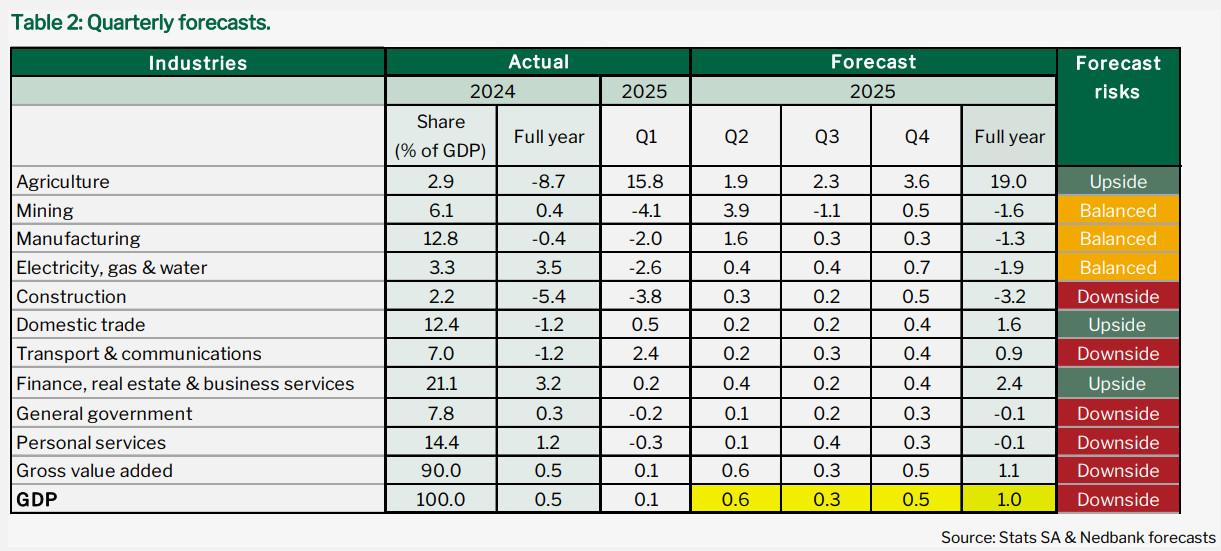
The bank expects South Africa to record 1% growth for the year, putting it squarely in the optimists’ corner, compared to bearish assessments pointing to sub-1% growth.
It anticipates 1.5% growth in the following years, with government policy and structural reforms boosting GDP.
However, the economists do acknowledge the risks at play.
“Despite ongoing structural reforms, operating conditions remain challenging, and production costs high,” they said.
“Weaker global demand amid higher US tariff barriers will weigh on output, particularly given SA’s elevated cost structures, underlying inefficiencies, and significant infrastructure constraints.”
“The uncertain global environment, high US tariffs and the expiry of AGOA pose significant downside risks to some manufacturing industries.”
The finance group said that the government needs to focus on accelerating structural reforms, which are key to enhancing industries’ international competitiveness.
“This would enable the economy to grow faster and create more jobs without hitting supply bottlenecks, driving up costs, and stoking inflation,” it said.
overall, Nedbank said that it expects a moderate recovery over the next three years, with GDP growth averaging around 1.5%.
“Domestically and globally, subdued inflation and interest rates will likely boost demand. However, much depends on the need for faster progress with reforms in the energy and logistics space and the effect on global demand from Trump 2.0,” it said.
















 Loading ...