

Two provinces in South Africa where more people are unemployed than working


South Africa’s latest Quarterly Labour Force Survey (QLFS) shows that the Eastern Cape and North West are the only two provinces where more people are unemployed than working.
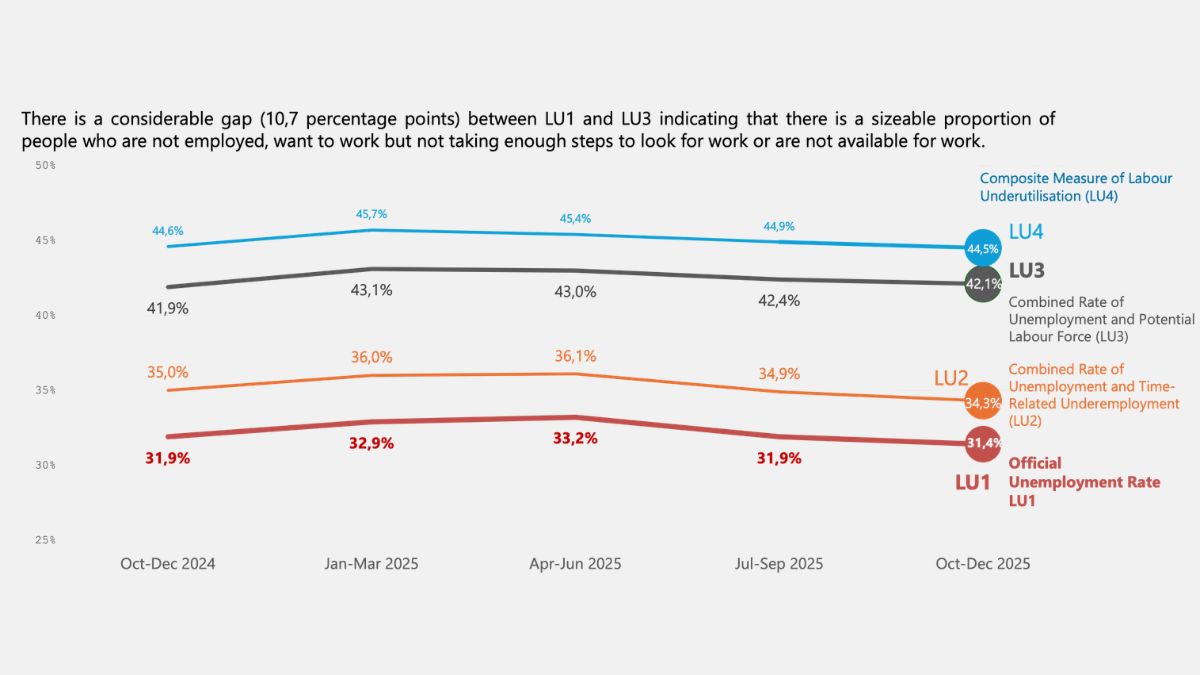
According to Statistics South Africa (Stats SA), the country’s official unemployment rate dropped to 31.4% in the fourth quarter of 2025, down from 31.9% in the previous quarter.
This marks a 0.5 percentage point improvement and means about 44,000 more people found jobs, bringing the total number of employed South Africans to 17.1 million.
At the same time, the number of unemployed people fell by 172,000 to 7.8 million.
However, despite this improvement, the total labour force—those who are either working or actively looking for work—actually decreased by 128,000 people.
Additionally, the combined rate—now serving as the new proxy for the previous “expanded unemployment rate”—remains at 42.1%, down from 42.4% previously.
The combined rate accounts for unemployed individuals and those who are available to work but are discouraged or not actively seeking employment.
Stats SA clarified that this metric differs from the previous expanded unemployment rate but closely tracks it, and that it will be used going forward.
In the fourth quarter, the number of discouraged job-seekers increased by 233,000, reaching a total of 3.7 million.
Other available job-seekers decreased by 110,000 to 855,000, while unavailable job-seekers dropped by 41,000 to 42,000.
This resulted in a net increase of 82,000, bringing the total potential labour force population to 4.6 million.
Additionally, the number of individuals outside the labour force increased by 165,000, reaching 12.5 million.
When combining the potential labour force with those outside the labour force, the total rose by 248,000 to 17.1 million in Q4 of 2025.
Overall, South Africa’s labour market shows improvements across multiple measures. However, the rates remain extremely high, which indicates a persistent jobs crisis in the country.
From Q4 2015 to Q4 2025, the number of unemployed individuals in South Africa rose from 5.2 million to 7.8 million, while the proportion experiencing long-term unemployment increased from 66.9% to 79.7% over the same period.
Youth unemployment also remains notably high, with a rate of 44.3% for individuals aged 25-34.
Two provinces in trouble
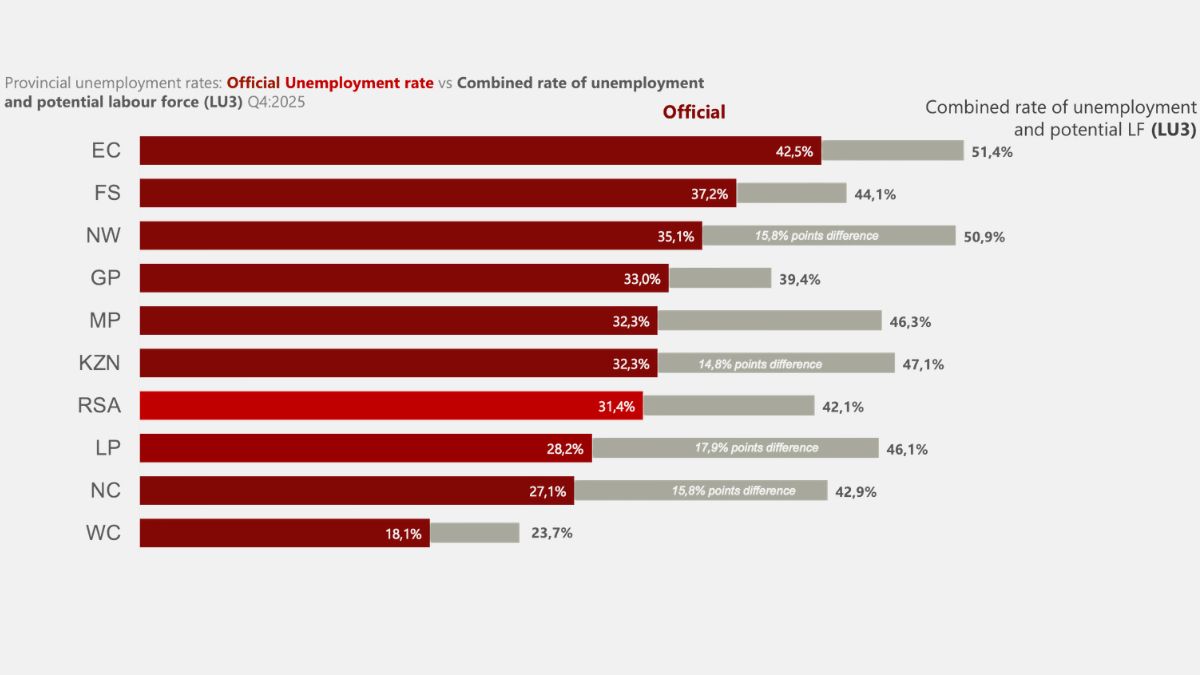
Across the provinces, the differences are striking. The Western Cape continues to have the lowest official unemployment rate in the country at 18.1%, maintaining its decade-long position as the best-performing province.
The Northern Cape follows at 27.1%, while Limpopo recorded rates of 28.2% and KwaZulu-Natal and Mpumalanga both recorded 32.3%.
However, the situation looks much worse in the Eastern Cape and North West. The Eastern Cape recorded the largest increase in unemployment, with a 1.3 percentage-point change in the fourth quarter.
Under the new expanded definition, its unemployment rate now sits at 51.4%, meaning more than half of its adult population is unemployed.
This means the Eastern Cape has overtaken the North West as having the most people unemployed than working. The North West recorded an expanded unemployment rate of 50.9%.
By contrast, the Western Cape’s expanded unemployment rate is recorded at 23.7%, showing that its economy remains relatively stable and better able to create jobs.
Still, the national picture shows that South Africa’s job market remains deeply uneven. KwaZulu-Natal also faces major challenges, with an expanded unemployment rate of 47.1%, placing it just behind the North West and Eastern Cape.
Other provinces may have shown slight improvements, but millions of South Africans are still locked out of the job market.


















 Loading ...