

Red line under R268 billion of taxpayer money in South Africa


The Department of Cooperative Governance and Traditional Affairs (COGTA) has published its annual report for 2024/2025, highlighting a lack of consequence management in local government, with unauthorised, wasteful spending amounting to R268 billion.
This figure represents taxpayer money that was spent improperly, went unaccounted for, or in some cases, was even stolen across South Africa’s municipalities.
While it does not necessarily reflect money that was wasted or stolen, it does reflect poor bookkeeping and other maladministration, adding to the burden of financial mismanagement in the country.
This amount has increased from R264 billion in the previous year, showing that poor finances remain a pressing issue in South Africa.
In an attempt to combat this financial mismanagement, the cabinet has approved the Final Revised White Paper on Local Government, which calls for strict professionalism among municipal staff.
COGTA said that the Revised White Paper responds to persistent governance, institutional, financial and service delivery challenges facing municipalities.
“It places renewed emphasis on strengthening implementation, accountability, institutional coherence and financial sustainability across the local government system,” said COGTA.
The new framework is scheduled to be launched by President Cyril Ramaphosa on 22 October 2026.
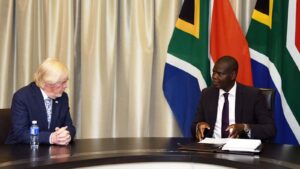
COGTA Minister Velenkosini Hlabisa told Talk Radio 702 that the competence of officials and political leaders plays a significant role in the massive wasteful expenditure of taxpayer money.
“If you have a competent Chief Financial Officer (CFO), Municipal Manager, and all senior managers, you won’t experience such. If you go to municipalities that get clean audits consecutively, you won’t find such,” said Hlabisa, referring to the massive wasteful expenditure by the government.
He explained that municipalities that employ competent and qualified staff do not experience such levels of wasteful spending and achieve consistent clean audits.
“The key is the employment of staff who are competent. The White Paper introduces this concept of professionalisation of staff, cadre deployment, and the employment of friends and family members has brought our municipal space to where it is,” he said.
Competency of government officials questioned

The Minister highlighted several major reform proposals from the revised White Paper on Local Government to combat the high levels of financial mismanagement.
Currently, municipal candidates automatically assume duty if the national department does not respond to the hiring submission within 14 days.
The new White Paper abolishes this rule and will require explicit financial approval from the national Minister before any senior official can take office.
The White Paper introduces strict professionalism standards to eliminate cadre deployment, cronyism, and political patronage in local government.
The COGTA will monitor all municipal job advertisements from the time of first publication to enforce mandatory qualification standards.
This will help correct non-compliant qualification requirements before candidates can be interviewed or appointed.
After the local government elections, new municipal councils will perform audits to assess staff qualifications and competence.
All Municipal Manager recruitments will undergo the new ministerial vetting process, as Municipal Manager contracts expire one year after the election.
Officials of failing municipalities who are found incompetent will be repositioned or redeployed to roles that match their actual capacity to avoid lengthy court battles.
Mayors will be required to inspect Section 71 financial reports monthly to catch instances of wasteful spending early.
In cases where financial irregularities involve corruption or theft, Municipal Managers and councils will be expected to formally open criminal cases with law enforcement.
Minister Hlabisa highlighted the significant regional gap between provinces with the highest levels of wasteful spending and those with the lowest.
The North West province recorded the highest wasteful spending over R71 billion, followed by Gauteng, which recorded over R53 billion. The Western Cape recorded the lowest level of wasteful expenditure, at R2.77 billion.
He highlighted that, in addition to incompetent officials, the lack of consequence management played a significant role in the extent of wasteful expenditure.
Although 178 municipalities established disciplinary boards in 2024/2025, few dismissals or actions were taken because disciplinary decisions are made entirely by independent municipal councils rather than by the national government.















 Loading ...