

Government urges private sector to fix municipal failures



Deputy Minister of Cooperative Governance and Traditional Affairs, Namane Dickson Masemola, has called on the private sector to assist in fixing the country’s municipal failures.
Addressing the Social Justice Summit, Masemola emphasised that South Africa must shift from planning to execution to overcome persistent poverty, unemployment, and inequality.
Speaking on behalf of the Deputy President, Masemola highlighted the District Development Model (DDM) as a key framework for intergovernmental cooperation to drive local service delivery.
The DDM is an intergovernmental planning and execution framework introduced by the government to fix fragmented planning, eliminate working in isolated groups, and improve service delivery.
The model covers all 44 district municipalities and eight metropolitan areas, aiming for national, provincial, and local government departments to coordinate their strategies, budgets, and implementation under a single plan for each district.
Masemola explained that the DDM could turn constitutional promises into tangible improvements, including reliable water, electricity, housing, healthcare and local job opportunities.
“Its guiding principle, ‘One District, One Plan, One Budget,’ is aimed at improving coherence, reducing duplication and accelerating service delivery,” he said.
Although he addressed the importance of intergovernmental cooperation, Masemola also placed significant weight on the private sector, treating business as a critical co-partner within the DDM structure.
Masemola called for strong public-private partnerships to mobilise private investment and technical expertise to repair and sustain municipal utilities and services.
“Strong partnerships will be essential to mobilise the expertise and investment needed to sustain reliable infrastructure and services,” he said.
He stressed that it will be impossible for the government to achieve regional development and the 2030 Sustainable Development Goals under the DDM alone, and that this will require cross-sector execution.
“Government, business, labour, civil society, traditional leaders, faith-based organisations and communities must work together to drive development and monitor progress.”
“It serves little purpose to build new assets if we cannot maintain those we already have”
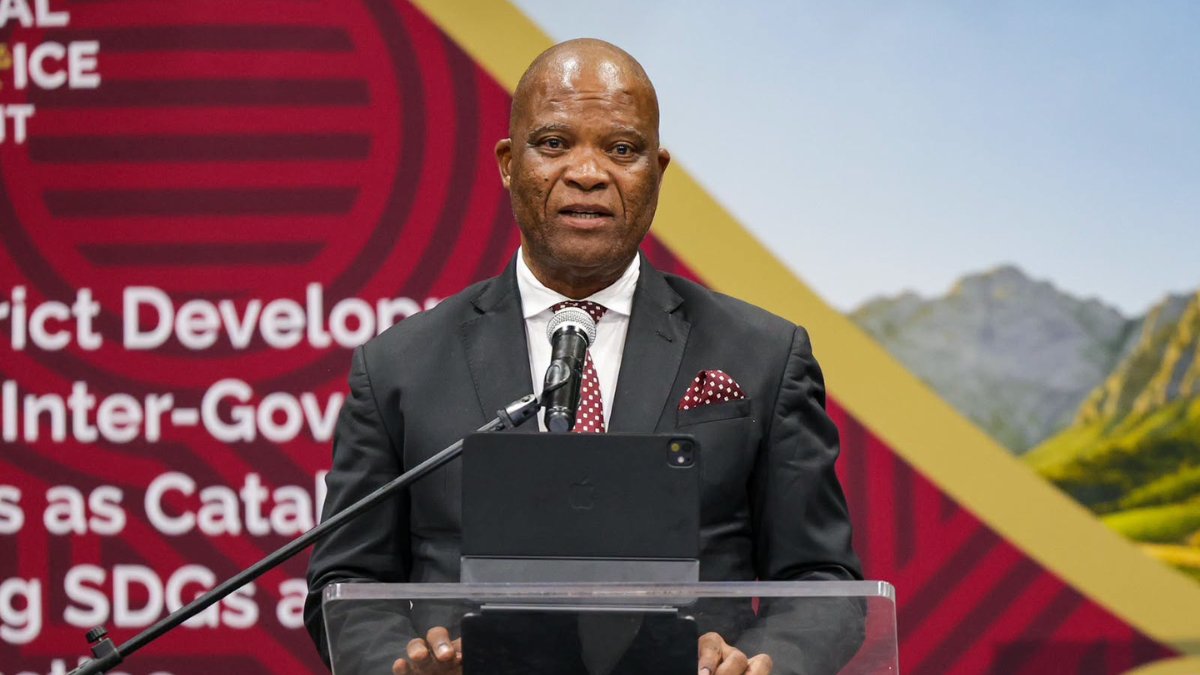
In the address, Masemola highlighted the importance of infrastructure delivery, management, and preservation, describing them as the core pillars of social justice.
He urged the government to give infrastructure maintenance the same priority as new infrastructure, warning that “it serves little purpose to build new assets if we cannot maintain those we already have.”
Masemola addressed the factors leading to deteriorating infrastructure, unreliable water and power supplies, and delayed housing projects.
“We must also confront the reality that many municipalities remain under severe strain. Financial distress, weak governance, poor planning and capacity constraints continue to undermine service delivery and development.”
He stressed that when municipal infrastructure is inconsistent, citizens bear the greatest burden on their everyday lives.
He emphasised that communities have a right to expect ethical, accountable and capable local government.
“Our task is therefore not simply to rescue struggling institutions, but to build municipalities that are sustainable, well-managed and responsive to the needs of the people,” he said.
Building institutional capacity, specifically in infrastructure delivery and financial management, is listed as one of the core priorities for leading the implementation of the DDM.
Masemola made reference to the Revised White Paper on Local Government, which calls for sound infrastructure management, merit-based administration, and financial sustainability.
The COGTA Deputy Minister said that initial progress under the DDM has already been noted in infrastructure development and water security across some districts.
However, he also addressed public unrest in the country, explaining that destroying public infrastructure, such as schools, clinics, libraries, roads and water facilities, disadvantages the communities that rely on them.
“Our collective challenge is to ensure that people have trusted and effective channels through which their voices can be heard, concerns addressed, and solutions found before frustration gives way to unrest.”


















 Loading ...