

Unemployment rate rises again in South Africa


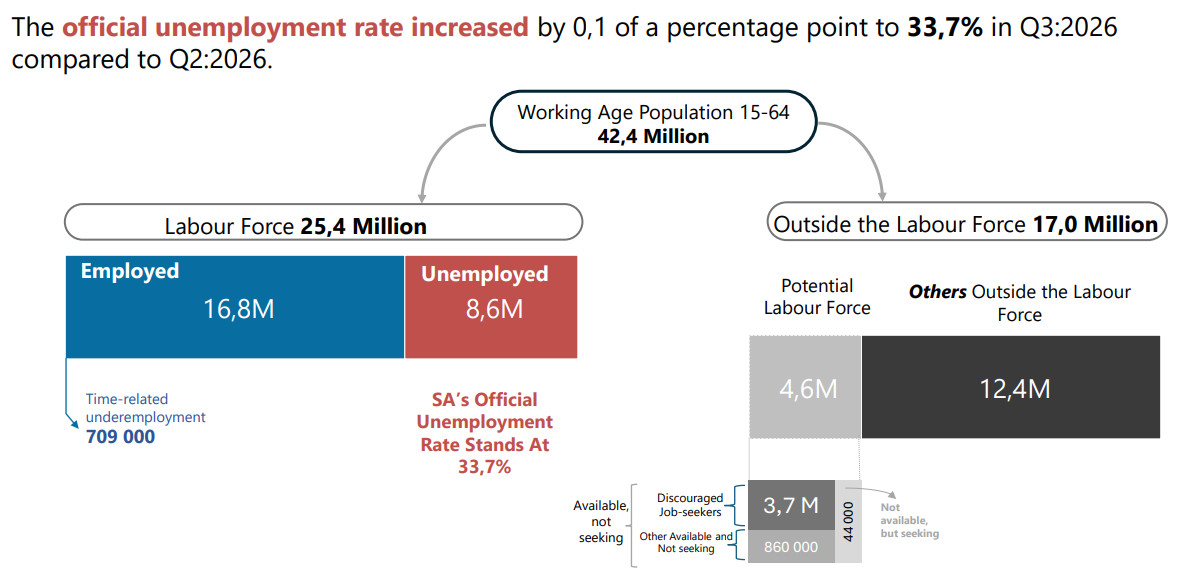
South Africa’s unemployment crisis has deepened, with the unemployment rate rising to 33.7% in the third quarter of the year, up from 33.6% in Q2.
According to the Quarterly Labour Force Survey for the quarter, there was an increase of 101,000 in the number of employed persons to 16.8 million.
However, the number of unemployed persons also increased by 97,000 to 8.6 million compared with the second quarter of 2026.
This resulted in an increase of 198,000 (or 0.8%) in the labour force during the same period.
The above changes in employment and unemployment resulted in the official unemployment rate increasing by 0.1 percentage point from 33.6% in Q2 to 33.7% in Q3.
Discouraged job-seekers increased by 70,000 to 3.7 million, other available job-seekers decreased by 1,000 to 860,000, and unavailable job-seekers remained the same at 44,000.
This resulted in a net increase of 69,000, to 4.6 million, in the potential labour force—i.e., persons who were available but not seeking, or unavailable but seeking.
According to Stats SA, those outside the labour force for other reasons decreased by 150,000 to 12.4 million.
Persons outside the labour force, which is the total of those in the potential labour force and others outside the labour force, decreased by 82,000 to 17.0 million in the third quarter of 2026.
In addition to the unemployment rate, other indicators of labour underutilisation were measured.
The combined rate of unemployment and time-related underemployment decreased by 0.1 of a percentage point to 36.5%.
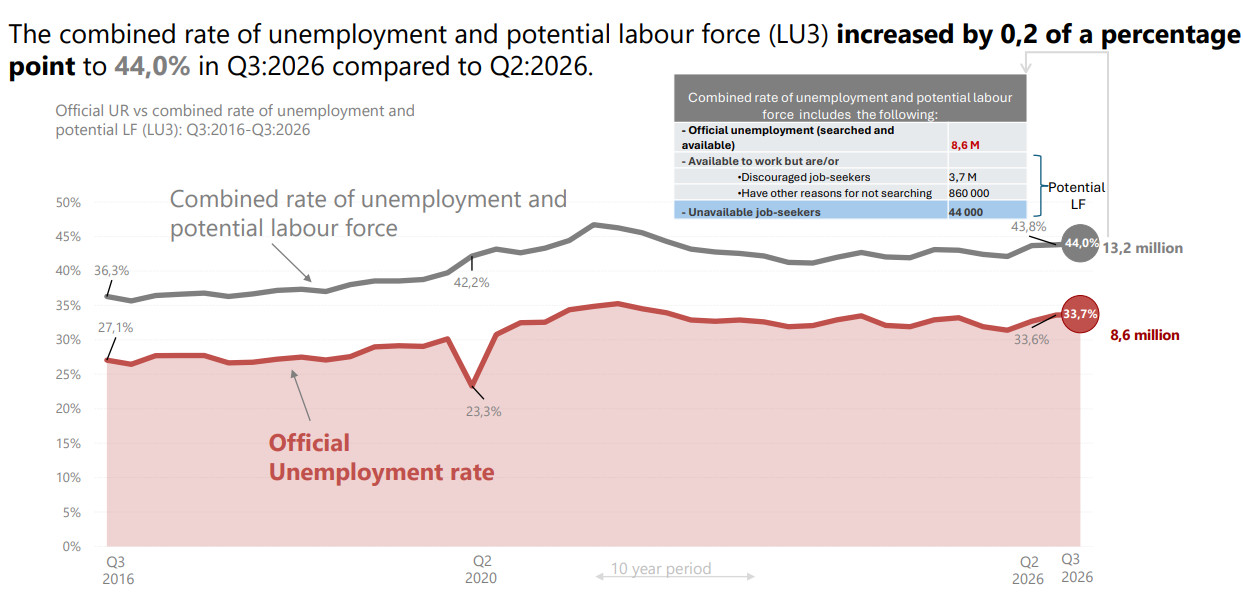
The combined rate of unemployment and potential labour force—most analogous to the historical measure of the ‘expanded unemployment rate’—increased by 0.2 percentage points to 44.0%.
The composite measure of labour underutilisation, which combines time-related underemployment, unemployment and potential labour force as a proportion of extended labour force, remained unchanged at 46.3%.
Hardest-hit industries
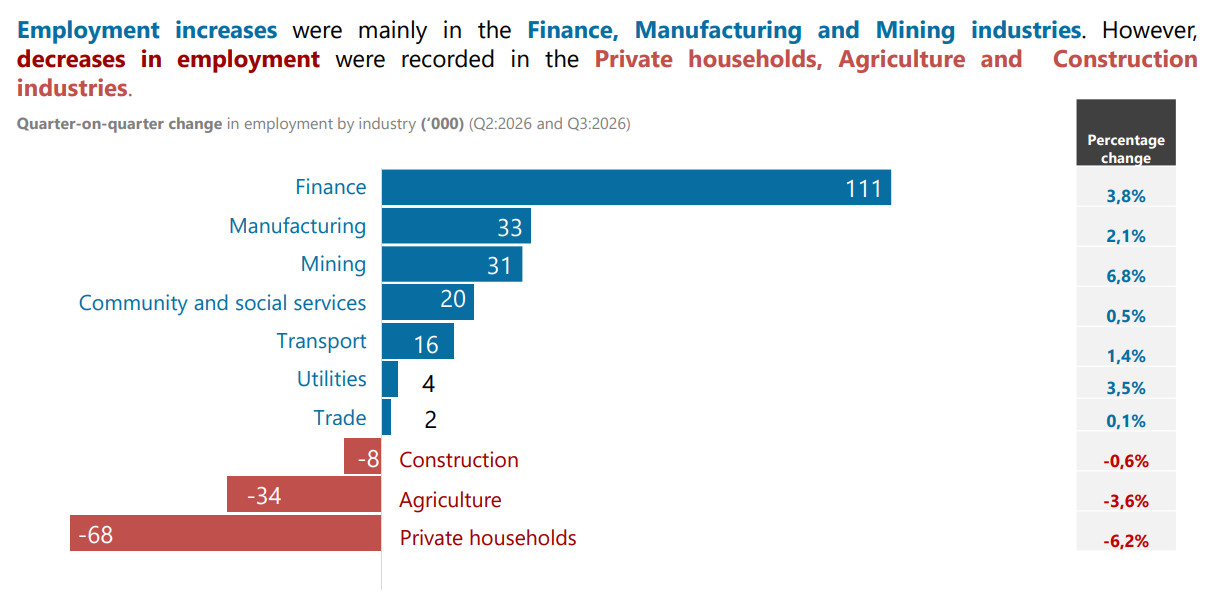
Between Q2 and Q3, the number of employed persons increased in seven of the ten industries.
The largest increases in employment were recorded in the Finance industry (111,000), followed by the Manufacturing (33,000), Mining (31,000) and Community and social services (20,000) industries.
Decreases in employment were recorded in Private households (68,000), followed by Agriculture (34,000) and Construction (8,000).
Compared with the same period last year, a net decrease of 215,000 in total employment was largely due to decreases in the number of persons employed in the Community and social services (197,000).
Private households (87,000), Construction (44,000) and Trade (33,000) industries were also hit hard.
Gains in employment were recorded in Finance (132,000), followed by the Mining (32,000) and Transport (11,000) industries.


















 Loading ...