

What you should earn to live a ‘decent’ life in South Africa


Data from the PMBEJD Group, the Living Wage South Africa Network (LWSA), and other firms show that a person needs to earn anywhere between R6,600 and R27,600 per month to live a ‘decent’ life.
This is the amount needed for a worker to maintain dignity, functionality, and stability in their household on a monthly basis.
This range is what is required to cover the basic necessities of life, such as food, electricity, transport, and other essential services.
However, some believe this is not enough, arguing that a ‘decent’ life includes modern life essentials such as savings, a few luxuries, good schools and entertainment.
In this context, affordability refers to the ability to pay the cost of goods and services based on one’s income. For most working South Africans, this means stretching every rand to meet their families’ needs.
PMBEJD data from January 2026 highlighted that the typical breadwinner in South Africa supports four people. This puts significant pressure on households, particularly where there is only one source of income.
Even when someone works full-time, the reality is that basic monthly expenses far exceed what they take home.
The National Minimum Wage (NMW) was introduced to set a baseline for worker pay, but it still falls short of covering the actual cost of living.
For March 2026, the Minister of Employment and Labour announced a 5% increase in the minimum wage, from R28.79 per hour to R30.23 per hour.
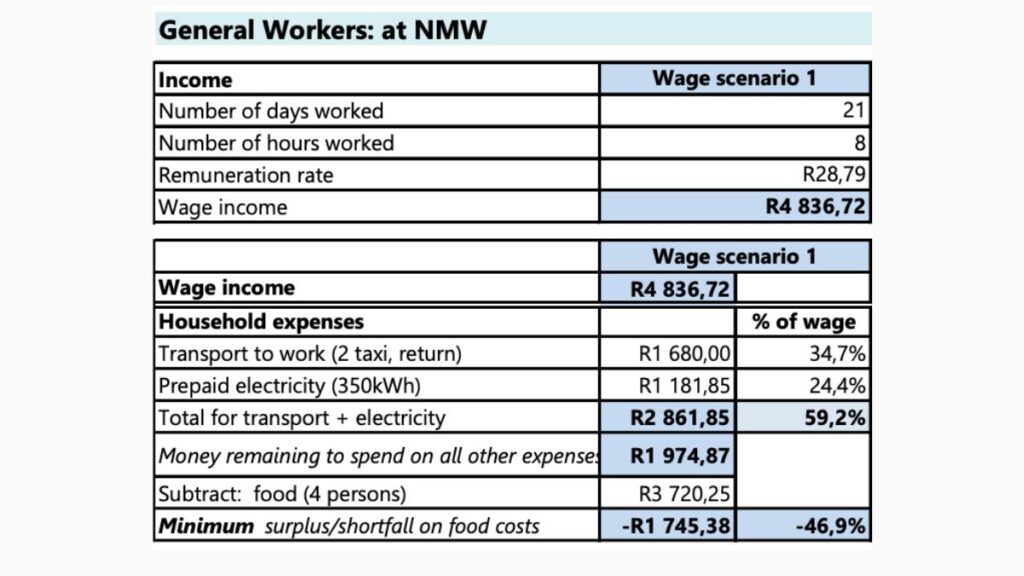
For someone working eight hours a day, this equates to around R241.84 daily and R5,894.40 monthly, assuming a 23-day work month.
While the NMW annual adjustment is meant to improve earnings, as of February 2026, it still leaves workers roughly R1,745 short of even the most conservative estimates for basic living expenses.
According to PMBEJD’s calculations, which are based on the cost of a Basic Nutritional Food Basket for a family of four in major cities, a minimum wage earner will still struggle to cover essentials like food, electricity, and transport.
“The National Minimum Wage is a poverty wage. It hurts workers, reduces workplace productivity, and slows economic growth,” the organisation said.
A decent wage is a comfortable one
PMBEJD argues that small annual increases based on such a low starting point, especially when they do not keep up with inflation or anticipate future cost increases, mean that workers are getting poorer each year and not better off.
The group believes that the minimum for basic dignity and household functionality is R6,600 per month. However, some experts view even this figure as insufficient.
The Living Wage South Africa Network argues that the real figure needed for a truly decent life is between R12,000 and R15,000 a month.
This estimate is not based solely on the cost of goods, but on how people themselves define and experience a good quality of life.
The LWSA network explained that research conducted by the University of Cape Town surveyed about 2,300 people across all nine provinces.
Participants were asked about different aspects of life, such as housing, healthcare, and job quality, and whether they felt able to achieve what they considered a “good life.”
By mapping this feedback against people’s reported incomes, researchers could see the income level at which people begin to feel they have reached that standard.
The network noted that this is the true “living wage”, which covers essentials and allows people to save for emergencies, avoid financial vulnerability, and make meaningful life choices.
However, Wise Move, South Africa’s biggest moving services, believes that a decent life includes what many consider a necessity in modern-day South Africa in 2026.
According to the company, a decent life is a comfortable life, which generally aligns with a middle-class lifestyle.
Considering this, they outlined that a South African should take home closer to R27,600 to live a decent life.
In its analysis, the firm included all those listed by the PMBEJD, as well as items they believe are still necessary.
This includes an entry-level personal car and petrol, school fees, medical aid, going out, rent for a home, and internet access.













 Loading ...