

This is the wealthiest township in South Africa


Data from Lightstone has noted that Soweto is the wealthiest township in South Africa based on income and property values.
South Africa’s property market conversation tends to focus on the country’s major cities, which are Johannesburg, Cape Town, and Durban, with their skylines, luxury developments, and booming suburbs.
However, the country’s largest townships on the edges of these cities tell a more interesting story about South Africa’s urban landscape.
According to Hayley Ivins-Downes, Lightstone Managing Executive Real Estate & Director at Prop Data, the townships of Soweto, Umlazi, and Khayelitsha reflect the true pulse of the nation’s housing market.
“Townships like Soweto, Umlazi and Khayelitsha reflect South Africa’s urban reality in ways that city skylines cannot,” she said.
“While each carries the weight of inequality and historic disadvantage, they are also centres of growth, resilience and entrepreneurship.”
Lightstone analysed these three townships by looking at household income, property values, and transfer activity.
They were chosen because they are the largest in South Africa’s wealthiest provinces and central to understanding the shifting property market.
Soweto, located near Johannesburg, is the oldest and best-known, with about 1.5 million residents.
Umlazi, Durban’s largest township, houses around 486,000 people, while Khayelitsha on Cape Town’s outskirts is home to approximately 520,000 residents.
“Soweto’s scale and maturity give it an edge in income and property value, but Khayelitsha’s rapid growth highlights the pull of the Western Cape,” explained Ivins-Downes.
Demographics underline their different trajectories. Adults make up three-quarters of Soweto and Khayelitsha’s populations, but only two-thirds of them are in Umlazi, likely because younger adults migrate from Durban’s township to other provinces for work.
Over the past decade, Soweto’s adult population has grown by 25%, Umlazi’s by 10%, and Khayelitsha’s by an impressive 40%, reflecting strong migration into the Western Cape.
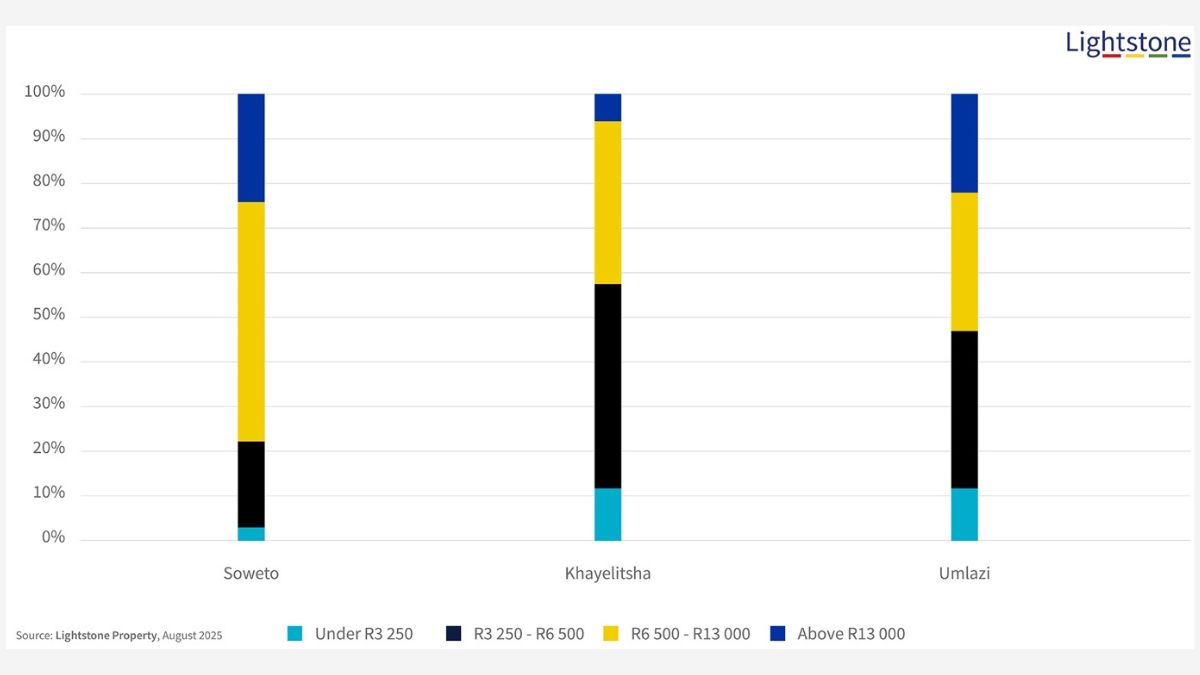
When it comes to income, Soweto is South Africa’s wealthiest township. Over 20% of households there earn more than R13,000 a month.
Umlazi has similar proportions at the top end, but Khayelitsha lags far behind, with nearly 60% of households earning less than R6,500 a month.
“Apart from being the oldest township with the largest population, Soweto is also the wealthiest of the three townships when it comes to household income. Khayelitsha is the youngest and the poorest,” said Ivins-Downes.
Property up to seven times cheaper than their city counter parts
Property values follow the same pattern. Soweto’s average property is worth R585,000, Umlazi’s R560,000, and Khayelitsha’s just R350,000.
Most homes in Khayelitsha are valued between R200,000 and R400,000, compared to R400,000 to R700,000 in Soweto and R400,000 to R600,000 in Umlazi.
Soweto also has 1,600 properties worth more than R1 million, while Khayelitsha has none.
The differences are even more evident when compared to the cities themselves. Johannesburg’s average property value is three times higher than Soweto’s, Durban’s is double Umlazi’s, and Cape Town’s is seven times higher than Khayelitsha’s.
“This is not surprising. Khayelitsha is the poorest of the three townships, and property prices in Cape Town have been surging in recent years as the Western Cape attracts people from other provinces,” said Ivins-Downes.
Ownership is another factor. Soweto has a stronger ratio of households to registered properties at 2.25:1, compared to 3.2:1 in Umlazi and 3.3:1 in Khayelitsha.
Soweto has seen middle-class housing, lifestyle estates, and government upgrades. Umlazi has some formal housing developments in areas like Z and BB sections.
Khayelitsha, however, is still dominated by informal and RDP housing, reflecting its rapid population growth and lower-income base.
Property transactions also vary. Soweto still records the most transfers, despite a general decline over the past decade.
Umlazi shows a similar trend. Khayelitsha, however, saw rising transfers between 2018 and 2022 before falling in the past three years.
Ivins-Downes noted that this data proves that townships are central to the country’s housing picture.
“Understanding these dynamics is critical, because the future of South Africa’s property market is as much about our townships as it is about our cities,” she said.















 Loading ...