

SA awaits SKA decision


An announcement to reveal the winning bid to host the R15.75 billion Square Kilometre Array (project) is expected this afternoon (25 May 2012).
If awarded to South Africa, the project is set to bring major investment into the country, as well as validating the millions already spent by local companies in securing the bid.
Scientists hope the Square Kilometre Array will shed new light on fundamental questions about the universe, including how it began, why it is expanding and whether it contains life beyond our planet.
The SKA will consist of about 3,000 dish-shaped antennae spread over a wide area, and will be 50 times more sensitive than any former radio device, and more than 10,000 times faster than today’s instruments.
If Africa wins the bid, the core of the telescope will be constructed in the Karoo region of the Northern Cape, with outlying telescope stations throughout SA, and in Namibia, Botswana, Ghana, Mozambique, Zambia, Kenya, Madagascar and Mauritius.
Information leaked to the media in early March 2012 suggesting that the selection committee, which conducted its assessments earlier this year, had recommended the project be awarded to South Africa.
Locally invested
Local companies and organisations have already invested heavily into the SA SKA bid to make it the most appealing host country for the project.
Sentech, the commercial provider of all broadcast transmissions in South Africa, adapted its FM radio and digital TV band plans and transmitter locations to accommodate the regulations in the Astronomy Geographic Advantage (AGA) Act, Act No. 21 of 2007, legislation protecting the radio reserve.
Vodacom and MTN, are developing and implementing directional antenna technologies that will ensure that towers surrounding the reserve do not transmit signals into the reserve that contravene the AGA regulations.
The main fibre link between Carnarvon and Cape Town being provided by Broadband Infraco and local and international data connectivity for the SKA are being investigated in collaboration with the submarine cable operator SEACOM and national dark fibre provider FibreCo Telecommunications.
Collaborative work is being undertaken with Nokia Siemens Networks to develop termination equipment solutions for both the MeerKAT and SKA.
Investment boost in South Africa
Science and technology director general Phil Mjwara said in February that a winning bid by SA would see billions of rand flowing into the local economy, reports Sapa.
After updating Parliament’s science and technology portfolio committee on the bid process, he noted that the cost of building dishes for the MeerKat radio telescope, in the Karoo, was about R1 billion.
“If we’re spending about R1 billion on 64 dishes, you can imagine that if all of the dishes for the SKA are going to be manufactured here – about 3,000 dishes – you can just do the maths. So huge resources are going to flow into South Africa,” Mjwara said.
“But it’s not just going to be the huge resources; it’s the intellectual capital that’s going to flow in, with all the spin-offs in terms of some of the ICT and processing technology that we need for the country.”
Asked if it would be correct to say the SKA would provide a multi-billion rand boost to the South African economy, he replied: “That would not be an exaggeration.”
The SKA timeline
- 1991 – Concept
- 2006 – Short listing of suitable sites
- 2008-12 – Telescope system design and cost
- 2011 – Establish SKA organisation as a legal entity
- 2012 – Site selection
- 2013-15 – Detailed design and pre-construction phase
- 2016-19 – Phase 1 construction
- 2018-23 – Phase 2 construction
- 2020 – Full science operations with Phase 1
- 2024 – Full science operations with Phase 2
Global array
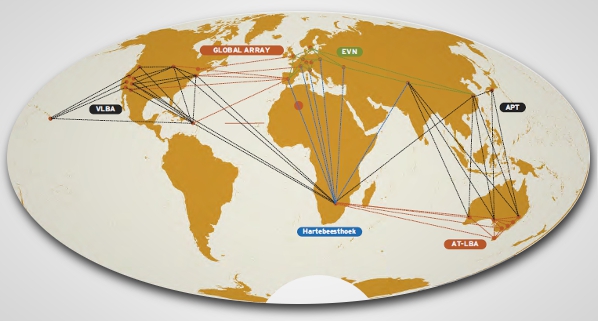
The global array
Related aritcles
SKA announcement delayed, Pandor disappointed
IBM wins 32.9 million Euro SKA contract















 Loading ...