

The biggest, deadliest earthquakes in history


Nepal has been hit by a second devastating earthquake on Tuesday after an initial 7.8 magnitude quake killed over 8,000 people two weeks ago.
The second quake registered a surface wave magnitude of 7.3 that left at least 16 people killed and almost 1,000 injured, according to reports.
The quake struck near the base camp for Mt Everest and was measured at a shallow depth of about 18km.
A series of aftershocks, including a 6.3 magnitude tremor, hit in the same area, the US Geological Survey reported.
Biggest earthquakes in the 21st century
Measuring magnitude
Earthquakes are measured by magnitude, which in seismology is either measured on a local magnitude scale or surface wave scale – both attributed to seismologists Charles Francis Richter and Beno Gutenberg.
Magnitude is determined from the logarithm of the amplitude of waves recorded by seismographs. The scales are base 10, meaning every whole number increase on the scale reflects a ten-fold increase in magnitude.
Effectively this means that a magnitude 6 earthquake is ten times bigger than a magnitude 5 – and 100 times bigger than a magnitude 4.
Energy released, thus the strength of an earthquake, is measured on base 32.
A more detailed breakdown of the differences can be found on the USGS website.
The Nepalese earthquake marks the most destructive seismic activity since the 9.0 magnitude off the east coast of Japan in 2011, which left 18,200 people dead, and almost 3,000 missing.
Before that, however, the past 15 years have seen some truly harrowing and destructive earthquakes hit some of the poorest nations in the world.
On Boxing Day 2004 (26 December), a 9.1 magnitude earthquake struck the Indian Ocean, causing a tsunami which hit many countries in South East Asia.
The earthquake, combined with the tsunami, has been described as the world’s deadliest natural disaster since 1976 – with the tsunami in particular the most damaging in recorded history.
The death toll was put at over 184,000 casualties, though estimations put the total closer to 230,000, with a further 45,000 missing, presumed dead.
The most destructive earthquake, based on the quake alone, happened in 2010 in Haiti, where a magnitude 7.0 quake epicentered near the town of Léogâne, ulimately leading to as many as 160,000 deaths.
Poor levels of healthcare in a shattered country after the quakes lead to further pain as Haiti suffered a cholera outbreak in the years that followed. This resulted in 10,000 additional deaths.

Shifting plates along fault lines cause earthquakes
5 biggest earthquakes since 2000
| Earthquake | Region | Year | Deaths | Magnitude |
| Indian Ocean Earthquake | Indonesia | 2004 | 280 000 | 9.1 |
| Tohoku Earthquake | Japan | 2011 | 18 200 | 9.0 |
| Chile Earthquake | Chile | 2010 | 550 | 8.8 |
| Indian Ocean Earthquake | Indonesia | 2012 | 10 | 8.6 |
| Sumatra Earthquake | Indonesia | 2007 | 25 | 8.5 |
10 deadliest earthquakes since 2000
| Earthquake | Region | Year | Magnitude | Est. Deaths |
| Indian Ocean Earthquake | Indonesia | 2004 | 9.1 | 280 000 |
| Haiti Earthquake | Haiti | 2010 | 7.0 | 160 000 |
| Kashmir Earthquake | Pakistan | 2005 | 7.6 | 100 000 |
| Sichuan Earthquake | China | 2008 | 7.9 | 87 500 |
| Bam Earthquake | Iran | 2003 | 6.6 | 27 000 |
| Gujurat Earthquake | India | 2001 | 7.7 | 20 100 |
| Tohoku Earthquake | Japan | 2011 | 9.0 | 18 200 |
| Nepal Earthquake | Nepal | 2015 | 7.8 | 8 100 |
| Java Earthquake | Indonesia | 2006 | 6.3 | 5 800 |
| Yushu Earthquake | Algeria | 2010 | 6.9 | 2 700 |
The deadliest earthquake ever recorded occurred in 1556 in Shaanxi, China, with an estimated death toll of 830,000 people.
The death toll has been questioned, mostly due to the lack of accurate measurement for the time, however due to the massive damage caused by the magnitude 8.0 quake – a 840 kilometre wide area was destroyed – the estimates are considered to be in range.
Another disastrous earthquake struck China in 1920, and again in 1976, which lead to the deaths of almost a million people, combined.
Historical data on earthquakes before the 20th century is often regarded as inaccurate and is subsequently based on estimates from studies into the long-term effects of seismic activity and other historical accounts.
Some of the largest and deadliest earthquakes occurred in regions where seismic activity is most concentrated – specifically in East Asia, a region where multiple tectonic plates meet, and regions of the middle east that sit on the cross-points of two or more plates.
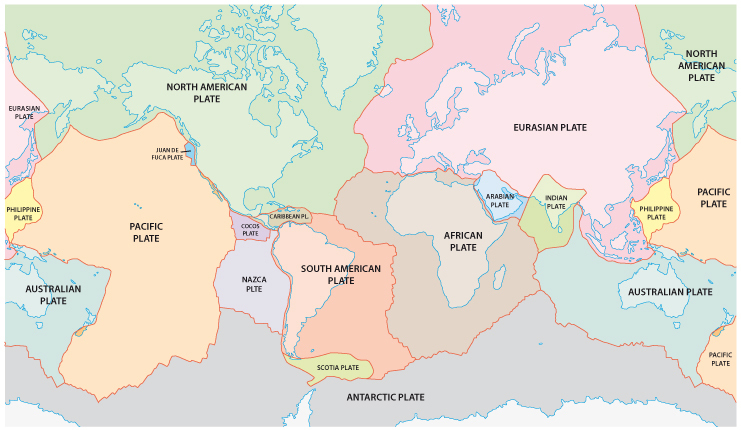
World tectonic plates map
10 biggest earthquakes in history
| Earthquake | Region | Year | Deaths | Magnitude |
| Chile Earthquake | Chile | 1960 | 1 700 | 9.5 |
| Great Alaskan Earthquake | Alaska | 1964 | 131 | 9.2 |
| Indian Ocean Earthquake | Indonesia | 2004 | 280 000 | 9.1 |
| Tohoku Earthquake | Japan | 2011 | 18 200 | 9.0 |
| Kamchatka Earthquake | Russia | 1952 | 0 | 9.0 |
10 deadliest earthquakes in history
| Earthquake | Region | Year | Magnitude | Est. Deaths |
| Shaanxi Earthquake | China | 1556 | 8.3* | 830 000 |
| Tangshan Earthquake | China | 1976 | 7.8 | 655 000 |
| Indian Ocean Earthquake | Indonesia | 2004 | 9.1 | 280 000 |
| Haiyuan Earthquake | China | 1920 | 7.8 | 270 000 |
| Antioch Earthquake | Turkey | 526 | 7.0* | 265 000 |
| Antioch Earthquake | Turkey | 115 | 7.5* | 260 000 |
| Aleppo Earthquake | Syria | 1138 | – | 230 000 |
| Hongdong Earthquake | China | 1303 | – | 200 000 |
| Damghan Earthquake | Iran | 856 | 7.9* | 200 000 |
| Tabriz Earthquake | Iran | 1780 | – | 200 000 |
* estimated
South Africa is not known to be a high quake risk region.
However, in August 2014, Johannesburg was hit by a 5.5 magnitude earthquake – the second biggest after a 6.3 magnitude quake that hit Tulbagh in the Western Cape in 1969.
Professor Andrzej Kijko of the University of Pretoria natural hazard centre, quoted in a TimesLive report after the most recent Joburg quakes, pegged the country’s seismic activity on the mining sector.
Kijko said that 95% of South Africa’s earthquakes were caused by mining, especially around the areas of Klerksdorp, Welkom and Carletonville.
“Mining in South Africa is leading to enormous stress factors being created. If there is a natural fault weakness 6km underground the stresses caused by mining can easily activate it.”
“In South Africa one can easily expect earthquakes of such magnitude to occur every five to seven years,” he said.
More on the world
Joburg hit by 5.3 magnitude earthquake
World’s largest “supervolcano” is even bigger than previously thought
















 Loading ...