

South Africa submits ambitious deal to the US, and the state-owned firm that pays the average worker R1.7 million


The rand remained mostly stable in early trading on Friday, as investors refrained from making significant bets ahead of the South African Reserve Bank’s (SARB) interest rate decision next week.
It traded at 16.47 against the dollar, very close to its previous close. The market is primarily focused on the SARB’s Monetary Policy Committee meeting scheduled for Thursday.
Most economists anticipate a 25-basis-point rate hike, likely resulting from a split vote. Economists noted that the interest rate hike could reduce the likelihood of second-round inflation pressure.
However, they also pointed out that policymakers might argue that current monetary conditions are already tight enough and could overlook what is expected to be a temporary spike in inflation.
Recent data revealed that inflation surged to 4% in April, up from 3.1% in March, marking the highest level since August 2024.
Investors will also be keeping an eye on several economic indicators set to be released next week.
This includes the leading business cycle index on Tuesday, producer inflation on Thursday, and figures for money supply, private sector credit, trade balance, and budget balance on Friday.
The US dollar remained flat against a basket of currencies after a volatile overnight session, amid conflicting signals on a potential US-Iran peace deal. However, investors remained hopeful for some progress.
On the Johannesburg Stock Exchange, the Top-40 index rose by 0.7%. South Africa’s benchmark government bond for 2035 showed little movement in early trades, with a yield of 8.77%.
On Monday, 25 May, the rand was trading at R16.34 to the dollar, R22.02 to the pound, and R19.01 to the euro. Gold is trading lower at $4,561.66 an ounce, while oil prices were at $97.88 a barrel.
5 important things happening in South Africa today

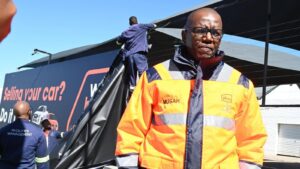
New AGOA deal submitted: The South African government is defending its eligibility for the African Growth & Opportunity Act (AGOA) and is seeking a 15-year extension of the duty-free pact. The Department of Trade, Industry, and Competition, led by Parks Tau, argued in its submission to the US that a longer agreement would benefit both countries. [Business Day]
State-owned company paying R1.7 million on average: The average employee at the Public Investment Corporation (PIC) received a total pay package of around R1.7 million in 2025. This is higher than at the Reserve Bank, where the average employee is paid R1.4 million, and is significantly more than the National Treasury’s average of R600,000. [Daily Investor]
Bad news for medical aid members: Young South Africans are increasingly dropping out of medical aid schemes, putting serious financial pressure on the remaining members and threatening the long-term sustainability of private healthcare in the country. [BusinessTech]
Government throws a lifeline to car manufacturers: South Africa plans to change its auto-industry incentive programme to channel more support to electric vehicle (EV) battery manufacturers, boosting the nation’s prospects of becoming a manufacturing hub for the fast-growing technology. [MyBroadband]
Treasury clamps down on indebted municipalities: The National Treasury will deduct amounts owed to municipalities by national and provincial government departments to settle outstanding debts, announced Finance Minister Enoch Godongwana in his Budget Vote address. [Engineering News]








 Loading ...