

Is it better to buy to rent or invest in property stocks in South Africa?


You may spend your holidays thinking about owning coastal property, or maybe you are considering increasing your property portfolio with a number of buy to rent assets.
Dale Peckover, wealth manager at AlphaWealth considers whether it is easier and more lucrative to just buy into Real Estate Investment Trusts (REITs).
REITs are a security that trade like a stock on the major exchanges and invest in real estate directly, either through properties or mortgages.
Individuals can invest in REITs either by purchasing their shares directly on an open exchange or by investing in a unit trust that specialises in public real estate.
Peckover states: “It’s easy to see why buy to rent is an attractive investment: you can see your bricks and cement and manage it in a way you just can’t do with shares.
But there is a great deal of risk associated with rental income and it is very easy to overlook the real investment risks associated with buy to rent, the considerable costs you might incur, not to mention the drain this type of investment might have on your time.
If you want to have the laid back life as a property investor, property stocks are the way to go.”
Asset class performance: 20 years to 31 March 2016
| Nominal return | Real return | |
|---|---|---|
| Equity (ALSI) | 14.6% | 8.1% |
| Property (AJ255/J253) | 21.9% | 15.0% |
| Bonds (ALBI) | 11.8% | 5.4% |
| Cash (STEFIND) | 9.3% | 3.1% |
| Gold (ZAR) (GOLR) | 13.2% | 6.8% |
| Residential property (ASAHPI) | 10.9% | 4.6% |
| CPI (ECPI) | 6.0% |

As illustrated in this graph, listed property (REITs) have significantly outperformed property on a nominal and real basis not only over 20 years but also over one year, five years 10 years and even 30 years.
| REITs | Property | |
|---|---|---|
| Buying Costs | Trade fees: +/- 0.50% per trade |
|
| Ongoing costs | Custodian fee: +/- R750 p.a |
|
| Selling costs | Trade fees: +/-0.50% per trade |
|
But why is this so? Both property types have identical tax treatments, i.e. rental income and distributions from REITs are both taxed according to income tax rates, both incur capital gains tax upon sale and neither of them qualifies for primary residence exemption.
Peckover offers a number of explanations:
1. The cost differential
2. Gearing and cost of debt
If a bond is used to purchase your buy to rent property, this is essentially gearing or leverage i.e. the use of borrowed capital to generate/ increase the potential return of an investment.
By investing in REITs, your gearing is still achieved, however at a much lower borrowing rate due to the borrowing being done by the REITs. Where individuals are able to borrow at prime or prime less 1%, REITs are able to borrow at a rate of at least prime less 2%.
3. Risks
- Default and loss risk: When buying to rent, any borrowing to acquire your property is done in your personal capacity thus introducing the risk of default, being blacklisted and potentially losing more capital than you put in (i.e the amount you borrowed, the amount you put in as well as any outstanding interest). When buying property stocks, the borrowing is done by the REITs themselves. Therefore there is no debt in your personal capacity and thus no risk of default. Instead the risk you take on when you buy REITs is limited to the amount you invested – you can’t lose more than you put in.
- Increasing interest rates: As illustrated below, interest rates are at low levels and may continue to rise in the coming years. Even if they are not predicted to rise very far or even very fast, the rise in interest rates will directly impact your borrowing rate and as such your monthly repayments. The increase in monthly repayments is a real risk. This needs to be considered when taking on monthly repayments which may already be putting you under strain.
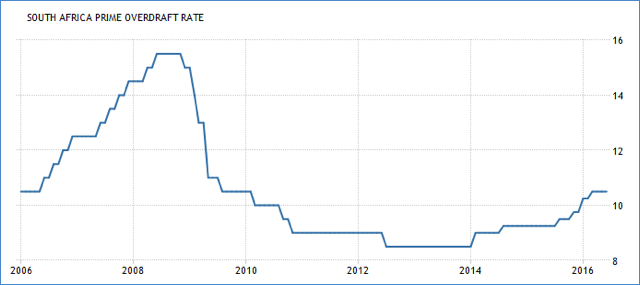
When investing in REITs, the interest rate needs to be addressed by the REIT and not you. Many of the REITs are hedging or have already hedged a portion of their interest rate exposure to minimise their risk in an increasing interest rate environment.
- Volatility risk: REITs are stocks and are therefore subject to stock market volatility; however house prices also go up and down, although less frequently. Remember that during periods of market stress, residential property is not left unscathed.
- Vacancy risk: When you own a property, you face the risk of your tenant leaving, cancelling or not paying. Should any of these occur, you face the risk of loss of rental income and the cost of turnover, this could lead to having to outlay cash to fund other expenses/savings your rental income ordinarily covered. REITs also have vacancy risks and these cannot be avoided. REITs generally have management companies that try to assist in the alleviation of vacancies and the vacancy is not something you need to spend hours trying to resolve.
4. Rental income versus REIT distributions
Rental income is not guaranteed. Distributions from REITs are not guaranteed either. REITs however are affected by market sentiment coupled with market reputation that significantly reduces the likelihood of decreased or no distributions.
5. Diversification benefits
With the price of property and all the other associated costs of buying, diversification of any sort is exceptionally difficult. REITs provide immediate diversification by the nature of the various property portfolios.
These often consist of investments in a number of property types, including industrial properties, warehousing, offices, residential properties, shopping centres and many more.
To further diversify, they are in different geographical regions (this includes offshore exposure) with different opportunities, tenants, growth possibilities, income streams and capital appreciation potential.
It is also simple to gain more exposure to particular property types by investing in REITs that have more exposure to the property type you favour.
6. Liquidity
Rental properties are not liquid. It could take months or years to sell a rental property and if you need to sell it quickly to raise cash, you might need to drop the price below the current market value to attract a buyer.
REITs, by contrast, can be bought and sold with the click of a mouse. This makes them very liquid investments that can be quickly and easily converted to cash without losing substantial amounts of time and paying excessive fees.
7. Admin
Buying a rental property isn’t solely a financial decision. You need to be prepared to screen tenants, run credit checks, collect rental, negotiate rental escalations, field complaints and get the geyser repaired right now.
Alternatively you can use a sales or letting agent to take care of your administration but this will incur additional fees which will reduce your return. When you own a REIT, none of the admin is your concern.
More on property
Two ways to help your child onto the property ladder
How Brexit will impact the value of your house – and the SA property market


















 Loading ...