

South Africa has a tough fight to keep its title as Africa’s top economy


South Africa, Nigeria and Egypt have spent the last year shuffling around as the top three economies in Africa – but with a technical recession and economic growth slowing to a crawl, SA’s spot as “Africa’s number one economy” won’t be around for much longer.
The IMF recently released its World Economic Outlook for April 2017, showing how all the countries in the world currently sit on a number of economic indicators, as well as how they are projected to perform to 2022.
As one of the most populous countries on the continent, Nigeria is hailed as the ‘GDP leader’, leveraging its population of over 185 million people to bolster its production.
Since 2014, a rebasing of its GDP data put Nigeria’s economic numbers into a more up-to-date context, pushing the country to the top of the pile as Africa’s biggest economy.
There were a few instances in 2016, where the Nigerian economy faltered, giving South Africa a gap to reclaim the title, but the IMF’s latest data shows that it was short-lived.
Amid a crumbling economy in the wake of several political scandals in 2016 – most notably the state capture saga – South Africa was even overtaken by Egypt as the second biggest economy on the continent, though this was again reversed a few months later.
Despite these ups and downs and shifts among the top three – South Africa has always been able to claim the title of “Africa’s top economy” using one key metric – GDP per capita; total wealth spread across each individual citizen.
But now South Africa is at risk of losing that position as well, the IMF data shows, as it looks to be decisively beaten out by its continental competitors.
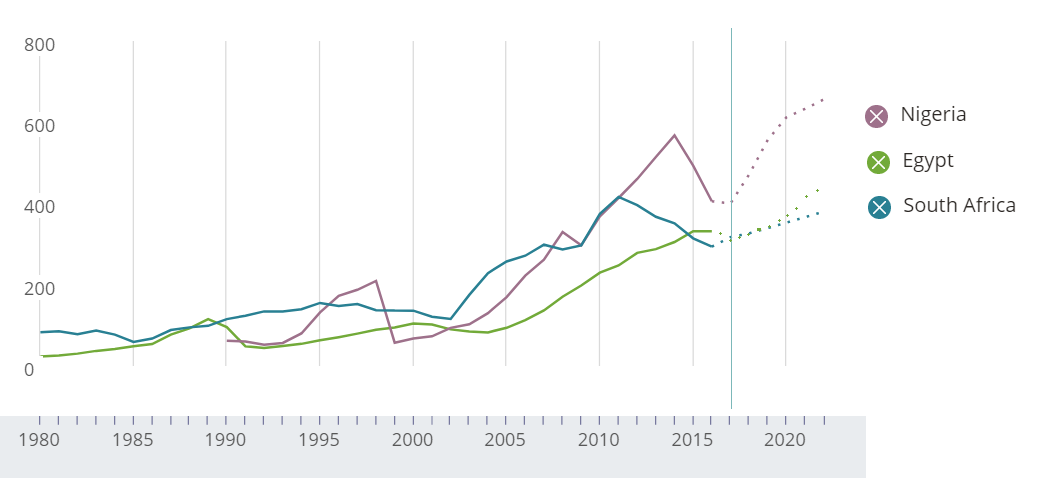
Nominal GDP
Projected GDP output among the top three for 2017 looks like it will maintain the status quo: Nigeria’s projected output of $400.6 billion puts it at the top of the table, followed by South Africa’s $317.6 billion, and Egypt’s $294.1 billion.
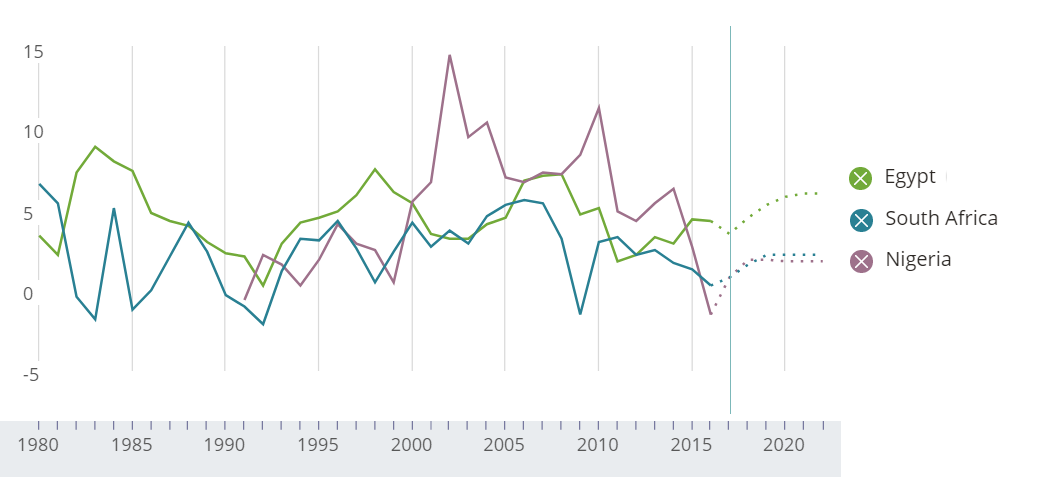
But as the countries move ahead, South Africa’s low growth rates (expected at between 0.2% and 1.0%, depending on who you ask) gives way to Egypt’s far more positive data (a growth rate of between 4.5% and 6.0% over the years) to take decisively take second place.
By 2022, Nigeria is expected to still be on top with $656.9 billion, with Egypt at $416.5 billion, and South Africa trailing behind at $380 billion.
Real GDP growth
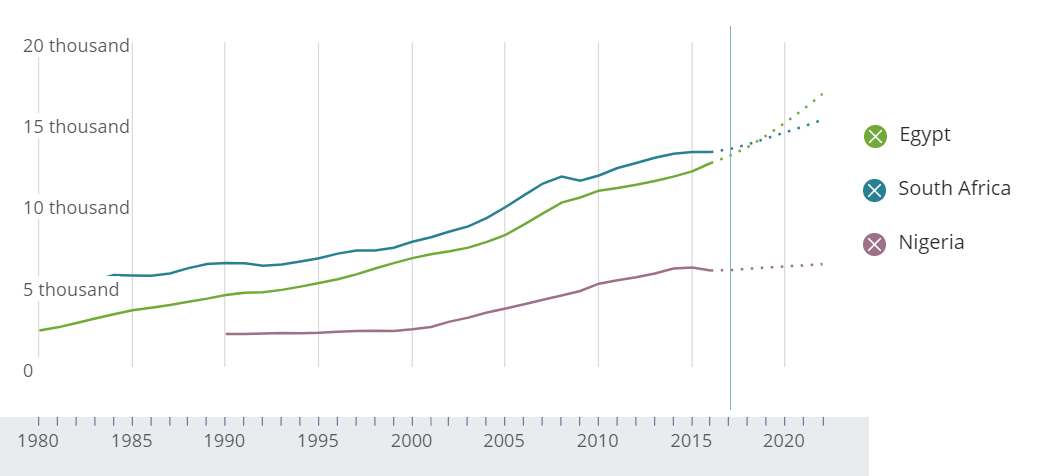
GDP per capita (PPP)
Looking at GDP per capita, South Africa has always maintained a strong lead over African countries – however things are about to change.
In 2017, GDP per capita (adjusted for purchasing power parity – ie cost of living in a country), South Africa’s is still at the top at $13,410 per person, with Egypt already creeping up at $12,980 per citizen.
By 2022, this picture will have changed, where Egypt will be at $16,810 per person, and South Africa at $15,220, officially losing any claim to be Africa’s leading economy using this metric.
On a nominal basis (not adjusted for PPP) however, South Africa will remain in the top spot ($6,180 per person, versus Egypt’s $3,721 and Nigeria’s $3,040).


















 Loading ...