

Voice prices and MTRs: the truth



South Africa’s mobile termination rate (MTR) reductions of March 2011 and March 2012 have not, contrary to the claims made by operators, hurt the industry or led to higher retail prices, lower investments or retrenchments.
This is according to Research ICT Africa head, Professor Alison Gillwald, who presented her findings to the Parliamentary Portfolio Committee on Communications last week.
“While end-user prepaid mobile telephony prices have come down to some extent, the prices are still high, and SA’s MTRs are still far above the cost of an efficient operator,” said Gillwald.
Gillwald said that the regulator’s (Icasa’s) glide path is too slow and will not take the MTRs down to the cost of an efficient operator.
“As a consequence, South Africa continues to be among the most expensive countries in Africa for prepaid mobile usage,” said Gillwald.
She added that fair competition is needed in order to ensure a decrease in mobile tariffs, and above-cost MTRs are one of the main obstacles to fair competition.
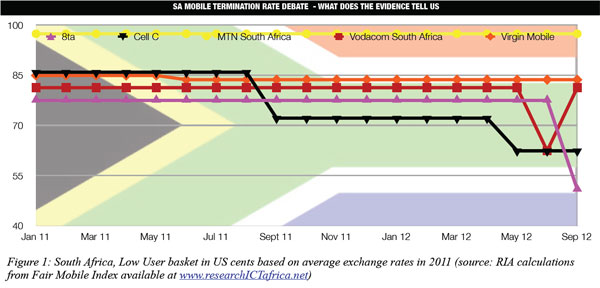
SA Mobile Termination Rates and retail prices
MTR reductions have been too small
Gillwald argued that more aggressive MTR price reductions will lead to far lower retail rates. The following summary from Research ICT Africa’s report describes the situation:
The belated and insubstantial MTR reductions in South Africa, initially through political pressure rather than cost-based pricing regulation – such that the rate was set far above the cost of an efficient operator — have failed to produce the positive competitive outcomes witnessed in countries such as Mauritius, Kenya, Namibia and Ghana.
In South Africa, dominant operators have been able to withstand short-term pricing pressure because as the MTR reductions have apparently been too small to allow marginal late entrants to sufficiently undercut incumbent operator prices.
The cases of Namibia and Kenya, where significant MTR reductions have occurred, demonstrate the positive effect on retail prices which can occur (as a result of pricing pressure on dominant operators).
But the South African case demonstrates that the pass-through to consumers of MTR savings is not automatic, and that relatively small reductions in termination rates do not provide new entrants with sufficient room to compete (i.e. to put their off-net prices in competition with the on-net prices of dominant operators in order to attract subscribers to their (smaller) networks).
Only MTRs set at the costs of an efficient operator can lead to the dynamic competition, with all its benefits for the consumers and the economy, witnessed in Namibia and Kenya.
On the other hand, mobile retail prices in South Africa have certainly not gone up to compensate for losses in MTR revenues – contrary to what the regulator ICASA was told by operators that the unintended outcome of rate reductions would be.
Moreover, the MTR reductions have not pushed Vodacom or MTN to the brink of bankruptcy or into making worker retrenchments.
Both did better in the last financial year, compared to the previous year, in all key performance areas — and should in fact be basking in the knowledge that they have grown the market.
The case of South Africa, as in many other countries, shows that there is no uni-directional link between MTRs and retail prices, contrary to the claims of those defending the status quo of arbitrarily high MTRs.
The evidence in South Africa, as elsewhere, is that the setting of mobile retail prices is not primarily a question of revenue replacement but rather one of profit maximization in a competitive environment where the choices of one operator influence the revenues and profits of another.
The erroneous argument sold to regulators — that termination rates and retail prices are linked through a two-sided market, and that reductions in termination rates will result in an increase in retail prices — is not supported by the evidence.
Related articles
South Africa’s mobile pricing regulatory challenges


















 Loading ...