

Province with the most dissatisfied South Africans – and their main complaints



New data show that Gauteng has the most dissatisfied South African consumers, accounting for a significant share of complaints lodged with the Consumer Goods and Services Ombud (CGSO).
The CGSO annual report for 2026 noted that the Ombud received 15,355 complaints between 1 March 2025 and 28 February 2026.
This represents a 25.8% increase from the 12,207 complaints recorded in the previous financial year. Of these, 13,076 cases were closed.
Chief Executive Officer Queen Munyai said the sharp increase reflected growing demand for the Ombud’s services.
“Demand for our service rose sharply this year. We received 15,355 complaints, 25.8% more than the previous year, and closed 13,076 complaints,” she said.
Gauteng, together with the Western Cape and KwaZulu-Natal, accounted for 78% of all complaints. These three provinces contain South Africa’s largest metropolitan areas and therefore have much larger concentrations of consumers and businesses.
The report does not rank the three provinces individually by complaint numbers, meaning it does not state that Gauteng alone had more complaints than the Western Cape or KwaZulu-Natal.
However, Gauteng’s large population and concentration of economic activity make it a major contributor to the overall volume of complaints.
The biggest complaints were not necessarily about specific provinces, but about the products and services consumers received. Defective goods, cancellations and delivery problems continued to dominate.
Goods that became defective within the first six months accounted for 19% of all complaints, while cancellations accounted for 16%.
Late or incorrect deliveries accounted for a combined 25%, making these among the most common sources of consumer frustration.
Ombudsman Liaquat (Lee) Soobrathi said these problems remained consistent with previous years. “Defective goods, cancellations and delivery-related disputes continue to account for a significant proportion of complaints received,” he said.
The table below displays the number and proportion of consumer complaints received across South Africa’s nine provinces, comparing the 2025/26 financial year with the 2024/25 period.
| Province | Complaints Received (2025/26) | % of Total (2025/26) |
|---|---|---|
| Gauteng | 7,196 | 47% |
| Western Cape | 2,870 | 19% |
| KwaZulu-Natal | 1,898 | 12% |
| Eastern Cape | 891 | 6% |
| Limpopo | 601 | 4% |
| Mpumalanga | 576 | 4% |
| North West | 570 | 4% |
| Free State | 554 | 4% |
| Northern Cape | 199 | 1% |
| Total | 15,355 | 100% |
The services and products South Africans complained the most about
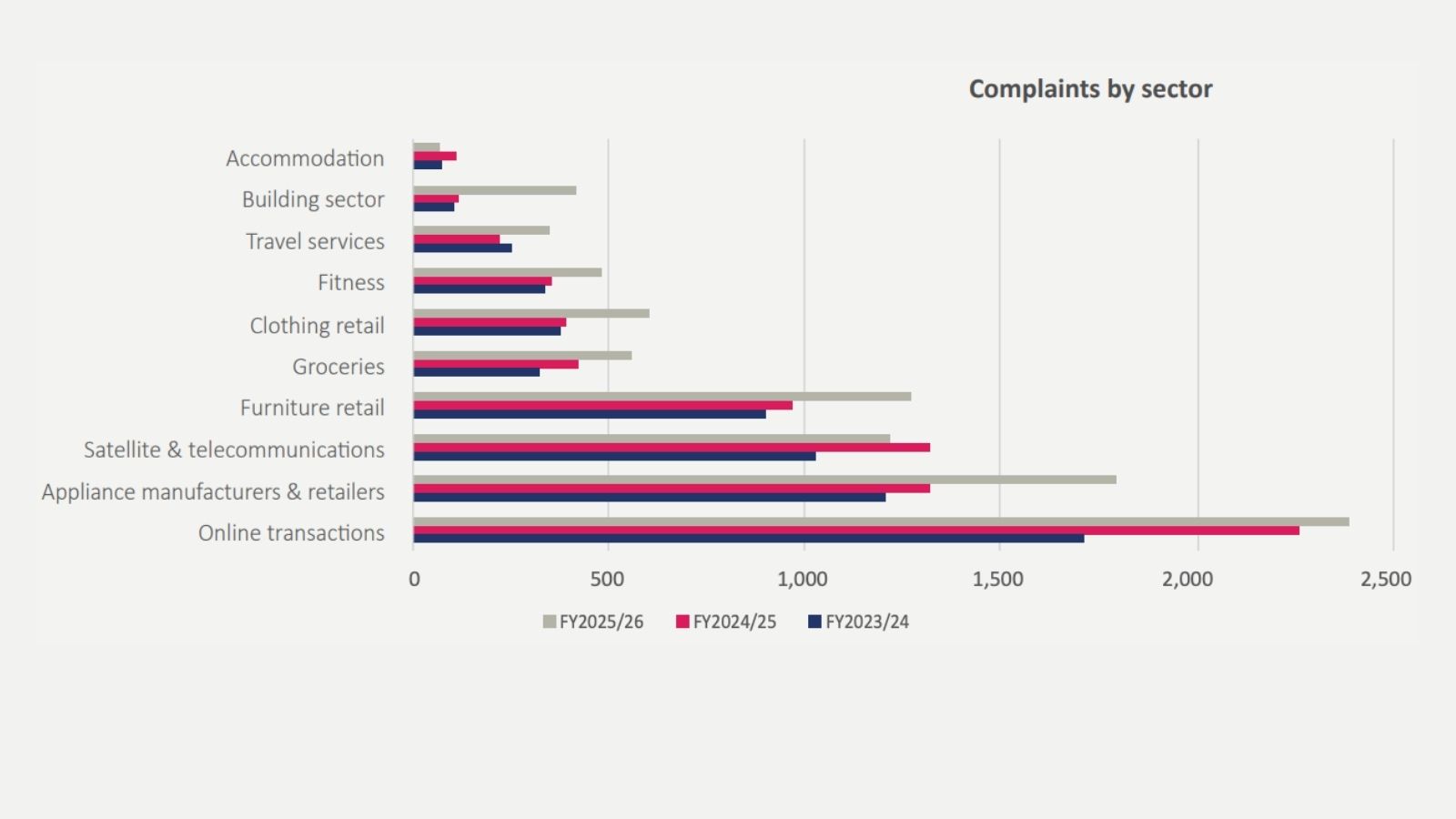
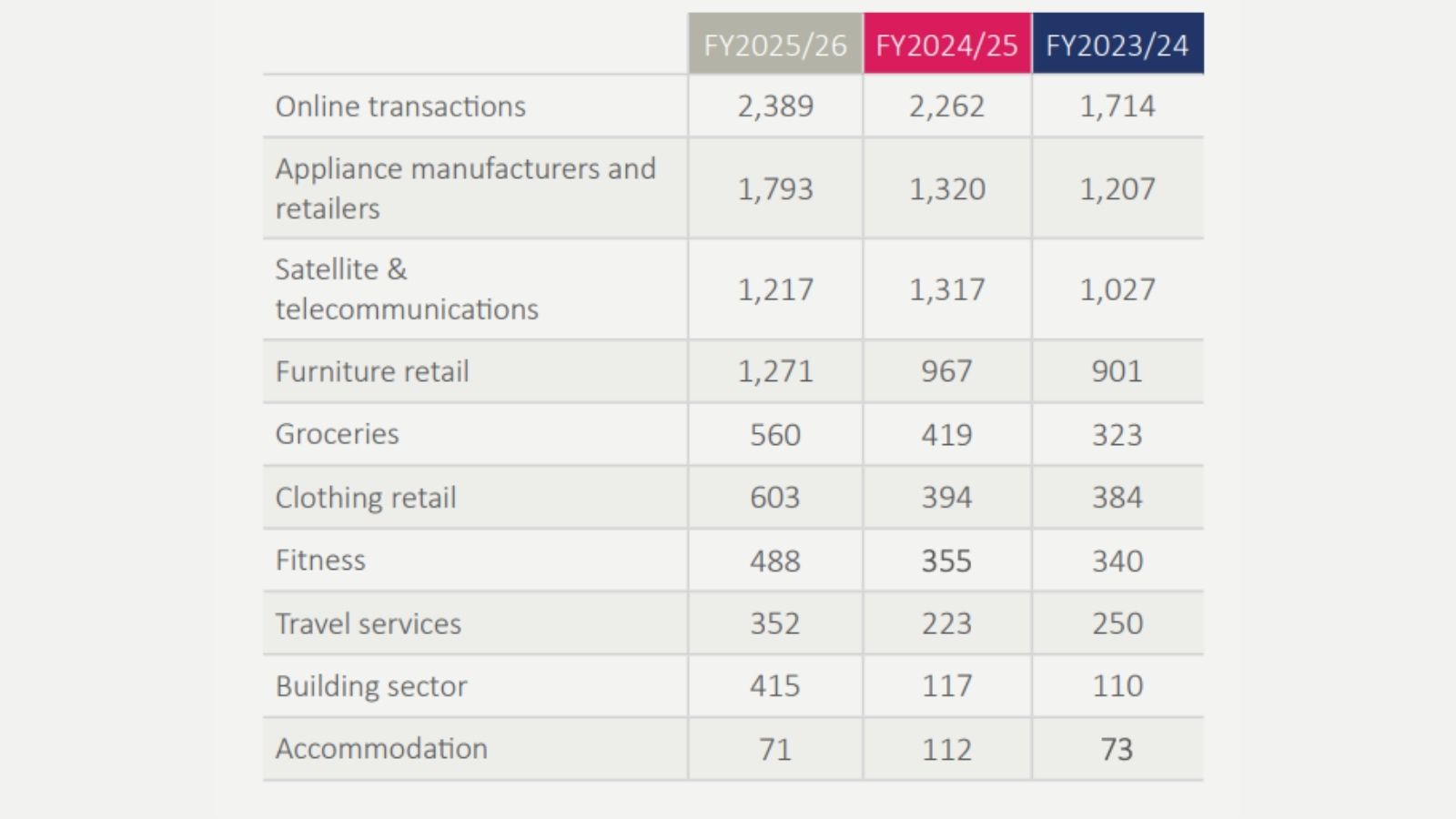
Online transactions were the largest contributing sector, accounting for 26% of complaints. This was followed by appliance manufacturers and retailers at 19%, furniture retailers at 14%, and satellite and telecommunications companies at 13%.
The figures highlight some of the difficulties consumers face when shopping online. Late or incorrect deliveries are subject to consumer protection rules, while online purchases can also involve cooling-off rights under the Electronic Communications and Transactions Act.
Defective products are covered by sections 55 and 56 of the Consumer Protection Act, which provide protection relating to quality and durability.
However, the CGSO noted that a further 7% of complaints involved products becoming defective after the initial six-month period, when manufacturer warranties may become more important.
Cancellations were another major source of disputes, particularly in telecommunications, fitness, travel and accommodation.
Despite the increase in complaints, consumers recovered almost R13 million through the Ombud process. The CGSO recovered R12,978,059.87 in cash or cash equivalents during the year, up from R11,956,064.43 previously, an increase of about 8%.
This was substantially less than the R2.5 billion initially claimed by consumers. However, the report noted that a single R2 billion claim accounted for most of this difference and was ultimately outside the CGSO’s jurisdiction.
Of the complaints closed, 3,317 could not proceed, mainly because they fell outside the Ombud’s jurisdiction. Of the 9,759 eligible complaints, 64% resulted in a positive outcome for consumers.
However, supplier cooperation remained a major problem. The CGSO issued 1,715 termination notices after suppliers failed to respond despite efforts to obtain their cooperation.
Munyai said this was one of the biggest barriers to resolving disputes. “The single biggest obstacle to a fair outcome is not the complexity of a complaint but the refusal of some suppliers to engage with this office,” she said.
Consumers whose cases are terminated can be referred to the National Consumer Commission (NCC), where non-cooperating suppliers may face penalties of up to 10% of annual turnover under the Consumer Protection Act.


















 Loading ...