

Greenpeace ranks worst carmakers for emissions efforts


The world’s top-selling automakers have come under fire from Greenpeace who ranked their carbon emission efforts by auto firms, citing Toyota as the worst culprit.
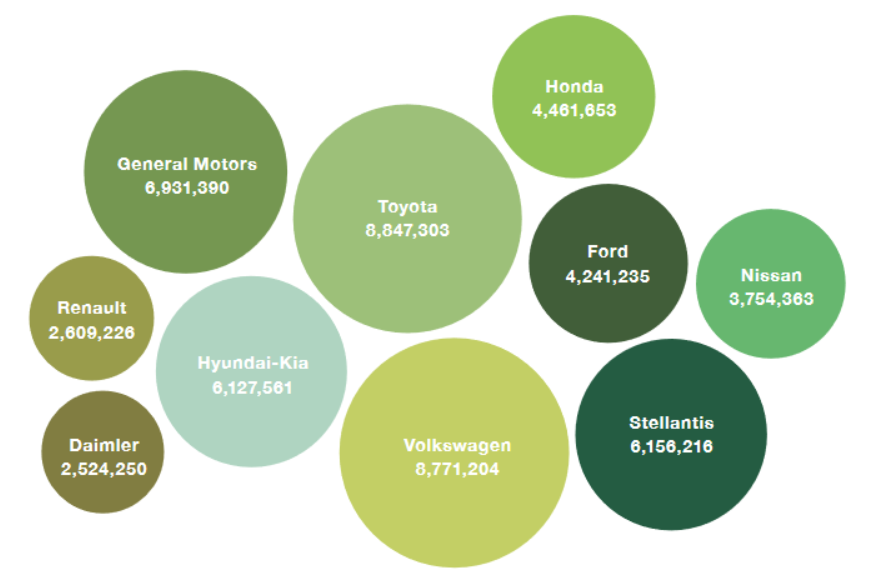
Greenpeace East Asia analyzed the world’s top 10 automakers’ decarbonisation efforts, ranking Daimler, Ford, General Motors, Honda, Hyundai-Kia, Nissan, Renault, Stellantis, Toyota, and Volkswagen.
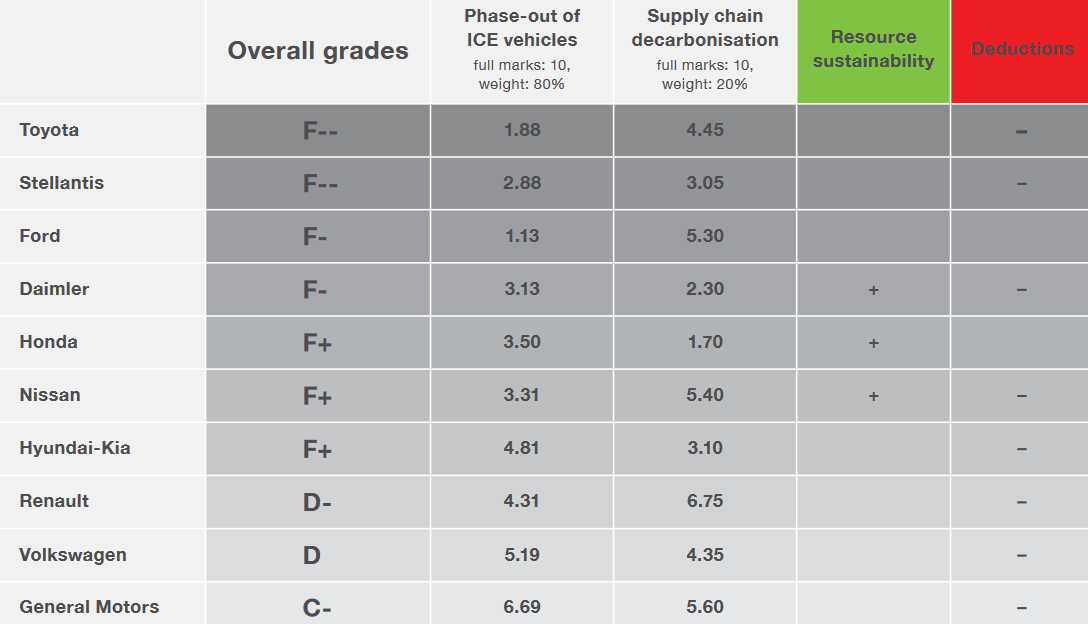
None of the companies plan to phase out internal combustion engine (ICE) vehicles earlier than 2035, which would make achieving the 1.5°C climate goal very difficult, and seven out of t10 automobile groups (Daimler, Ford, Nissan, Renault, Stellantis, Toyota, and Volkswagen) do not have a complete ICE phase-out date in any market for their main brands, it said.
“The Glasgow COP listed accelerating the transition to electric vehicles as one of the four key actions for governments today. Being a global automobile manufacturing hub, Japan’s new government needs to speed up this transition. However, its multinational carmaker Toyota has no action or intention to end the sales of the ICE vehicles,” said Greenpeace East Asia auto industry senior project manager Ada Kong.
The analysis compared the top 10 carmakers on the criteria of ICE vehicle phase-out, supply chain decarbonisation, and resource sustainability practices in the past five years. ICE vehicle phase-out is weighted 80% to represent the contribution of fuel combustion to a vehicle’s life cycle emission.
Between 2016 and 2020, Toyota, Honda, and Ford sold the least number of BEV/FCEV in proportion to their total sales, averaging less than 0.12% annually, Greenpeace said. Although Renault and General Motors sold the highest number of battery electric vehicles (BEV) /fuel-cell electric vehicles (FCEV) last year, this was still less than 5%, far from General Motors’ aspiration to sell 100% zero tailpipe emission light-duty vehicles by 2035, it noted.
“In terms of supply chain decarbonisation, the information disclosure of their suppliers’ greenhouse gas (GHG) emissions data (Scope 3) is poor: Half of the companies either do not or only partially disclose this data. Meanwhile, although many of these companies claim to have carbon neutrality targets for their whole supply chains, in reality, most lack specificity and are not compatible with the climate target of 1.5°C.”
Furthermore, Toyota is actively advocating for a delay of electric vehicle policy in Japan and abroad, advocating for ICE vehicles, including hybrids, and weakening climate regulations, Greenpeace said
“Last year, zero tailpipe emission vehicles still merely made up 3% of global sales. The auto manufacturers are too slow, while the climate can’t wait. The top car makers should shoulder the responsibility to end fossil fuel consumption as soon as possible,” said Kong.
“Top automakers need to phase out ICE vehicles in major markets by 2030 in order to keep the world within the 1.5℃ global temperature rise, and this should happen by 2028 in Europe. To deliver the best potential impact of a transition to EV, governments have a role to ensure the drastic increase in the supply of renewable energy in electricity generation. Ultimately, automakers will need to rethink their business model, which at the moment is set on profiting from selling more cars at an ever-faster pace.”
Read: New car licence service launching in South Africa – what you should know


















 Loading ...