

What are all-flash data centres and what are the benefits of using them?



Data centres are buildings used to store computing systems, telecommunications and companies’ specific data or information.
Many organisations have them and they play a vital role in the day-to-day operations of a business. However, there is another type of data centre called an all-flash data centre or All-Flash Array (AFA), which is different from Hybrid-Storage and Hard Disk Drive centres. We look at why this is the case.
Much like ordinary data centres, an all-flash data centre or All-Flash Array (AFA) is a storage infrastructure, but instead of using spinning-disk drives, it contains flash memory drives.
AFAs are designed to offer speed, performance and agility for business applications.
All-flash storage is referred to as Solid-State Array (SSA), and AFAs themselves have faster access times and memory read-write capabilities, increasing overall speed and performance.
The best All-Flash Arrays can also leverage NVMe over Fabrics (NVMe-oF), which allows them to maximise the speed at which it can transfer data and latencies throughout a Storage Area Network (SAN).
As well as speed, all-flash data centres use Solid-State Drives (SSDs) rather than Hard Disk Drives (HDDs). Solid-State Drives are smaller than hard disks, making them more portable, and flash memory has the advantage of space-per-capacity. It is also an improvement over HDD solutions on a cost-per-capacity basis.
Durability is another area where AFAs shine compared to HDDs and Hybrid-Storage. Due to there not being any physical moving parts, Solid-State Drives used in All-Flash Arrays are less likely to be damaged drops and shocks than spinning disks.
One of the biggest decisions faced by businesses when setting up a data centre is which type to go for. Is it better to go for an All-Flash Array, a Hybrid Storage Array or a conventional Hard Disk Drive?
As well as speed, performance, and durability mentioned above, security, maintenance and how easy they are to implement or adopt are also note-worthy considerations.
For the most part, All-Flash Arrays are the fastest and best-performing solution of the three.
In second place is the Hybrid-Storage Array, which uses a combination of All-Flash and HDD within the same storage, and lastly, while they may be the slowest, HDDs can be used to add capacity to your data centre storage when neither performance nor speed is a primary factor.
All-Flash Arrays have long been accepted as the premium Storage Area Network (SAN).
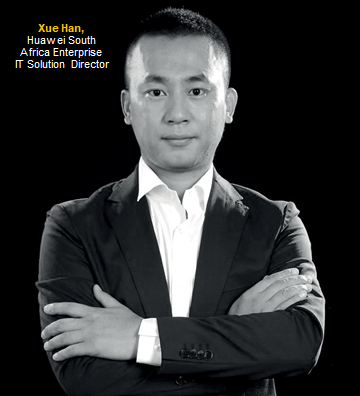
“So, All-flash data centres will be driven by more capable storage systems.”
“The solution implements end-to-end data acceleration in storage scenarios by leveraging all-flash storage systems and data centre storage network switches.”
“It takes full advantage of the million-level IOPS of all-flash storage and meets the petabyte-level development requirements of all industries.” Said Xuehan who is Huawei South Africa’s IT Solutions Director.
The all-flash era acted as a catalyst for new protocol developments, from SCSI to NVMe, and gradually to end-to-end NVMe supporting three types of networks (FC, Remote Direct Memory Access over Converged Ethernet, or RoCE, and TCP).
Storage networks require high levels of reliability, performance, and ease of use.
Zhang Nanjun who is Huawei South Africa Principal IT Solution Architect said, “Traditional FC storage networks do not match all-flash NVMe in terms of parallel high-throughput reads/writes, and the major reasons for this is FC networks provide insufficient bandwidth and poor scalability.”
 Zhang Nanjun, Huawei South Africa Principal Enterprise IT Solution Architect
There are four main reasons make the possibility of lossless ethernet storage network innovation:
- Dropping prices of flash media will accelerate NVMe-oF adoption
- The move to NVMe/PCIe will accelerate end-to-end NVMe
- Emerging workloads will drive growth of NVMe-oF, especially in terms of business application, engineering, and techniques
- NVMe-oF will enable cross-domain data management
With more than 30 years technology research and development, Huawei’s launch of the next-generation lossless Ethernet storage network solution NoF+ sits in line with the all-flash and all-IP trends of data centre storage.
Based on the intelligent lossless, perception, and collaboration features, the solution overcomes the packet loss challenges of traditional Ethernet and achieves high performance, high reliability, and easy O&M.
- Intelligent algorithms for 87% higher IOPS: Packet loss occurs on traditional Ethernet networks, where a packet loss of 0.1% decreases the network throughput by 50%. The Huawei NoF+ Solution includes an iLossless algorithm to achieve zero packet loss with 100% storage network throughput. Compared to FC, the IOPS improves by 87% and the latency reduces by 42%. In intra-city active-active scenarios, the solution uses 100GE links for 70 km lossless transmission, reducing cross-DC links by 90% compared to FC links.
- Proactive fault detection and failover within one second: Traditional Ethernet networks lack proactive fault detection and notification mechanisms. When a fault occurs, link failover takes a long time, thus interrupting storage services. The NoF+ Solution provides intelligent perception capabilities, meaning that switches can proactively report faults within milliseconds and work with storage devices to implement failover within one second, without affecting storage services when a single point of network failure occurs.
- Plug-and-play and one-click capacity expansion of storage: In storage scenarios, traditional Ethernet networks need to be manually configured node by node, which is a complex and error-prone process. The NoF+ Solution implements intelligent collaboration between storage devices and switches and supports plug-and-play and one-click capacity expansion of storage devices. Service changes can be automatically synchronized to the entire network after being configured at a single point, greatly improving the service provisioning efficiency.
Huawei’s next-generation high-performance Inter-DC Storage Network won the Runners-up of Interop Tokyo2021 Best of Show Award in Tokyo, Japan, on 14 April 2021.
This is the first international award the solution, better known as NoF+, has received. It combines three types of devices to achieve high reliability, low latency and cost-effective transmission.
Interop is the Industry-leading firms and organizations gather each year at Japan’s largest ICT exhibition to showcase their most sophisticated products and solutions.
This time, Huawei showed off its next-generation NoF+ solution, and the show’s professionals praised its improved performance, dependability and usability.
The NoF+ solution, which combines the latest-generation OceanStor Dorado All-Flash Storage and the CloudEngine DC storage network switch, is challenging traditional centralised storage networks.
The all-flash data centre and hyper-converged Ethernet are the foundations of the solution.
Locally, South Africa aspires to be carbon neutral by 2050 through the Low Emissions Development Strategy (LEDS), which is considered the beginning of the country ultimately reaching a net zero economy by 2050, says Donna Mostert, Huawei Line of Business Manager at Mustek.
She added that at the same time, South Africa is preparing itself to take the great quantum leap into the future through 4IR national strategy.
By 2030, South Africa aims to be a nation that has fully harnessed the potential of technological innovation to grow our economy and to uplift our people.
All Flash Data Centre and next-generation NoF+ solution will be the best choice for all industry customers in South Africa, emphasised Mostert. It makes one step closer to storage network innovation and also sparks lossless ethernet storage network innovation.
To learn more about Huawei Technologies Data centre and storage solutions complete the form below or contact [email protected] 011 237 1000


















 Loading ...