

How a portfolio can grow for years – and still fail a member at retirement



A retirement fund member can do almost everything right — save consistently, stay invested and benefit from long-term market growth — yet still retire with less income security than expected if markets fall at the moment they need to withdraw, transfer, or start drawing an income.
That is the uncomfortable reality of timing risk, and it is becoming one of the most important member-outcome challenges facing retirement funds and employers.
Global shocks can move quickly from oil markets, currency markets and interest-rate expectations into transport costs, food prices, employer budgets, and household finances.
For retirement funds, this means market volatility is not only an investment-market concern; it can also affect members’ day-to-day financial outcomes and the choices they need to make about retirement, preservation, and access to savings.
For members, these forces are not abstract.
They may show up as higher living costs in retirement, pressure on household budgets and greater sensitivity to the timing of retirement, withdrawal, or income drawdown decisions.
“Retirement fund design should not focus only on long-term return targets,” says Fred van der Vyver, Executive Head of Product Solutions at Old Mutual Corporate. “It should also consider the journey members experience on the way to retirement, and whether that journey is designed to reduce the impact of timing when it matters most.”
He describes this as one of the more uncomfortable truths in retirement saving.
Two members can save consistently, stay invested, and follow the same plan, yet retire with very different outcomes simply because they have to withdraw at different points in the market cycle.
“A member may save consistently over decades, remain invested, and still end up with a poorer outcome simply because retirement happens during a period of market stress,” he says. “That is not only a theoretical investment issue. It is a member-outcome risk that trustees, employers, and their advisers need to manage actively.”
Why timing risk changes the investment conversation
For employers, timing risk creates an important conversation.
A fund may meet its long-term return objective and still disappoint individual members when they retire, transfer, withdraw, preserve, or start drawing an income during a period of market stress.
“Members do not experience returns as long-term averages over rolling periods. They experience them at the moments that define their outcomes,” says Van der Vyver.
This means the conversation is shifting from “which portfolio performed best?” to “which design gives members the best chance of reaching retirement with the highest degree of confidence?”
The more useful question is whether the fund’s investment design exposes members to the full impact of adverse market conditions at the exact point they need to act, or whether it is designed to help members stay exposed to growth while also managing timing risk more deliberately through time.
“Markets can deliver long-term growth, but the path to those returns is becoming more uneven,” says Van der Vyver. “Members do not exit on average. They retire at a specific point in time.”
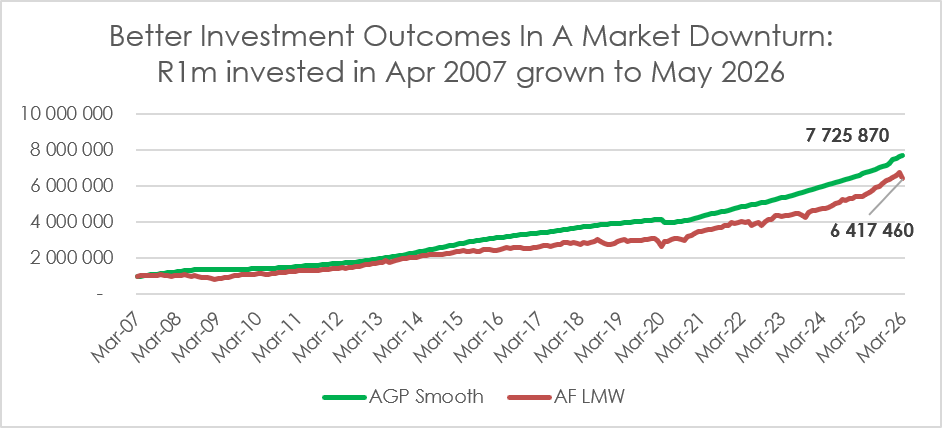
Source: Old Mutual Corporate Investment Solutions
The chart illustrates why the path of returns matters, not only the long-term target.
Members do not retire on averages; they retire, withdraw, transfer, or start drawing income at a specific point in time.
Smoothing is designed to help moderate the range of outcomes members experience at these key decision points.
At the end of March 2026, an investor in AGP Smooth was 20% better off than an investor in a typical balanced fund – due to the Middle-East war induced market downturn taking place in the same month as the retirement event.
This shows the same investment time period with the same investment discipline, but massively different investor outcomes.
Why employers need to look beyond headline returns
Members need growth exposure to build long-term income security.
But growth on its own is not enough if members are left carrying the full force of market shocks at the moments that define their outcomes.
Better retirement investment design is not only about identifying the strongest recent performer or the lowest-cost option.
It is about assessing whether growth is being delivered in a way that keeps members exposed to long-term opportunity while reducing the risk that adverse conditions at exit undermine their income security.
This has sharpened the focus on investment designs that not only broaden the sources of return across listed and unlisted assets and increase overall exposure to growth assets, but also help manage the return path through changing market conditions.
Old Mutual Corporate’s Smoothed Bonus portfolios, including the Absolute Growth Portfolios, combine diversified exposure across asset classes with smoothing mechanisms designed to reduce the impact of market uncertainty on members.
Smoothing does not remove investment risk.
It manages that risk and changes how that risk is experienced.
In stronger markets, part of the return may be held back in a Bonus Smoothing Reserve.
In weaker markets, that reserve may be used to support declared bonuses.
The effect is to help reduce the extent to which members experience the full impact of every market shock at the exact moment they retire, withdraw, transfer, or start drawing income.
In simple terms: smoothing is intended to turn a jagged investment journey into a steadier member journey.
The underlying portfolio remains growth-oriented, with about 83% exposure to growth assets, alongside global multi-asset strategies, alternative assets, and multiple equity manager styles.
Certain portfolios also include capital protection features, such as an 80% guarantee in AGP Stable at exit due to a benefit event.
“The objective is not to remove risk from retirement investing,” Van der Vyver says. “Without accepting appropriate investment risk, members are unlikely to get the real long-term growth they need. The objective is to deliver growth in a way that helps reduce the impact of short-term market shocks on member outcomes.”
For employers, the practical value is about understanding how growth exposure and member outcome protection work together rather being treated as opposing choices.
“The future of retirement fund design will not be judged only by whether portfolios delivered attractive long-term returns,” Van der Vyver concludes. “It will be judged by whether members were better able to convert those returns into real income security when it mattered. For trustees, employers, and advisers, that means asking a better question: not only what return did the portfolio earn, but how well was the investment journey designed to manage the risk of poor timing?”
For the full picture on Old Mutual Corporate’s thinking on retirement reform, fund design and improving member outcomes, visit: https://www.oldmutual.co.za/corporate/resource-hub/all-articles/reshaping-south-africas-retirement-fund-industry/
Visit www.oldmutual.co.za/employeebenefits for more information on our full range of employee benefits.
Old Mutual Life Assurance Company (SA) Limited is a licensed FSP and Life Insurer.


















 Loading ...